A twelve-hour drive to a remote Scottish site costs you a working day each way. Multiply that by crew size and day rate and the aircraft starts to look cheap. The harder part is choosing the right one, because the type of aircraft decides whether your people actually arrive with their tools, and where they can land.
This guide is for project managers, travel coordinators and procurement teams moving crews to grid, wind, hydro and construction sites. It covers the aircraft that make sense, what a charter flight for workers in Scotland costs in the market, and what to put in the request so the quotes you get back can be compared.
When does flying a crew beat driving?
Flying wins when the time you save, multiplied by crew size and day rate, is larger than the charter cost plus positioning. For a one-way journey of eight hours or more, or a crew of eight or more changing over in both directions, it usually does.
Here is the arithmetic with assumptions you should swap for your own. A crew of nine, a loaded day rate of £400 per person, and a drive that eats one working day each way.
- Driving: 2 lost days x 9 people x £400 = £7,200 per rotation, before fuel, vehicle hire and a hotel night en route.
- Flying: a 90-minute sector each way is three flight hours. At £1,700 to £2,000 an hour for an Islander, that is £5,100 to £6,000, plus positioning of the aircraft and landing fees.
Close. Now change the facts. If the same aircraft brings the new crew in and takes the old crew out, you pay for one charter and both groups travel. Your cost per head halves. If the drive is ten hours or the site has no accommodation nearby, the lost days double. If your crew has to be on the tools by 07:00 on day one, the drive was never really an option.
Where it does not win: crews under four, sites within a three-hour drive of a decent road, and any week when you cannot guarantee the headcount. An aircraft with empty seats costs the same as a full one. See our small aircraft charter cost guide for how hourly rates work across the UK market.
How many people does an Islander actually carry?
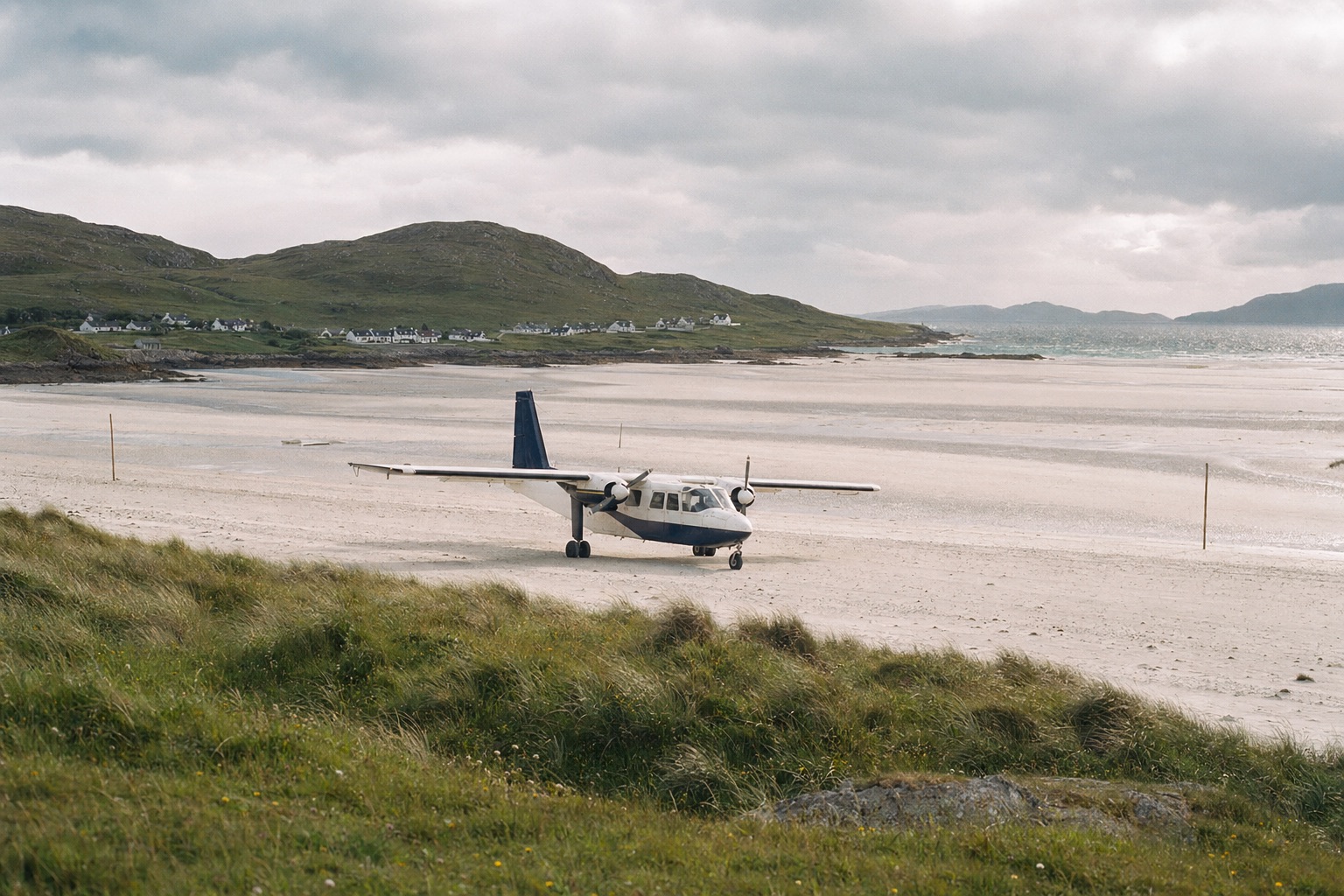
The Britten-Norman Islander is marketed as a nine-passenger aircraft, and brokers list eight or nine seats. With work bags, hand tools and a full fuel load for a Highland sector, expect closer to five or six people.
The Islander is a piston twin built for short, rough strips. Manufacturer data for the BN2B-26 puts the take-off run at under 400 metres to clear a 50-foot obstacle in standard conditions, and it cruises at around 120 to 140 knots. That makes it the default aircraft for Hebridean and Orkney island flying, and the reason Loganair keeps Islanders at Kirkwall for its Orkney inter-island contract.
The catch is payload. Published sample figures for a single-pilot piston Islander sit around 600 kilograms for the cabin load, and that moves with fuel, variant and temperature. At 120 kilograms a head for a person, a bag and personal kit, 600 kilograms is five people. Ask the operator for a payload figure for your actual sector, not the brochure seat count.
For a crew of four to six with moderate kit on a short sector, an Islander is hard to beat. It lands on strips that nothing faster can use. For nine people with tools, you are chartering two.
Is a Twin Otter worth it for a larger crew?
Yes, when you need to move twelve or more people to a short strip in one lift. The DHC-6 Twin Otter seats up to 19, stays under 400 metres on a STOL take-off, and carries real baggage.
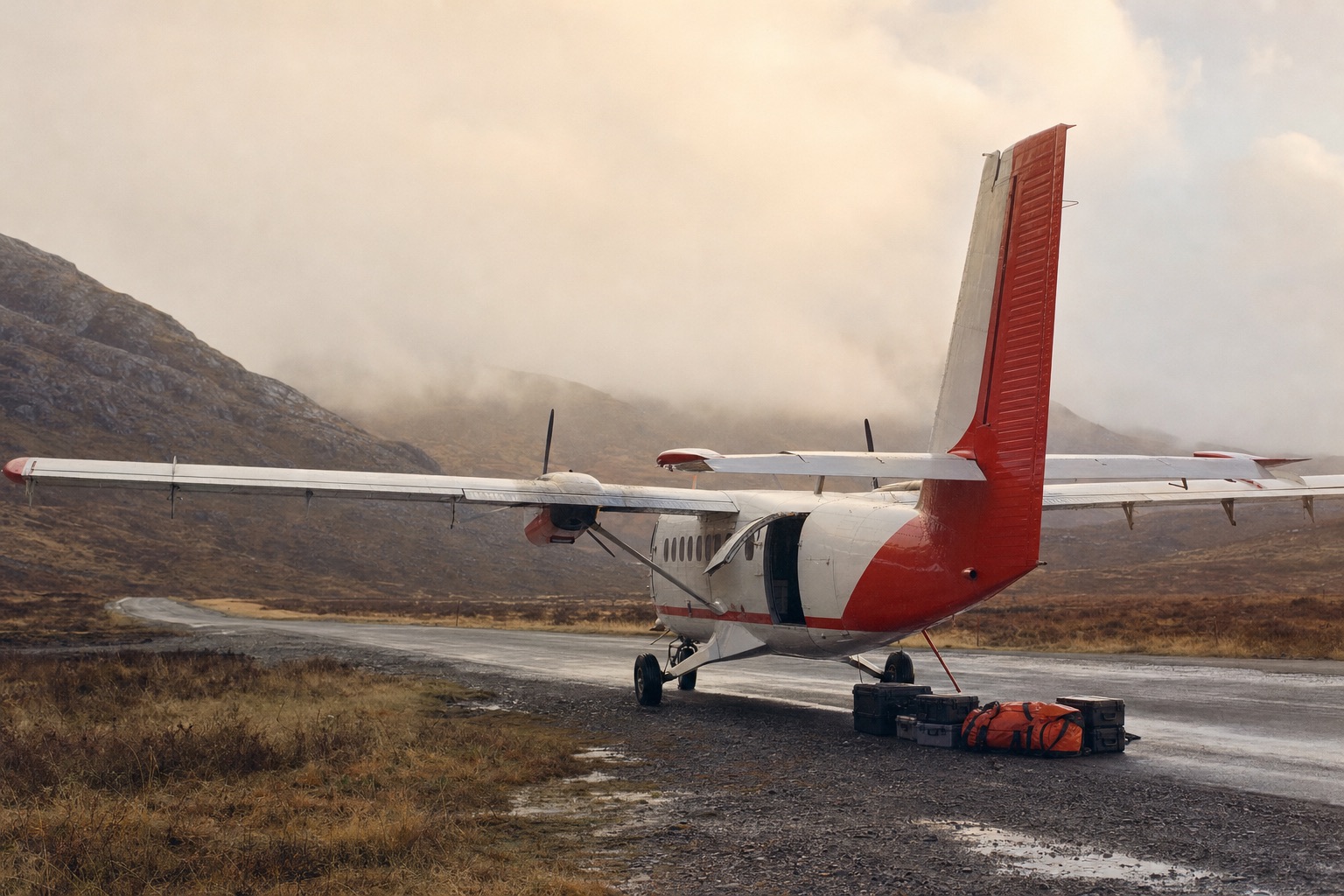
De Havilland Canada's Classic 300-G sheet lists a STOL take-off distance of 366 metres to 50 feet and 19 passenger seats. The Series 400 is similar. Aggregator figures put the maximum payload near 1.8 tonnes and cruise at 150 to 170 knots. It is slower than a turboprop single and noisy. It has served remote work for decades because it lands where the others cannot.
Two practical points. First, charter operators often configure fewer than 19 seats, so ask for the actual layout. Second, there are very few Twin Otters in the UK. Loganair's fleet lists three, and two of them fly for the Scottish Government, so spare capacity for charter is limited. Check availability early, and for a campaign of rotations give the operator the whole block of dates.
Skye's Broadford airstrip is a good example of why the Twin Otter matters. It is 771 metres long, owned by Highland Council, and a HITRANS feasibility study found that 19-seat types including the Twin Otter can operate within the 750-metre restriction there. The study also concluded that scheduled services would need substantial upgrading. Occasional charter use is a different matter, and it comes down to licensing, covered below.
King Air and PC-12: speed for smaller teams
A Pilatus PC-12 or a King Air 350 makes sense when the crew is small, the runway is proper tarmac and the distance is long enough for speed to matter. Neither suits rough strips.
The PC-12 NGX has a take-off distance of about 758 metres over a 50-foot obstacle at maximum weight and cruises at up to 290 knots at altitude, according to the Pilatus factsheet. Charter listings show six to nine seats. The same factsheet gives maximum payload as 2,236 pounds, but only 988 pounds with full tanks. That is roughly 450 kilograms, or under four people with kit, on a long sector.
The King Air 350 seats eight or nine, needs around 1,000 metres, and cruises near 300 knots. Both are pressurised turboprops that cruise well above the weather the Islander flies in. For a team of four to six flying from Manchester or Birmingham to Inverness, Aberdeen or Glasgow, they are quick and flexible. For a comparison of turboprops and jets on short hops, see turboprop vs light jet.
If the site is an unlicensed strip, a PC-12 or King Air is usually the wrong tool. They want longer, harder runways and an operator comfortable with them.
Aircraft compared on the numbers that matter
Payload and runway are the real constraints, not seats. Cost figures are indicative market ranges, not quotes, and sources disagree. Use them to sanity-check a quote.
| Islander (piston) | Twin Otter | PC-12 NGX | King Air 350 | |
|---|---|---|---|---|
| Seats (charter) | 8 to 9 | up to 19 (often 15 to 19) | 6 to 9 | 8 to 9 |
| Crew with kit, realistic | 5 to 6 | 12 to 16 | 5 to 7 | 5 to 7 |
| Take-off to 50 ft | under 400 m | about 370 m (STOL) | about 760 m | about 1,000 m |
| Typical cruise | 120 to 140 kt | 150 to 170 kt | up to 290 kt | about 300 kt |
| Suits rough or short strips | Yes | Yes | No | No |
| Indicative cost per flight hour | £1,700 to £2,000 (our working UK estimate) | US listings $2,000 to $2,500; UK quotes scarce | UK turboprop rates from about £2,150; US listings $1,600 to $3,500 | US listings $1,800 to $3,000 |
On the US side, AceJet lists Islanders and Twin Otters at about $2,000 to $2,500 per flight hour, with the lowest rate for bookings three weeks out on quiet days. US figures exclude UK positioning, handling and VAT treatment. For a UK anchor, a published PrivateFly example for Glasgow to Islay on an eight-seat Islander, 28 minutes each way, showed about £3,800 for a three-night return. That price probably includes the aircraft waiting, which is the point of the next section.
Positioning, weather standby and who pays
The hourly rate is only part of the bill. Positioning, standby and weather cancellation add the rest.
Positioning. Aircraft live somewhere. Hebridean Air Services bases its Islanders at Oban. Loganair's Islanders sit at Kirkwall. If your crew leaves from Glasgow and the aircraft starts in Orkney, you pay for the empty leg to reach you and the empty leg home. Ask where the aircraft is based and where it will sleep.
Waiting time. A one-day return where the aircraft waits at the site is charged by the hour or at a daily standby rate. A crew change where the aircraft flies out full, flies back full, and does not wait, is the cheapest shape.
Weather. Highland and island weather cancels flights. Many Scottish strips have no instrument approach, so low cloud and crosswinds close them. A recruitment notice from Oban's airport operator describes the scheduled Islander routes as VFR. Agree in writing who pays when the pilot makes a safe-to-fly decision: a cancellation, a delay, or a diversion to the nearest licensed airfield with your people on board. Our guide to travel disruption for crews in Scotland covers the fallback plan. Build it into the booking, not the week of travel.
Extras. Landing fees, handling, fuel uplift at remote strips, and VAT. Whether VAT applies depends on how the operator and aircraft are classed, so ask for quotes shown with and without it.
Who operates crew charters in Scotland?
Loganair, Hebridean Air Services and Airtask Group are the Scottish operators to start with. The list is short, and capacity is limited, which is why the request matters more than the price.
Loganair runs Scotland's largest regional network and markets private charter alongside it. Its Islanders serve the Orkney inter-island contract, and two of its three Twin Otters fly for the Scottish Government, so charter capacity is by enquiry. Start at the charter page on loganair.co.uk.
Hebridean Air Services operates three Islanders from Oban on scheduled routes to Coll, Tiree and Colonsay, and between Benbecula and Stornoway. Its website lists charter flights to airfields across Scotland. It is owned by Airtask Group.
Airtask Group also owns Directflight, which holds a CAA Air Operator Certificate. Check current fleet and availability directly, because some third-party fleet data is years old.
Any other operator should be checked against the CAA's list of AOC holders. A broker can also source operators and types based elsewhere in the UK.
For airfield-by-airfield detail, see our crew guides to Stornoway, Benbecula, Kirkwall and Orkney, Sumburgh and Shetland and Wick and Caithness.
Do you need a licensed airfield for a commercial charter?
Usually, and any exception is for the operator to confirm, not for you to assume. The rules depend on the weight of the aircraft and the type of flight, so whether an unlicensed strip can be used for your charter is a question for the operator's compliance team.
First the operator. Anyone flying passengers for payment in a UK-registered aircraft needs an Air Operator Certificate from the CAA. A private pilot cannot charge you for a flight outside the narrow cost-sharing rules. If a quote comes from a company that cannot show you its AOC and the registration of the aircraft, stop. Check your own insurer's position too, because your duty of care for the crew does not move to the operator.
Then the airfield. The Air Navigation Order 2016 (articles 207 and 208) sets out when a commercial passenger flight must use a licensed or certificated aerodrome. The requirement turns on the aircraft's maximum take-off mass (5,700 kilograms is the key threshold), on whether the flight is scheduled, and on whether it operates by day or at night. The CAA's own guidance summarises the position as commercial passenger transport needing a licensed aerodrome. Some lighter-aircraft, non-scheduled daytime flights may sit outside that, but it is not something to plan around until the operator has confirmed it, in writing, for the specific aircraft, strip and flight. Heavier types such as the King Air 350 are above the threshold, and the Twin Otter is close to it depending on variant.
Broadford is the live example. It is unlicensed, 771 metres, and the council says no commercial services have run there since 1988. Even where a flight is permissible, it is not easy. There is no fire cover, no fuel, no handling and no terminal. The operator will need the landowner's permission, recent information on the surface and obstacles, and may want to inspect it. Allow time for a first approval.
How to brief a charter request
A good brief gets comparable quotes in hours. A vague one gets a wide spread of prices and a list of questions. Send these facts:
- Crew: headcount, and whether the number is firm or a maximum.
- Weights: a weight per person with bag, plus the weight and size of tools, kit and any hazardous items (batteries, fuel, gas).
- Route: the departure airport, the destination strip by name, and the date and local time windows.
- Shape: one-way, return with the aircraft waiting, or a crew change with full legs in both directions.
- Repeat: how many rotations, how often, and for how many weeks.
- Site: is the strip licensed or unlicensed, who owns it, and who can give landing permission.
- Flexibility: how many hours either side of schedule you can move, and what happens if weather cancels.
- Paperwork: the AOC holder's name on the quote, who the insurer is, and whether quotes are with or without VAT.
For rotations, ask for a fixed price per block and a clear rule on weather. For help turning a site plan into a travel plan, our crew travel page and business service describe how we work with contractors, and Highland grid projects: crew travel and accommodation covers the rest of the trip.
When the aircraft is only half the problem
Most of the work in a crew charter is not the flight. It is knowing which strip the Islander can use this week, which operator has the aircraft free, who has the landowner's number, and what happens when the cloud comes down at 06:30. We use the best intelligence available to narrow the field quickly, and people who make the calls to get it done. If Skye is on the route, our note on a private flight to the Isle of Skye covers the airfields.