The Rule That Decides Most Cases
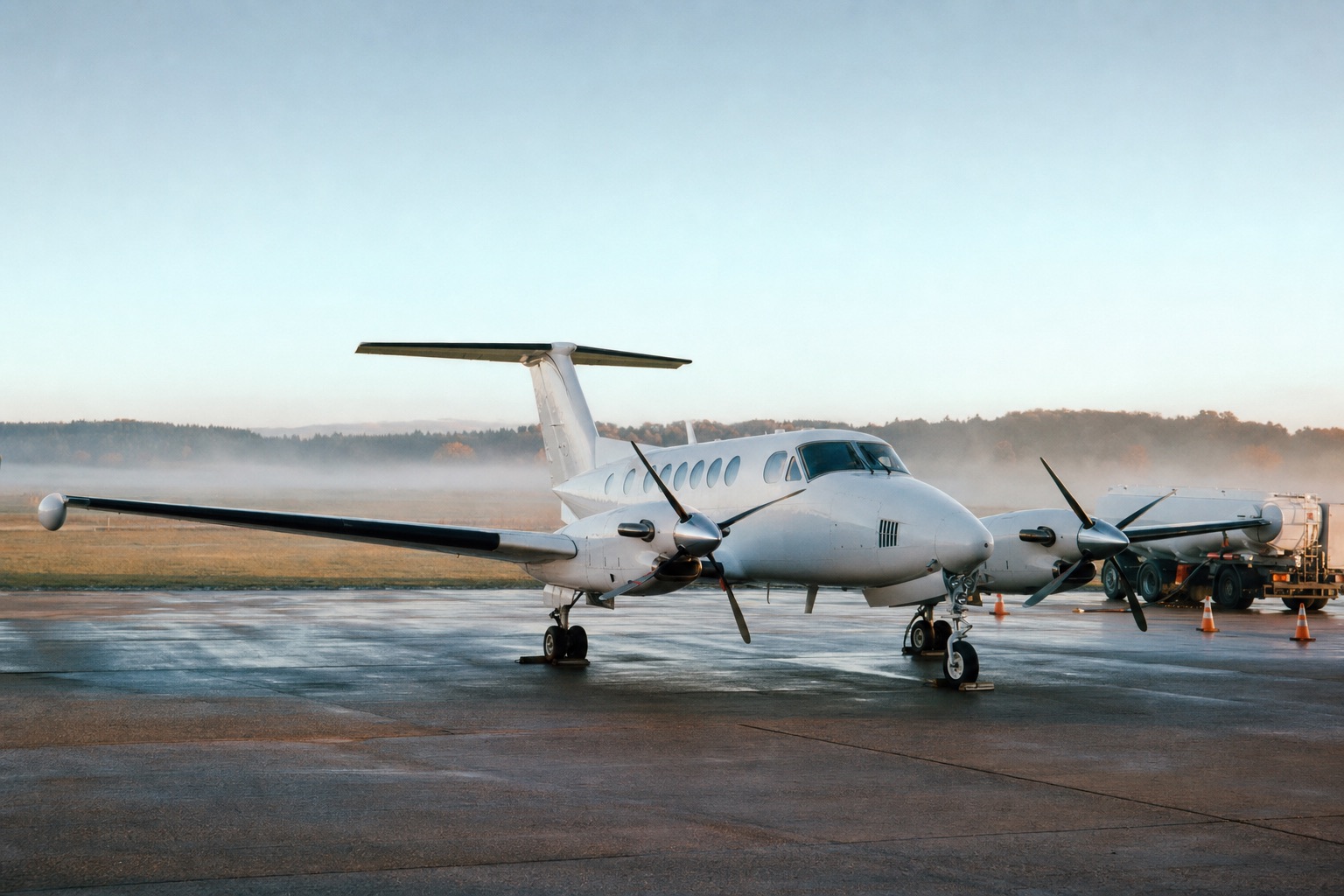
Here is the shorthand we use when clients ask this exact question: under 300 miles, book the turboprop. Over 450, book the light jet. Between them, price both and let the day's agenda decide.
The reasoning sits in how each aircraft spends its time. A light jet cruises around 400 knots at up to 41,000 feet, but it still taxis, climbs and descends at the same speeds as everything else. On a London-Amsterdam flight of 220 nautical miles, the jet saves perhaps fifteen minutes over a King Air while costing a third more. Stretch the same comparison to London-Milan, 610 miles, and the jet arrives forty minutes earlier having climbed into smooth high-altitude air the turboprop never reaches. Now the premium buys something real.
What Each One Costs
UK and northern Europe rates for 2026:
| Aircraft | Seats | Hourly rate | Cruise | Range |
|---|---|---|---|---|
| Pilatus PC-12 | 8 | £1,600-3,400 | ~290kt | ~1,600nm |
| King Air 200 | 7 | from £1,400 | ~270kt | ~1,500nm |
| King Air 350 | 8 | from £1,800 | ~310kt | ~1,800nm |
| Citation Mustang (VLJ) | 4 | £2,200-3,600 | ~340kt | ~1,100nm |
| Citation CJ2+ | 6 | from £2,600 | ~390kt | ~1,300nm |
| Phenom 300 | 7 | £2,800-3,200 | ~420kt | ~1,900nm |
Two worked routes make the trade-off concrete:
London to Amsterdam (220nm): King Air 200 comes out near £3,200 one-way; a CJ2+ nearer £5,000. Same door-to-door experience, same FBO treatment, twenty minutes' difference in the air. The turboprop wins unless the schedule demands otherwise.
London to Milan (610nm): the King Air needs three hours against the Phenom's two, and much of the jet's flight happens in calm air at 41,000 feet while the prop bumps along at 25,000 through whatever weather sits over the Alps. Here the extra £1,500-2,000 buys genuine comfort and punctuality, not just bragging rights.
Which Is More Comfortable: Turboprop or Light Jet?
Modern pressurised turboprops are not old technology wearing nostalgia. A King Air 350 has a quiet-ish cabin, club seating and a lavatory; a PC-12 feels like a well-appointed SUV with wings. But physics is physics: propellers make noise and vibration, cabins sit lower where the air is thicker, and anyone prone to motion sickness will notice the difference on a rough day. Our seasickness guide covers why cabin altitude matters for similar reasons at sea.
Light jets counter with height (smooth air above weather), speed, and enclosed lavatories with proper doors. Their compromises: tighter cabins, less baggage room, and four-to-six-seat layouts that punish groups who travel heavy. If your trip involves golf bags, ski equipment or a large dog, check the hold dimensions before falling for the sleeker aircraft; this is the single most common mistake we see. Several turboprops load through a cargo door designed for exactly that problem.
Before You Pick, Check These
- How far, honestly? Use door-to-ground-distance, not great-circle optimism. Under 300nm favours the prop; past 450nm the jet pulls ahead.
- What is the weather doing? Summer haze between London and Paris suits either aircraft. Winter fronts over the Alps argue firmly for something that climbs above them.
- Where do you actually land? Regional strips and shorter runways welcome turboprops happily. Some light jets need more runway than smaller airfields offer, which adds a road transfer nobody budgeted for.
Cost Per Seat: The Group Effect
Because charter prices attach to the aircraft, seat maths swings wildly with headcount. The same London-Geneva routing:
| Aircraft | Seats | One-way total | Per seat, full |
|---|---|---|---|
| King Air 250 | 8 | £4,800 | £600 |
| PC-12 | 8 | £5,200 | £650 |
| Citation CJ2+ | 6 | £6,900 | £1,150 |
| Phenom 300 | 7 | £7,400 | £1,060 |
Read that table twice if you fly in eights rather than fours. A full King Air undercuts a half-empty CJ2+ by nearly half per head while carrying more luggage. Scheduled business class on the same day runs £250-500 per person booked ahead, £700-plus bought inside a fortnight of Geneva's ski weekends. The private premium is therefore smaller than most people assume, and it shrinks again every time fuel surcharges push airline fares up.
Where Empty Legs Fit
Both aircraft classes generate empty legs, but they behave differently on the discount lists. Very light jets and turboprops dominate the short European repositioning market because operators run dense schedules of one-way charters; that is why the sub-€2,000 legs you see published are almost always Mustangs, CJ-series aircraft or King Airs. Heavier jets reposition less often relative to their fleet size and their legs cost thousands even discounted.
Practical consequence: if your corridor is a busy business lane (London-Paris, London-Geneva, London-Amsterdam), set alerts for both categories. A turboprop leg at 60 percent off usually beats a light jet at the same percentage, because the base fare started lower. Our empty legs guide covers the cancellation risks in detail.
Routes Where Each Aircraft Shines
A few corridors we quote constantly, and what usually wins them:
London-Dublin (290nm). Turboprop territory, barely a jet advantage in the air, and Dublin's general aviation handling is quick for everyone. King Air lands near £4,500; CJ2+ nearer £6,800.
London-Zurich (480nm). The genuine toss-up. Winter favours the jet for altitude over the Alps; summer mornings let the turboprop match door-to-door times for 30-35% less.
London-Palma (730nm). Light jet, clearly. Two-and-three-quarter hours against four-plus, and summer afternoons over Spain are exactly the turbulence the jet climbs above.
Inverness or Islay from London. Turboprop again, partly for economy and partly because Highland strips suit aircraft designed to use short, wet runways without ceremony. The PC-12 was practically built for this itinerary.
For the UK business case, with door-to-door times to Edinburgh, Manchester and Aberdeen against rail and airline, see same-day business trips by private plane.
A Note on Cabin Etiquette and Pets
Turboprops win another quiet victory: animals. A dog crate fits through a PC-12's cargo door without folding the animal into hand luggage dimensions, and several operators flying props are notably relaxed about pets in the cabin. Light jets vary; some take small dogs on a blanket, none want a Labrador and its box on a summer leg.
The same logic applies to sports kit. Two sets of skis plus boots fit a King Air hold easily. On a Mustang they are a negotiation involving roof-free garages you do not have. Tell the broker about luggage before you choose the aeroplane, not after.
What We Do For Clients
Sulu quotes both aircraft classes as standard practice on our aviation requests, with the totals side by side rather than whichever option pays us better. Roughly half the time the honest recommendation is the cheaper aeroplane. When it is not, you will get the reason in one sentence, not a paragraph.
Message us on WhatsApp or Telegram with your route. More background: what small aircraft charters cost, and why flying private by small aircraft makes sense.