The Fear Is Worse Than the Reality
Seasickness is the number one reason people hesitate before booking a yacht charter. It is a legitimate concern. Nobody wants to spend 5,000 euros on a holiday and then feel nauseous for a week. But here is what the data actually says: on a well-planned charter in sheltered waters, with the right boat and some basic precautions, most people are absolutely fine.
About 20% of the general population is susceptible to motion sickness. In rough conditions on fast boats, that number can climb to 70%. But a sailing charter is not a fast ferry crossing the Channel in January. You are moving slowly (5 to 8 knots), in warm water, with short passages and long stops at anchor. The conditions that trigger severe seasickness rarely apply.
That said, some people genuinely suffer. If that is you, this article is about what actually works, what does not, and how to choose the charter that minimises your risk.
Medications Ranked by Evidence
Not all seasickness medications are equal. Here is what the clinical evidence says, ranked from most to least effective.
1. Scopolamine patch (Transderm Scop). The most effective option for sustained prevention. A single patch behind the ear lasts 72 hours. Studies show it is as effective as dimenhydrinate but with roughly half the drowsiness. It works by blocking the signals from your inner ear to the vomiting centre in your brain.
The downsides: it requires a prescription in most countries. Dry mouth affects up to two-thirds of users. Blurred vision can occur, usually because people touch the patch and then rub their eyes (wash your hands after applying). It takes 6 to 8 hours to reach full effect, so apply it the evening before your charter.
Not suitable for children, elderly people, or anyone with glaucoma. If you are diving or doing water sports, be aware it can cause disorientation underwater.
2. Dimenhydrinate (Dramamine). The classic over-the-counter option. Genuinely effective for prevention, especially if taken 30 to 60 minutes before sailing. Available worldwide without a prescription.
The downside: it makes you drowsy. Significantly drowsy. Some people find it knocks them out for hours. This is fine if you are a passenger on a short crossing, less ideal on a sailing holiday where you want to be present. The non-drowsy version (Dramamine II, which is meclizine) is less effective.
Dosage for adults: 50 to 100mg every 4 to 6 hours. For children, the dose is weight-based (1 to 1.5mg per kg). Always test it before your trip. Give your child a dose at home first to check how they react.
3. Meclizine (Bonine/Antivert). Less sedating than dimenhydrinate, which is its main advantage. But studies show it is also less effective, particularly in rougher conditions. Good for mild susceptibility. Not enough for people who get seriously seasick.
Take it 1 hour before sailing. Available over the counter in most countries. Fewer side effects than the other options, which makes it a reasonable first choice for people who are mildly prone to motion sickness but do not want to be knocked out.
4. Ginger. A Cochrane Review (the gold standard of medical evidence reviews) confirms that ginger at 1g daily significantly reduces nausea. A landmark study with 80 naval cadets in heavy seas found ginger root was 72% more effective than placebo at preventing vomiting.
The loading dose is 1,000 to 1,500mg taken one to two hours before boarding. Continue with 500mg every four hours. Ginger biscuits, ginger sweets, or capsules all work. The active compounds (gingerols and shogaols) help your stomach empty faster, reducing that heavy, nauseous feeling.
No side effects. No drowsiness. No prescription needed. It is not as powerful as scopolamine or dimenhydrinate, but for mild to moderate susceptibility, it is genuinely useful and can be combined with other methods.
5. Acupressure wristbands (Sea-Bands). They press on the P-6 acupressure point on your inner wrist (three finger-widths from the wrist crease). Some maritime studies show measurable relief. Other studies show no significant effect beyond placebo. The honest answer: the evidence is mixed, but they are cheap, have zero side effects, and some people find them helpful. Worth trying, especially for children.
What does NOT work: Ondansetron (Zofran). Despite being an excellent anti-nausea drug for other conditions, multiple peer-reviewed studies show it is ineffective for motion sickness. The mechanism of nausea in seasickness is different from other types. Do not waste your money or your GP's time getting a prescription.
Catamaran vs Monohull for Seasickness
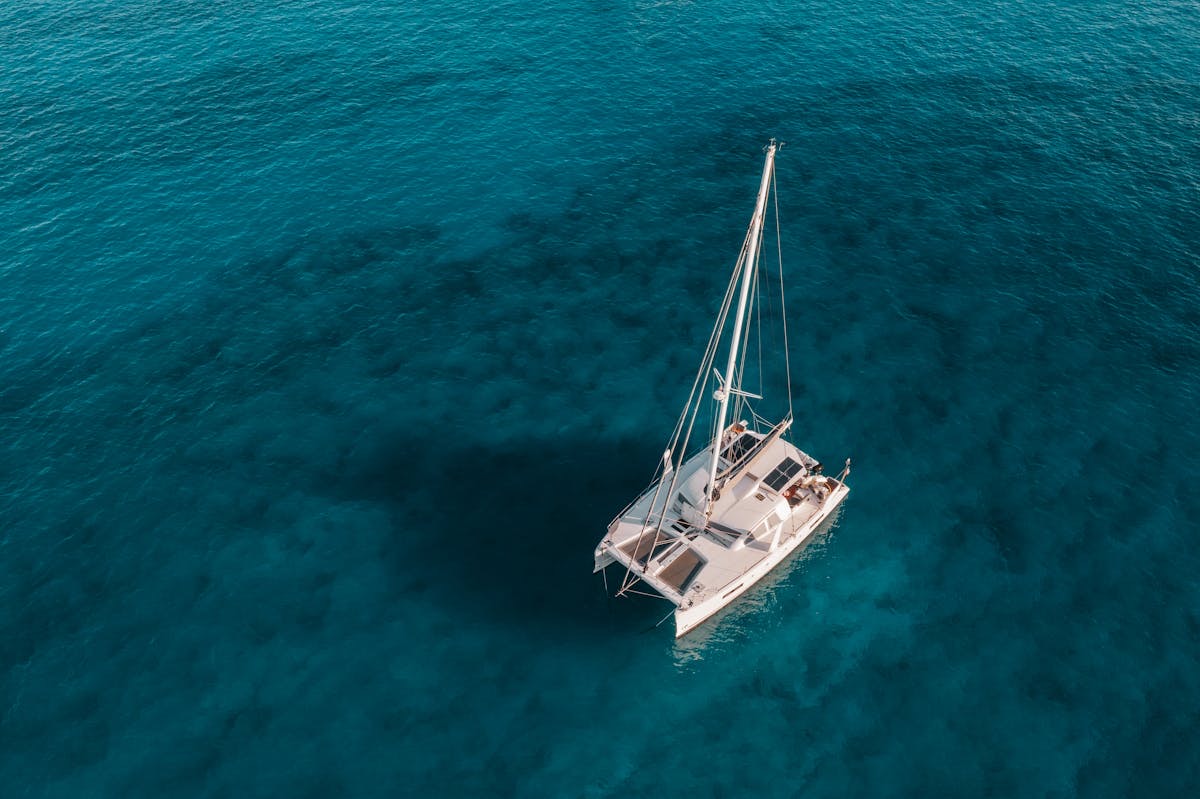
One study found that seasickness incidence is roughly three times lower on a catamaran than on a comparable monohull. The reason is simple physics: a 45-foot catamaran is about 22 feet wide, creating a stable platform that barely tilts. A monohull heels 15 to 20 degrees when sailing and rolls at anchor.
If you are prone to seasickness, a catamaran is not optional. It is essential. See our full catamaran vs monohull comparison for more detail.
The motion is different too. A monohull rolls (side to side), which is the motion pattern most likely to trigger nausea. A catamaran's primary motion is pitching (front to back), which most people tolerate much better.
One important caveat: in beam seas (waves hitting the side), some catamarans develop a jerky, snapping motion that can be unpleasant. But this is uncommon in the sheltered waters where most charters operate. In typical charter conditions (light to moderate winds, short passages, anchored bays), a catamaran provides dramatically better comfort for anyone prone to motion sickness.
The cost difference is 30 to 50% more than a monohull. For full pricing details, see our cost guide. If seasickness is a concern, this is the single most impactful thing you can spend money on.
Destinations Ranked by Calmness
Where you sail matters as much as what you sail on. Here are the major charter destinations ranked from calmest to roughest.
Calmest: Ionian Islands, Greece. Sheltered between the Greek mainland and the islands, with light winds (5 to 15 knots), short passages, and hundreds of protected bays. The calmest major sailing destination in the Mediterranean. Ideal for first-timers and anyone worried about seasickness. Season: May to October, calmest in June and September.
Calm: Turkish Southwest Coast (Gocek to Marmaris). Extremely sheltered. The coastline is deeply indented with fjord-like inlets (called "bays" locally) that provide flat water even when the open sea is rough. Warmer and calmer than most Greek destinations. Season: May to October.
Calm: British Virgin Islands. Steady trade winds (10 to 20 knots) but short passages and line-of-sight navigation. The islands are close together, creating sheltered channels. The predictability of the conditions makes it forgiving. Season: December to April. Avoid hurricane season (June to November, worst August to October).
Moderate: Croatia (Central Dalmatia). Beautiful and well-suited to sailing, but more exposed than the Ionian. The Maestral (afternoon sea breeze) can build to 20 knots, and the Bora (a cold northeasterly) occasionally appears. Most summer days are manageable, but conditions are less consistently gentle than the Ionian or Turkey. Season: May to October.
Rougher: Cyclades, Greece. The Meltemi wind dominates July and August, blowing 20 to 30 knots from the north for days at a time. It creates steep, short seas that are uncomfortable even for experienced sailors. Seasickness is common. Beautiful islands, but not the right choice if you are worried about motion sickness. If you must, go in June or late September when the Meltemi is weaker.
Rougher: South of France (Côte d'Azur). The Mistral (a cold northwesterly) can produce sustained winds of 50km/h and waves of 4 to 7 metres. It occurs mainly in winter and spring but can appear any time. When it is not blowing, the sailing is lovely. When it is, even experienced sailors stay in port.
Roughest: Open Atlantic crossings. Not relevant to most charter holidays, but worth mentioning: crossing from the Canaries to the Caribbean involves 2 to 3 weeks of open ocean sailing with swells of 2 to 4 metres. This is where serious seasickness happens. Do not confuse this with a sheltered Mediterranean charter.
Practical Tips That Make a Real Difference
These are the things experienced sailors and charter skippers actually recommend.
Stay on deck. Going below is the single biggest trigger. The mismatch between what your eyes see (a stationary cabin) and what your inner ear feels (motion) is what causes nausea. On deck, looking at the horizon, your eyes and inner ear agree. If you feel queasy, come up immediately.
Sit midship, not at the bow or stern. The middle of the boat moves least. The ends amplify every wave. On a catamaran, the cockpit (in the centre, between the two hulls) is the most stable spot.
Sail in the morning. Wind and waves build through the afternoon due to thermal activity. Morning passages are smoother. Plan to be anchored by lunchtime.
Keep passages short. Two to three hours between anchorages. Most seasickness hits within the first hour of continuous motion. Short hops in sheltered water rarely cause problems. If your itinerary involves daily 6-hour passages, change the itinerary.
Eat light but eat something. An empty stomach makes seasickness worse. Eat bland, light food: crackers, bread, bananas, plain rice. Avoid heavy, greasy, or spicy food before and during sailing. Avoid alcohol the night before.
Stay hydrated. Dehydration worsens nausea. Drink water steadily. Not coffee (diuretic), not alcohol (dehydrating), not fizzy drinks. Water.
Avoid strong smells. Diesel exhaust, cooking odours below deck, heavy perfume. These all aggravate nausea. If someone is cooking below while sailing, go upwind.
Stay warm. Cold increases susceptibility. Even in the Mediterranean, the wind on a moving boat can make you chilly. Bring a light layer.
Do not read or use screens. Below deck, while moving. This is the fastest way to trigger seasickness in anyone. If children want to watch a tablet, wait until you are anchored.
Take your medication early. Every seasickness medication works better as prevention than as treatment. Once you feel nauseous, it is much harder to stop. Take your chosen remedy before you feel anything.
When You Should Not Book a Sailing Holiday
Honesty is important here. Some people should genuinely not charter a yacht.
If you get severely carsick on every journey over 30 minutes. Car sickness and seasickness share the same mechanism (vestibular-visual conflict). If you vomit regularly in cars despite medication, a yacht is a significant risk, even with a catamaran in the calmest waters.
If you have Meniere's disease or a vestibular disorder. These conditions affect your inner ear's ability to process motion. A sudden vertigo attack on a yacht is not just unpleasant, it is potentially dangerous. Consult your specialist before considering a charter.
If you tried a boat trip before and the medication did not help. Some people are genuinely resistant to treatment. If you have tried scopolamine and dimenhydrinate on a previous boat trip and still suffered badly, a week-long charter is unlikely to be different.
For everyone else: pick a catamaran, sail in the Ionian or Turkey, keep passages short, take your chosen medication, and you will almost certainly be fine. If you are planning a family charter with children, our family guide has specific seasickness advice for kids.
We Match You to the Right Charter

If seasickness is a concern, the choice of boat, destination, and itinerary matters enormously. We help clients who are nervous about motion sickness find the right combination: a stable catamaran, sheltered waters, short passages, and an experienced skipper who knows where the calm anchorages are.
Message us on WhatsApp or Telegram and we will plan a charter you can actually enjoy.