A same day business trip by private plane in the UK sounds like an indulgence until the sums are done for six people going to Aberdeen. For one person going to Manchester, it is a poor idea. The answer depends on the route, the headcount and how many stops the day needs.
This guide compares four ways of getting from a central London office to the city centre in Edinburgh, Manchester and Aberdeen: train, scheduled flight, a chartered turboprop and a light jet. The timings are planning estimates built from published rail and flight times. The costs are indicative market figures, not quotes.
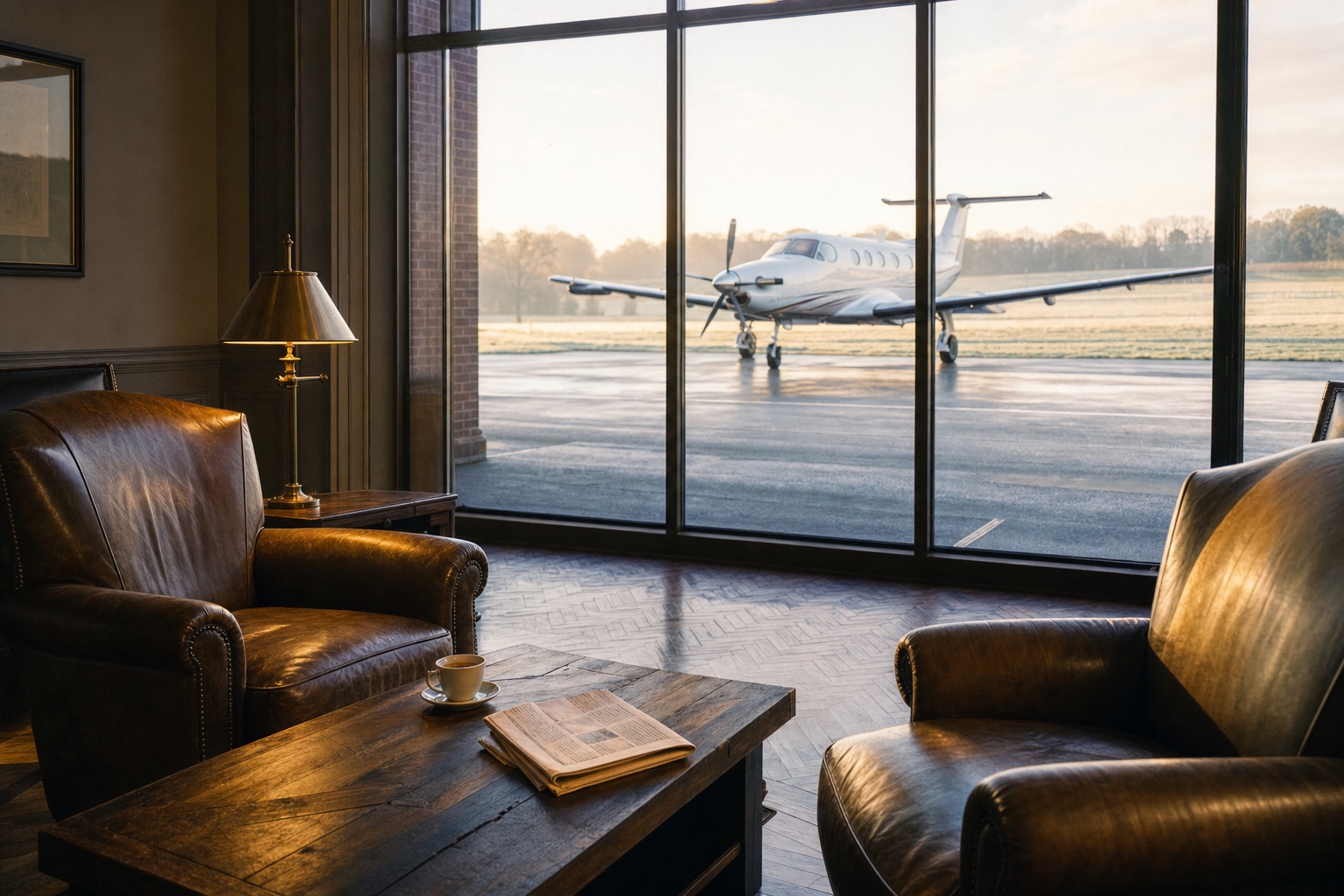
How do the journey times compare door to door?
For Edinburgh, a scheduled flight from London City and a chartered turboprop land within 30 minutes of each other. For Manchester the train matches a charter. For Aberdeen, the charter saves about four hours over rail and about 45 minutes over a scheduled flight. Those are the honest numbers, and they shape everything below.
Start with the published times. The fastest LNER trains from King's Cross to Edinburgh take around 4 hours 10 minutes, and many services run closer to 4 hours 30. Avanti's fastest Euston to Manchester Piccadilly runs are just over 2 hours. The quickest direct London to Aberdeen trains take about 7 hours. Scheduled flights run at roughly 1h25 from Heathrow to Edinburgh, 1h20 from London City, 1h05 to Manchester and 1h35 to Aberdeen. The Edinburgh figures are Rome2rio averages; Manchester and Aberdeen come from aggregator listings. Check the airline schedule for your date.
Then the pieces around the flight or train, which is where the time goes.
| Leg | Train | Scheduled flight (Heathrow) | Scheduled flight (London City) | Charter turboprop |
|---|---|---|---|---|
| Office to station or airfield | 20 min | 60 min | 35 min | 45 to 90 min (Biggin Hill to Farnborough) |
| Arrive before departure | 10 min | 75 min | 50 min | 15 min |
| Destination hub to city centre | 10 min walk or taxi | 25 to 45 min | 25 to 45 min | 20 to 35 min |
Edinburgh's tram takes about 30 minutes to the centre. Aberdeen is quicker by taxi, at around 20 minutes by one university guide. The 15 minutes at the charter end is the point of a business airfield, which the London airports guide covers in more detail. The 75 minutes at Heathrow is a planning assumption for a hand-baggage-only business traveller, not an airline rule.
Put those together and the totals look like this.
| Route | Train | Scheduled flight via Heathrow | Scheduled flight via London City | Turboprop charter | Light jet charter |
|---|---|---|---|---|---|
| Edinburgh | 4h50 to 5h10 | 4h15 to 4h50 | 3h30 to 3h50 | 3h15 to 3h45 | 3h00 to 3h20 |
| Manchester | 2h50 to 3h05 | About 4h | Not reliably served, check | 2h50 to 3h10 | 2h45 to 3h00 |
| Aberdeen | 7h40 to 8h00 | 4h30 to 5h00 | No direct service found | 3h40 to 4h10 | 3h20 to 3h40 |
All figures are one way, office to city centre, and assume a weekday with no disruption. Charter flight times are estimated from distance and typical cruise speeds: roughly 295 nautical miles from Farnborough to Edinburgh, 135 to Manchester and 360 to Aberdeen. That works out at about 1h15 to 1h30 to Edinburgh, 40 to 50 minutes to Manchester and 1h30 to 1h45 to Aberdeen in a turboprop, with a light jet saving 15 to 25 minutes on the longer sectors.
Two things stand out. First, a charter does not beat a fast scheduled flight by a margin worth paying for if you are one person going to Edinburgh. Second, the gap opens with distance, and on the return leg: a charter leaves when the meeting ends, while a scheduled flight leaves when the airline says.
Choosing the airfield and the aircraft
The airfield decision is a drive-time decision, not a prestige one. Farnborough suits south-west London, Surrey and the M3 corridor. Biggin Hill suits the City, Canary Wharf and south-east London. London City is 15 minutes from the Docklands but its steep approach rules out much of the charter fleet, so ask whether your aircraft is approved. Oxford is the pick for Thames Valley and Oxfordshire offices. RAF Northolt accepts a capped number of civil movements and is not something to assume at short notice. All of these are covered in which London airport to fly private from.
Opening hours matter more than people expect. One business-aviation guide lists Farnborough as open 0700 to 2200 on weekdays with no extensions possible, and 0800 to 2000 at weekends. Biggin Hill is listed from 0630 on weekdays, though sources disagree on closing times. Confirm with the operator, because a 06:30 Farnborough departure that cannot happen is the sort of thing found out too late.
At the far end, the dedicated business terminals are Signature at Edinburgh and Aberdeen. Manchester has more than one handler, and the airport is slot-coordinated, so private movements need advance arrangement. Hours for all three vary by source. Verify them with the handler before fixing a schedule.
For the aircraft, the useful range is narrow. A Pilatus PC-12 or a King Air carries six to eight people, flies in cloud and cruises at roughly 250 to 300 knots. A light jet is faster and quieter but costs more per hour. The trade-offs are in turboprop vs light jet. On these sectors, the time saved by a jet is 15 to 25 minutes, which rarely justifies the premium.
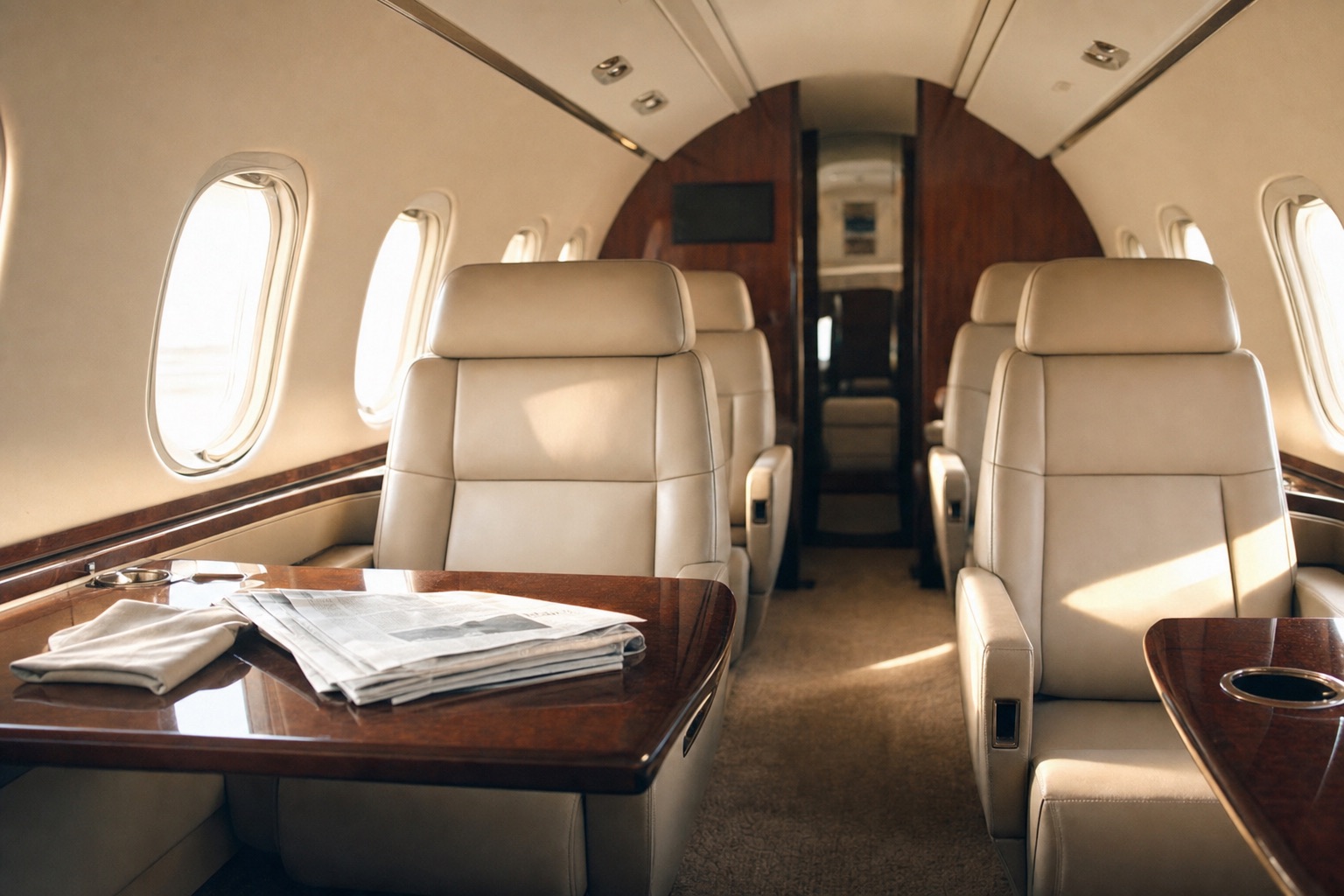
When does a charter make sense?
A charter makes sense when four or more people travel together, when the day needs two or more stops, or when the destination is poorly served by rail and scheduled flights. If none of those apply, the train or a scheduled flight is the better buy.
Groups of 4 to 8. The aircraft costs the same whether it carries one person or eight, so the cost per seat falls fast. Six people in a PC-12 is the sweet spot. Beyond eight, you need a bigger aircraft or two.
Multiple stops. This is where a charter does something nothing else can. Aberdeen to Edinburgh is about 85 nautical miles, a half-hour flight, against roughly two and a half hours on the train. The next section sets out a day built on that.
Poorly served destinations. Aberdeen is the obvious one, and so are sites away from city centres. The same logic that moves crews to remote Scottish sites applies to a board visiting a plant.
Working on board. A chartered cabin is a private room for a team. Use it to prepare, to debrief on the way home, or to take a confidential call on the ground before you land. Turboprop cabins are louder than jet cabins, so plan on reading and talking in person rather than long video calls. Ask the operator what connectivity the specific aircraft has.
Control of the day. A scheduled flight cancelled at 17:00 strands a team. A chartered aircraft leaves when the group is ready, within the airfield's hours. That is hard to price, but it is why some firms charter for board days and not for routine trips.
A multi-stop day, illustrative
This is an illustrative timetable, not a booking. A team of five from south-west London leaves Farnborough at 07:15 on a weekday and lands in Aberdeen around 09:00. They are in the city by 09:45 and meet from 10:00 to 13:00. Wheels up at 13:45 for the half-hour hop to Edinburgh, into town by 15:00, meetings until 17:30, wheels up at 18:00 and back at Farnborough around 19:30. The flying totals about 3h30 across three sectors.
By rail and scheduled flight the same itinerary becomes an overnight stay, at least one extra day for five people and a hotel bill. The charter's price looks very different against that.
What does a same-day charter cost per seat?
For a day return with the aircraft waiting, expect roughly £5,000 to £9,000 for a turboprop to Edinburgh, £2,800 to £5,000 to Manchester and £6,000 to £11,000 to Aberdeen. These are indicative market figures built from the hourly rates in our UK small aircraft charter cost guide, which put turboprops at £1,400 to £3,400 an hour and light jets at £2,200 to £3,600. Real quotes vary with season, positioning and how long the aircraft waits.
| Route (day return) | Turboprop, whole aircraft | Per person at 6 | Light jet, whole aircraft | Flexible rail for one, return |
|---|---|---|---|---|
| Edinburgh | £5,000 to £9,000 | £830 to £1,500 | £7,500 to £11,000 | About £410 |
| Manchester | £2,800 to £5,000 | £470 to £830 | £4,500 to £7,000 | About £386 |
| Aberdeen | £6,000 to £11,000 | £1,000 to £1,830 | £8,500 to £13,000 | Not verified |
The rail column is two Anytime singles. Avanti publishes a Euston to Manchester Anytime single at £193. The LNER figure of about £205 for Edinburgh comes from third-party fare guides, so check it. Airline flexible fares move day to day and are not shown. Use private jet versus first class for how those comparisons break down.
Charter prices exclude VAT, landing and handling charges, fuel adjustments, out-of-hours fees and Air Passenger Duty. Farnborough handling can add several hundred pounds or more, so ask for an all-in figure.
The arithmetic is unsentimental. Edinburgh on a charter costs two to four times the flexible train fare per head. What you buy is about an hour and a half per person each way against the train, plus the choice of when to leave. For six senior people on a day that matters, that can be worth it. For a routine visit, it is not. Aberdeen is different, because the alternative is a long train or a flight plus a late return, and the multi-stop day is impossible any other way.
Do private flights pay VAT and Air Passenger Duty?
Yes to both, with some nuance. Charter is normally charged at 20% VAT, and Air Passenger Duty is paid per passenger on departure, at rates that depend on the aircraft and are due to change in April 2027.
VAT. HMRC lets operators zero-rate passenger transport in aircraft designed or adapted to carry 10 or more people. Most turboprops and light jets seat fewer, so expect 20% on the quote. Ask the operator how the supply is treated if the aircraft is near the line. If the trip is a genuine business expense, a VAT-registered company can normally reclaim input VAT and deduct the cost. Check the specifics with an accountant, particularly for staff travelling with clients.
APD today. According to a business-aviation guide, aircraft below 5.7 tonnes maximum take-off weight fall outside APD altogether. HMRC's own APD notice is the primary source to check. A PC-12 qualifies at 4,740 kg. King Airs sit either side of the line depending on the variant, so ask for the weight of the specific aircraft. Heavier aircraft pay by destination band. The 2026-27 rates for domestic flights are £8 reduced and £16 standard per passenger. The £142 domestic higher rate applies only to aircraft of 20 tonnes or more with fewer than 19 seats, which is not what you charter for a UK hop. So today, turboprops and light jets pay either nothing or the £16 standard rate.
APD from April 2027. HMRC has confirmed that from 1 April 2027 the higher rate extends to all aircraft of 5.7 tonnes or more used as a private or business jet. At 2026-27 rates that is £142 per passenger per departure domestically, about £1,700 on a six-person day return (12 passenger departures), before any inflation uplift. The policy paper does not mention turboprops, so whether heavier ones are caught depends on the final legislation. Aircraft under 5.7 tonnes stay outside. Scotland is replacing APD with its own Air Departure Tax, and the Scottish Government says it will match UK rates in the first year, 2027-28.
What Sulu does on a day like this
The aircraft is the easy part. The work is a plan that holds: the right airfield for where the team actually starts, an operator whose aircraft can use it, handling at both ends, and a return slot that respects opening hours. If the day has two stops, the order matters, and so does the weather.
That is the job. Sulu uses the best intelligence available to research the options, then people make the calls: to the operator, the handler, the driver at the other end. It is quick, and a person checks it before it reaches you. For companies that move teams regularly, the business page explains how that works.