The Short Answer
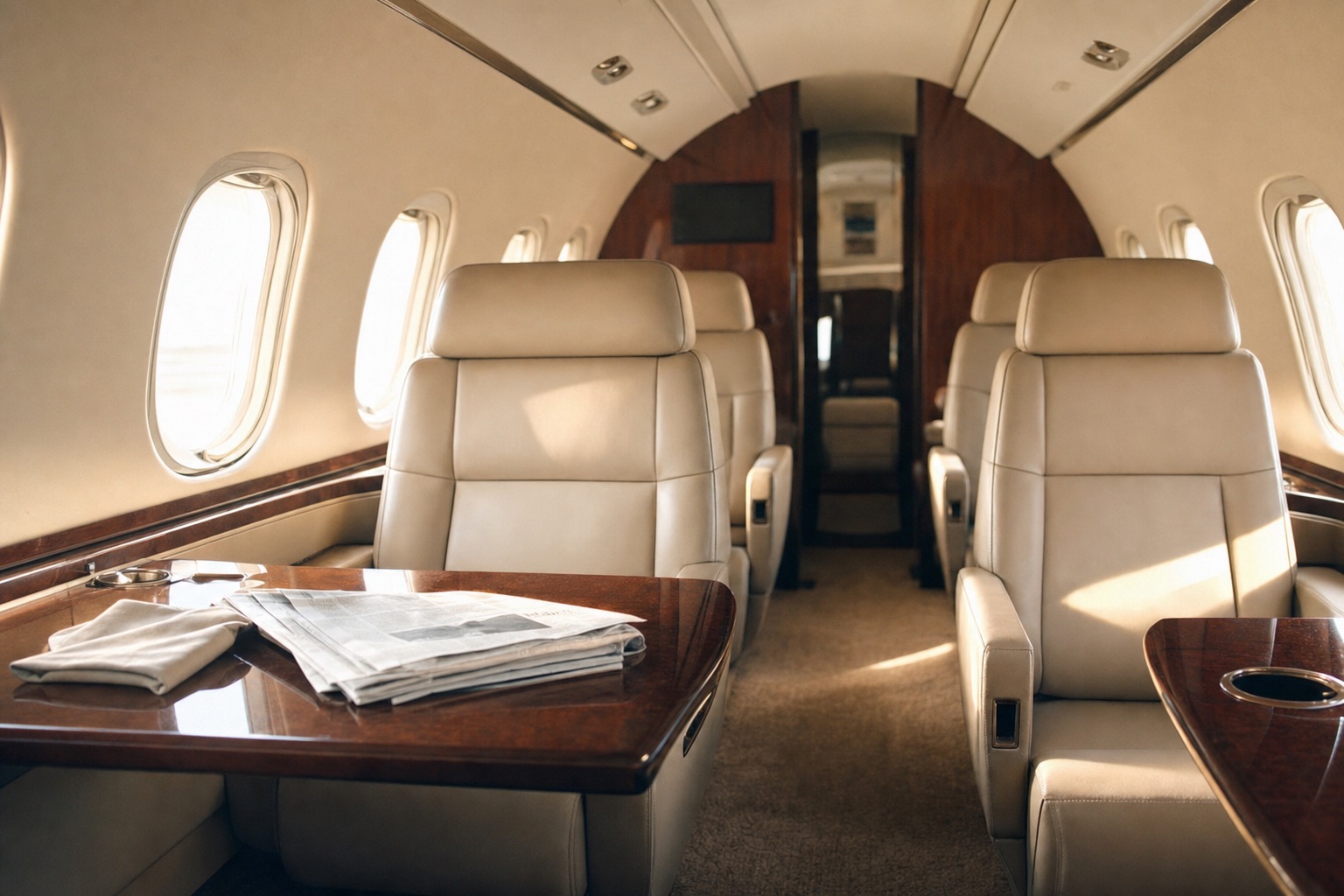
For a couple flying London to New York, first class is cheaper than any private option by an order of magnitude, and we will not pretend otherwise. For five to eight people flying a short European sector, the maths flips in a way that surprises people who have only ever seen headline hourly rates.
The comparison also needs reframing before it starts. Within Europe, genuine first class has all but disappeared: the best seat sold on London-Geneva or London-Nice is a business class recliner. So the question this article answers is whether a chartered turboprop or light jet justifies its premium over scheduled business class. Sometimes yes. Often no. Here is how to tell which side your trip falls on.
What Each Option Costs
Charter pricing in 2026, UK and western Europe:
| Aircraft | Seats | Hourly rate | Example route |
|---|---|---|---|
| Turboprop (King Air, PC-12) | 6-8 | £1,400-3,400 | London-Paris £3,100-3,900 one-way |
| Very light jet (Mustang) | 4 | £2,200-3,600 | Day return London-Edinburgh ~£7,900 |
| Light jet (CJ2+, Phenom 300) | 6-7 | £2,600-3,600 | London-Nice £9,000-14,000 one-way |
Scheduled premium cabins on the same corridors, bought sensibly in advance:
| Route | Business class, per person | First class, per person |
|---|---|---|
| London-Paris | £150-350 | does not exist |
| London-Geneva | £200-500 (more in ski season) | does not exist |
| London-Nice | £250-700 (£1,000+ bought late) | does not exist |
| London-New York | £2,000-4,500 | £5,000-12,000+ |
Now divide the aircraft price by actual bodies. Six colleagues on a London-Nice light jet at £11,000 pay about £1,830 each. Seven skiers sharing a King Air to Innsbruck territory might land near £550 each against £400-plus airline business fares once you price the specific February Saturday. Eight family members taking a PC-12 from Biggin Hill to Le Touquet pay less each than the taxi fare from their Surrey homes to Heathrow.
That is the entire trick of the comparison: charter is priced per aeroplane, airlines per backside.
Where the Time Goes
Ticket prices ignore the part our clients care about most, which is the day around the flight.
Scheduled business class, London to central Nice: drive or train to Heathrow (60-100 minutes), arrive two hours early, security and boarding (45-90 minutes), flight (2h10), Nice terminal to city (25 minutes). Call it five and a half hours door to door on a good day, seven on a bad one.
Light jet from Farnborough or Luton: arrive twenty minutes before wheels-up, walk thirty metres from car to aircraft, fly (2h05), and the car meets you on the ramp. Under three hours total, and the departure time moves if your morning moves.
Two to three saved hours each way is the honest range. Whether that is worth £1,200 per person depends entirely on what those hours buy you: for a family hauling children and luggage, it buys a holiday that starts at lunchtime instead of at bedtime. For a group heading to a wedding or a regatta, it sometimes buys attendance at all.
When Private Wins Outright
Some cases have nothing to do with per-seat arithmetic:
- No direct airline route exists. London to Le Touquet, Deauville or a Swiss valley airfield means connections via Paris or Geneva, or a small plane straight in.
- The airport is wrong even when the flight exists. A villa outside Siena is three hours from Pisa's scheduled terminal and fifteen minutes from its light-aircraft strip.
- The group travels with awkward cargo. Two dogs, ski bags and a golf set turn any airline booking into a negotiation; a charter treats them as weight.
- The schedule is the point. Leaving when the meeting ends rather than when BA's timetable says, or turning a two-city day into one day instead of two.
When Commercial Wins, Honestly
Solo or as a couple on a hub route with flexible dates, book the airline and pocket the difference; it will fund the hotel. Advance-purchase business fares undercut every private option for two passengers, and the gap widens further if you can fly midweek out of season.
Also worth saying: a £57 cost-shared seat in a Cessna exists in a completely different universe from both options above, and for a London-Bournemouth hop it beats everything. We wrote a whole guide on what small aircraft charters cost, including that end of the market.
The Long-Haul Case, Stated Fairly
Transatlantic is where the comparison ends honestly. London-New York on a heavy jet runs £70,000-110,000 one-way depending on category; the same route's first class sells from £5,000 if you shop sales, £8,000-12,000 bought like a normal person. Even at eight passengers the per-seat maths favours the airline by a factor of two or more, and a Gulfstream cabin, however lovely, offers a flatter bed for fewer hours than British Airways' Club Suite does on the daylight hop.
Where private still argues its case long-haul: groups above ten with specific timing (a family of twelve cannot sit together in any first class cabin), security-sensitive travellers, and itineraries airlines do not sell, such as London to a Caribbean island direct on the day required. For everyone else, buy the first class seat and invest the ninety thousand.
The middle distance (London-Dubai, Moscow in another life, West Africa) sits between these poles: business class wins on price alone, private wins when the schedule or the group says so. We quote both without religion.
Empty Legs Change Small Maths Dramatically
Discounted repositioning flights redraw the short-haul comparison entirely. A London-Nice empty leg published around €3,000-5,000 for the whole aircraft undercuts two full-flex business fares, let alone six. The catch remains what it always was: fixed timings, cancellation risk, one-way only. But for flexible travellers who treat an empty leg as a lucky find rather than a plan, it beats both first class and standard charter on price by a distance. Our empty leg guide explains how to hunt them without getting stranded.
Group Dynamics Nobody Prices
One uncosted variable decides more trips than any fare table: what the group does to each other en route.
Six friends in an airport lounge fragment into phones within minutes; the same six in a light jet cabin talk rubbish for two hours straight, which many clients describe as the actual holiday. Families with small children experience a different arithmetic again: two hours airborne with a toddler in a sealed cabin beats four hours of airport transit by whatever measure parents use after their third attempt at commercial travel. And mixed-generation groups (grandparents who will not climb airfield steps, teenagers who will not wake before ten) fit private schedules in ways no airline timetable accommodates.
None of this appears in a cost-per-seat calculation. All of it appears in post-trip emails, which is why we keep asking about group composition before quoting aircraft.
How We Book It
Sulu compares both sides for our aviation clients: real charter quotes from operators we work with, against the scheduled alternatives for your exact date and party size, with the door-to-door totals spelled out. Roughly a third of the time the honest answer is "fly scheduled", and we will say so. When the numbers do work, we handle the operator, the airfield slots and the ground transport in one message thread.
Message us on WhatsApp or Telegram with your route and headcount. Related reading: which London airfield suits which trip, and why small aircraft make sense for European hops.