If you move people to Scottish islands for a living, you already know the pattern. The plan works for four months of the year. Then a gale lines up with a vessel in dry dock and a single-track road, and a Tuesday crew change becomes a Friday one.
CalMac cancellations are not random bad luck, and they are not all weather. They follow patterns you can read in published data. This piece sets out those numbers, the failure points on the roads and in the air, and the rules we would use to decide when to abandon the plan and switch to the backup.
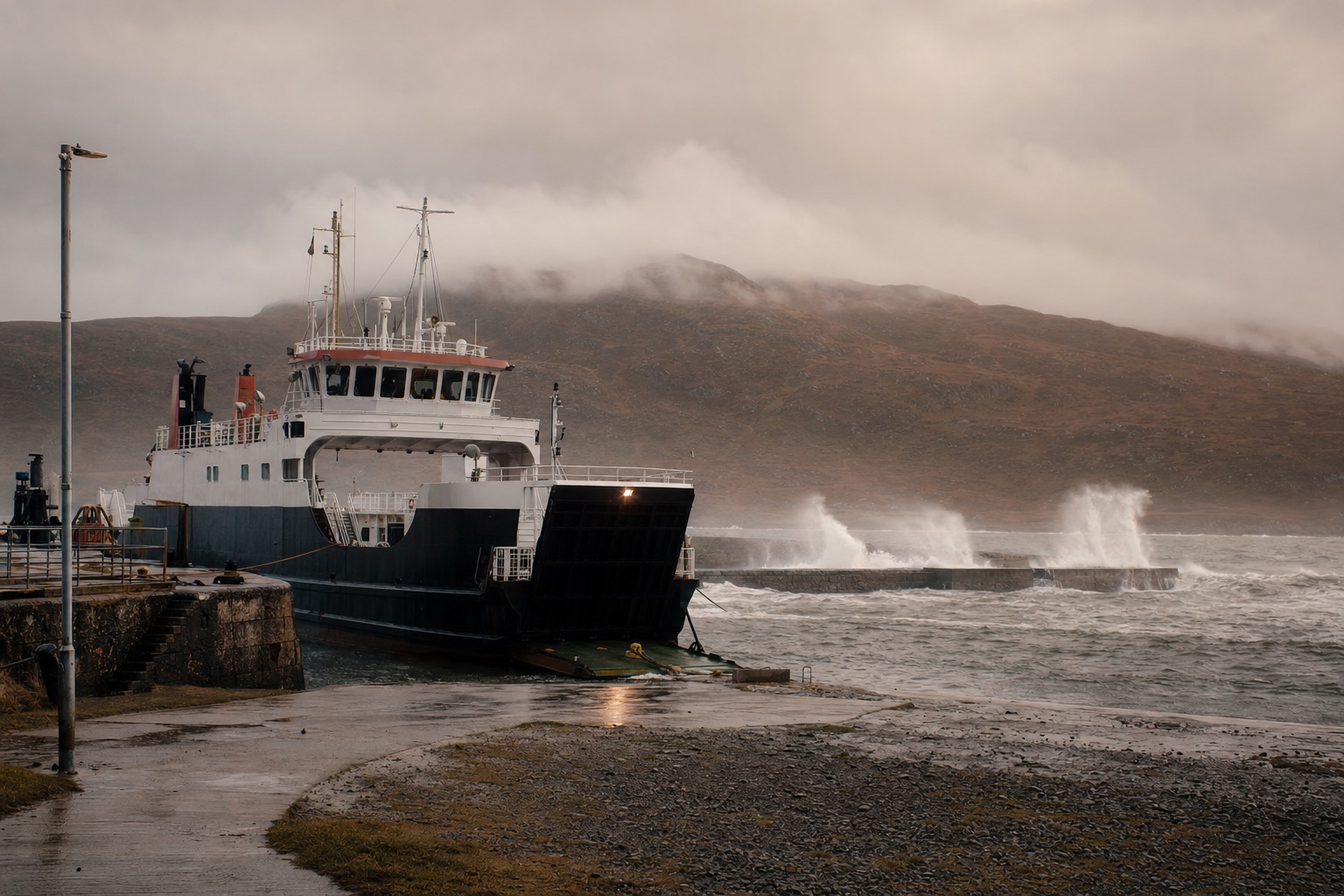
How reliable are Scotland's ferries?
On the busier CalMac routes, reliability is 80% to 93% across a full year, and it falls off a cliff between October and March. Reliability here means the share of scheduled sailings that actually ran, and it is published monthly by CalMac for each route.
The summer figures flatter the service. The winter figures are the ones to plan around. Here are CalMac's own route performance tables for the latest twelve-month windows we could find:
| Route | Period | Reliability over the year | Worst month |
|---|---|---|---|
| Ullapool to Stornoway | Apr 2025 to Mar 2026 | 93.0% (142 of 2,036 sailings cancelled) | Jan 2026: 79.6% |
| Kennacraig to Islay | Mar 2025 to Feb 2026 | 92.4% | Dec 2025: 84.5%, Jan 2026: 78.8% |
| Uig to Tarbert and Lochmaddy | Apr 2025 to Apr 2026 | 92.3% | Dec 2025: 78.0% |
| Oban to Coll and Tiree | Mar 2025 to Feb 2026 | 90.1% | Jan 2026: 63.3% |
| Oban to Castlebay and Lochboisdale | Apr 2025 to Mar 2026 | 80.0% | Mar 2026: 37.8% |
| Mallaig to Armadale | May 2025 to Apr 2026 | 75.5% | Oct 2025: 36.7%, Apr 2026: 36.4% |
Two things stand out. First, a route that averages 90% can spend a month at 63%. Oban to Tiree ran 100% of sailings in June and July 2025, then 73.9% in December and 63.3% in January. Second, the worst months are not always winter months. Mallaig to Armadale lost 221 of its 349 scheduled sailings in October 2025, and Kennacraig to Islay dropped to 74.5% in April 2026. When a vessel is out, a route can fail in good weather.
Kennacraig to Islay is a good example of why you should read the rolling window. The twelve months to February 2026 show 92.4%. The twelve months to July 2026 show 88.8%. Same route, four percentage points lost, because April 2026 was bad. CalMac publishes a monthly table for each route. The windows differ by route, so compare like with like.
Why ferries are cancelled: technical faults beat weather
In 2025, technical faults caused 54% of CalMac cancellations. Weather caused 38.2%. That was the first year in a decade that technical problems were the most common cause, according to Holyrood's analysis of freedom of information data (the 2025 figures exclude December).
The change is large. In 2015, CalMac cancelled 709 services for technical reasons, 10.4% of all cancellations. In 2025 it was 7,371. Fleet age and vessels out for repair are the reason, and the same report notes several large ships out of service at once.
For a coordinator, this changes the contingency. A weather forecast tells you about one cause. A vessel breakdown arrives with no forecast, and it can hit in flat calm. Worse, a technical failure on a single-vessel route means there is no like-for-like replacement. Services are cut or consolidated, and your booking can be one of those dropped.
So two separate defences are needed. Against weather, you watch forecasts and build buffer days. Against technical faults, you hold a second route or mode that does not share a vessel with the first.
How reliable are island flights?
Loganair is the main scheduled operator to the islands, and its punctuality is better than most people expect. An AirAdvisor analysis of Civil Aviation Authority data put Loganair at around 81% of flights on time for January to September 2025, against a UK average near 72%, as reported by NationalWorld. Loganair also topped the CAA's April to June 2025 quarter at 86%. The CAA counts a flight as on time within 15 minutes of schedule.
Punctuality is not the same as completion. We could not find published cancellation rates by Loganair route, so we will not guess a number. What the pattern shows is that island flying fails in specific ways:
- Fog at Sumburgh. Shetland's main airport has a history of being shut by fog. On 20 October 2017, fog made landing impossible and Loganair cancelled the rest of the day's Shetland flights after services from Aberdeen, Edinburgh and Glasgow were diverted, stranding about 200 people. In July 2013, fog disrupted flights for roughly a fortnight, and Loganair struggled to find beds for passengers. Beds are the second constraint after seats.
- Barra's beach runway. Barra's three runways are sand, covered at high tide. Flight times move with the tide and operations are in daylight only, so a delay can push you past the usable window and cancel the flight outright.
- Small aircraft, small margins. Crosswind and visibility limits bite harder on aircraft carrying nine to 50 seats than on a jet. That is why they are the first to be cancelled, and why a charter operator with a spare aircraft is a real option (see our comparison of crew charter aircraft in Scotland).
Roads: the A87, A82 and A9 failure points
Skye has a bridge, so the road is the risk, not the ferry. Most traffic to Skye arrives on the A87 through Glen Shiel and Kyle of Lochalsh. When that road closes, there is no short alternative.
When the A87 closed in both directions between Shiel Bridge and Bun Loyne after a collision in August 2023, police diverted traffic via the A890 and A832. That is a long way round through Wester Ross. Planned closures also happen: BEAR Scotland ran overnight full closures with short amnesty windows on the A87 across Skye in September 2026, which matters if your crew change lands at 2am.
Other pinch points to put in your plan:
- A83, Rest and Be Thankful. This is the road to Kennacraig and Islay. After landslips, traffic uses the single-track Old Military Road. When that is also shut, the diversion is long. Transport Scotland's project page lists the work as under construction, so check before you assume it is open.
- A82, Tarbet to Crianlarich. Past closures were diverted via the A85, A819 and A83, adding roughly 38 miles and about 53 minutes. A closure at Inverlochy during Storm Gerrit in December 2023 shows the same road can fail at the other end.
- A9, Drumochter. Snow gates close the pass in drifting snow. In December 2023 the A9 shut at Drumochter and drivers were stuck in tailbacks of around 20 miles.
The official source for all of them is Traffic Scotland, which carries live incidents and planned works. Check it the evening before and again before the vehicles leave.
Trigger points: when to switch plans
A backup plan only works if someone decides when to use it. Fix the trigger in advance, in writing, and make it a time rule rather than a judgement call at 5am. These are our rules of thumb, not operator thresholds.
Seven days out. Look at the route's last three months on CalMac's performance page. If winter reliability is under 85%, book a travel day either side of the work window.
72 hours out. Look at Met Office warnings. A yellow wind warning covering the crossing is the signal to price the backup, not to cancel the primary. Confirm the backup has seats.
24 hours out. Check CalMac service status and Traffic Scotland. If the route already shows disruption or a vessel swap, move to the backup now. Seats on the alternative go quickly once a sailing is cancelled.
Departure morning. Decide at a fixed time, for example two hours before the first leg. If the sailing or flight is not confirmed as running, switch. Do not wait for the cancellation notice. By then, the next sailing and the hotel beds in the port town are already taken.
Mid-journey. If you are already in transit and the next leg is cancelled, the priority is a bed and a seat, in that order.
One more rule: never plan a same-day connection between an island ferry and a flight home. Leave a buffer night.
Backup routes by destination
The table below pairs each destination with its main route and the realistic alternatives. Check every timetable before booking, as services change by season.
| Destination | Main route | Backup | Notes |
|---|---|---|---|
| Skye | A87 via Kyle of Lochalsh | Mallaig to Armadale ferry; Glenelg to Kylerhea (seasonal, small) | A87 closures divert via A890 and A832. Mallaig to Armadale was 75.5% reliable in the latest year. |
| Islay | Kennacraig ferry | Loganair from Glasgow | A83 is the approach road to Kennacraig. |
| Mull and Tiree | Oban ferry | Lochaline to Fishnish for Mull; Loganair from Glasgow for Tiree | Oban to Coll and Tiree ran at 63.3% in January 2026. |
| Lewis and Harris | Ullapool to Stornoway | Uig to Tarbert for Harris; Loganair into Stornoway | Ullapool to Stornoway is the most reliable route in our table. |
| Uists and Barra | Uig to Lochmaddy; Oban to Lochboisdale | Loganair into Benbecula and Barra | Barra flights follow the tide. Oban to Lochboisdale was 80.0%. |
| Orkney | NorthLink, Scrabster to Stromness | Pentland Ferries, Gills Bay to St Margaret's Hope; Loganair into Kirkwall | Both Pentland Firth ferries cancel in swell, so they are not independent. |
| Shetland | NorthLink, Aberdeen to Lerwick (overnight) | Loganair into Sumburgh | Shetland's ferry is NorthLink, not CalMac. Fog is the flight risk, gales the ferry risk. |
The two Pentland Firth ferries share a stretch of water and a weather system. Having two operators is not the same as having two independent routes. The useful backup is the one that fails for a different reason, which is usually a different mode.
Each island gateway fails in its own way. Our crew guides to Stornoway, Benbecula, Kirkwall, Sumburgh and Wick cover the local detail.
Who pays for standby, overnight and rebooking?
Short answer: weather cancellations cost you more than technical ones. For ferries, accommodation is not covered when the disruption is caused by weather that endangers safe operation, and CalMac's compensation scheme also excludes weather and tidal conditions.
What you do get, whatever the cause, is a choice of re-routing on the next available sailing or a refund. Under the UK rules on passenger rights at sea, the carrier must offer snacks or meals after a delay of more than 90 minutes. Where the cause is not weather, accommodation is capped at £70 per person per night for up to three nights. CalMac's own scheme for non-weather disruption sets its limit at £100 per person per night, up to three nights, and you arrange and pay first, then claim. Claims must be made within two months. Declining an offered re-route and waiting for service to resume leaves you liable for any costs after that.
On technical cancellations, CalMac's scheme pays 25% of the leg's ticket price for an arrival one hour late on short journeys, and 50% for a longer delay. It is small money. The cost of a stranded crew is the day rate and the hotel, not the ticket.
For flights, the rules are different. Under UK261, bad weather usually removes cash compensation, but you still get a refund or re-routing, plus meals and hotel accommodation while you wait, whatever the cause. Keep itemised receipts. If the airline does not provide care, you can pay for it and claim it back.
Two practical points for businesses. Travel insurance often excludes weather unless you have added disruption cover, so read the wording before you rely on it. And a crew held overnight is a cost to your project, not the carrier. Build it into the budget, as you would a contingency line.
A one-page checklist
Print this and put it in the project file.
- Before booking: read the last three months of reliability for each ferry leg. Winter under 85% means buffer days.
- Backup: name one alternative that does not share a vessel, runway or road with the primary. Hold a provisional booking if the fare allows.
- Authority: one named person decides on switching, with the time written down.
- Accommodation: note the nearest three hotels at each port and their phone numbers. Beds in a small port town go fast once a sailing is cancelled.
- Sources to check: CalMac service status, Traffic Scotland, NorthLink and Pentland Ferries for the Firth, and Loganair flight status.
- Vehicles: if a van or kit has to travel, vehicle space is the scarce item on a replacement sailing. Book it first and the people second.
- Receipts: every extra cost, itemised, kept for the two-month claim window.
- Crew: a plain message template for "plan B is live", sent once, with the new times.
- After: log what failed and why. Two incidents on one route is a reason to move the base.
Related reading: Highland grid projects and crew accommodation, the fastest way from London to Skye, and a private flight to the Isle of Skye.
When the plan needs a second pair of hands
This is the work we do on crew travel and for business clients: watch the forecast, hold the backup, and make the call at the right hour. The data is public. What helps is somebody reading it daily and ringing the people who can move a seat.
We use the best intelligence we can find, and people who will pick up the phone to make decisions.