A private flight to Skye ends at one place: Broadford airstrip, also called Ashaig, a Highland Council runway beside the A87 between Broadford and Kyleakin. It is short, unlicensed, has no control tower and no instrument approach. It is also the reason a Leeds-to-Skye day trip takes just over an hour each way instead of eight hours on the road.
Most pages on this topic are broker templates that say "private jets to Skye" and stop there. A jet cannot sensibly use this runway. The aircraft that can are Islanders, Caravans, Twin Otters and, with care, a Pilatus PC-12. This guide covers which one to pick, what the flight costs in the market, and what happens when Skye does what Skye does with the weather.
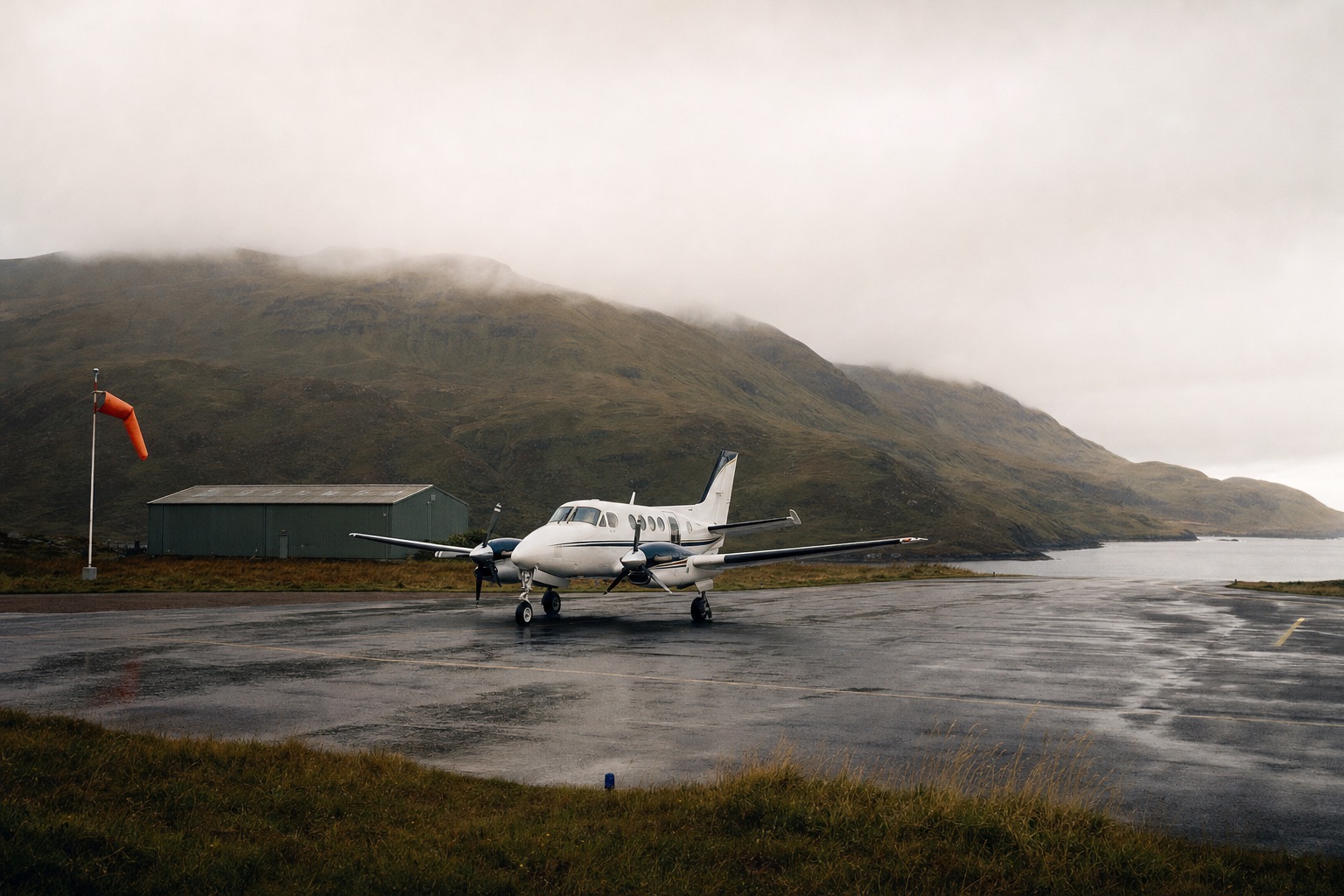
Can you fly to the Isle of Skye by private plane?
Yes. You can land a chartered aircraft at Broadford Airfield (ICAO EGEI), 24 ft above sea level on the south-east side of the island, with prior permission from Highland Council. You cannot land a light jet there in any practical sense, and nothing scheduled has flown there since 1988.
The runway is 07/25, asphalt, 771 m by 23 m according to Highland Council and the HITRANS report prepared for the CAA. Wikipedia lists 793 m. Plan on the lower number. The council owns and runs it. It is used by general aviation, Skye Flying Club, the coastguard and the air ambulance, and it was built by the Royal Engineers, opening in 1972. Loganair flew scheduled services to Glasgow from it until 1988.
The facts that shape every charter here:
- Unlicensed. The CAA does not license it. There is no air traffic control, no flight information service and no rescue or fire cover.
- Daylight only. Permitted hours are 0800 (or 30 minutes after sunrise, if later) to 2200 (or 30 minutes before sunset, if sooner). In December that is a short window.
- Visual approach. The 2007 report classes it as a Code 1 visual runway. The hills are close: Ben Suardal (281 m) sits beside the approach to runway 25. A precision approach would be needed for scheduled airline use. A charter pilot flies it by eye.
- No terminal. There is a hangar and basic welfare facilities. No cafe, no taxi rank, no car hire desk.
Not every operator will take it on. Each one decides on its own risk assessment. Ask early who is comfortable with it.
Which aircraft can land at Broadford?
Islanders, Twin Otters and Caravans fit comfortably. A PC-12 fits in good conditions at sensible weights. A King Air 200 is marginal and depends on the operator. Light jets do not fit.
| Aircraft | Seats | Fit at Broadford | Why |
|---|---|---|---|
| Britten-Norman Islander | up to 9 | Yes | Built for strips like this. The 2007 report notes the air ambulance Islander has used Broadford. |
| Cessna Caravan | up to 9 | Yes | Short-field turboprop. Loch Lomond Seaplanes has used Broadford with Caravan amphibians. |
| Twin Otter | 19 | Yes | A 2013 HITRANS feasibility study found it can operate within the current length. |
| Pilatus PC-12 | 8 | With care | Published 758 m take-off at maximum weight and 661 m landing over a 15 m obstacle, sea level, dry runway. Positive but thin margin on 771 m. |
| King Air 200 | 7 | Marginal | Broker figures put take-off near 2,500 ft (about 760 m) over 50 ft. Ask for the operator's own numbers. |
| Light jets (Phenom 300E and similar) | 4 to 7 | No | Phenom 300E take-off at maximum weight is 3,209 ft (978 m), longer than the runway. |
PC-12 figures come from the Pilatus factsheet, the Phenom figure from Embraer's certification data. Both assume standard conditions. Wet asphalt, a tailwind, a warm day or a full cabin eat the margin quickly. The pilot decides on the day, and on a 771 m strip with a hill off the end the right answer is sometimes to land at Inverness.
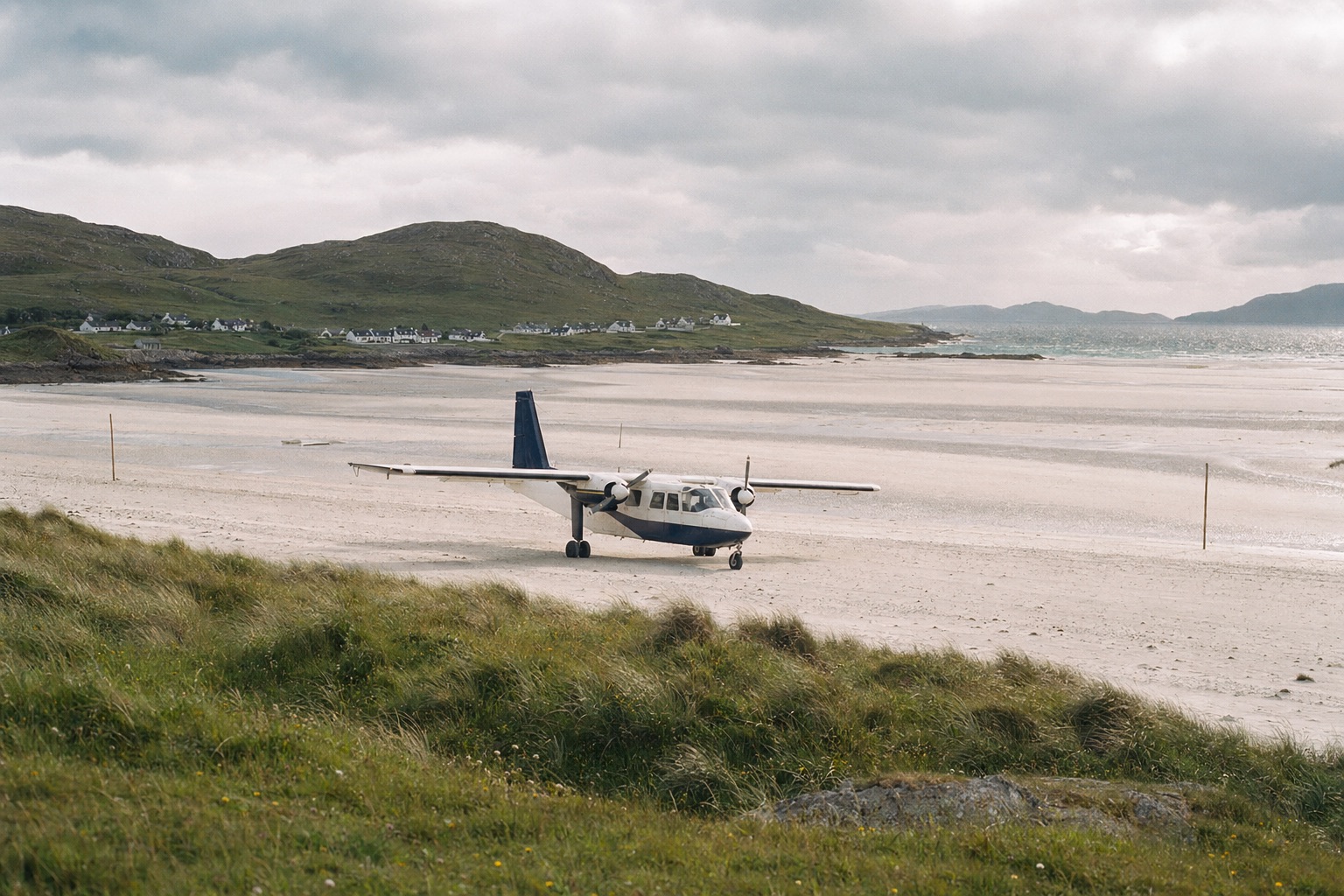
Most people reading about jets want speed. Over Skye distances a turboprop gives you nearly all of it. The full argument is in our turboprop versus light jet comparison, and the Islander's other home turf is covered in the Hebridean run.
Operators are the thin part of this market. Hebridean Air Services flies Islanders from Oban and does tailored charters across the Inner and Outer Hebrides. We found no Islander operator based on Skye itself, so your aircraft comes from somewhere else and positions in. That positioning is part of the bill.
Flight times to Skye from London, Leeds, Manchester, Edinburgh and Glasgow
From England, a PC-12 does the job in under two hours. From Scotland, an Islander is slower than a turboprop but much cheaper per hour. These are straight-line estimates from the Broadford runway, with allowance for departure and arrival. Routing, wind and airspace add time.
| From | Distance | PC-12 (about 250 kt) | Islander (about 140 kt) | By road |
|---|---|---|---|---|
| Farnborough or Biggin Hill | 400 to 410 nm | about 1h45 | 3h+, likely fuel stop | 11 to 12 hours |
| Oxford Kidlington | 360 nm | about 1h35 | about 2h45 | 10 to 11 hours |
| Manchester | 265 nm | about 1h10 | about 2h | 8 hours |
| Leeds Bradford | about 255 nm | about 1h05 to 1h15 | about 2h | 8 hours |
| Edinburgh | 115 nm | about 40 min | about 1h | 4.5 to 5 hours |
| Glasgow | 95 nm | about 35 min | about 50 min | 4.5 hours |
| Inverness | 63 nm | about 25 min | about 40 min | 2 hours |
Road times are our estimates, not guarantees. The Islander is not a London aircraft. For anywhere south of Manchester, use a turboprop. Choosing the London departure point is its own question, covered in which London airport to fly private from. If you are working out whether flying beats the alternatives for a specific trip, London to Skye: the fastest way compares them head to head.
How much does a private flight to Skye cost?
Expect a turboprop day trip from the north of England to cost roughly £4,000 to £11,000 for the whole aircraft, depending on where it starts. That is market pricing, not a quote. Rates move with fuel, season and availability. Check before booking.
The hourly ranges behind that number:
- Islander-class twin: our working planning figure is roughly £1,700 to £2,000 per flight hour. Published broker pages are all over the place, from about $1,200 to $5,000, and none are UK operator rates. Treat it as a planning number and get a real quote.
- Pilatus PC-12: about £1,600 to £3,400 per hour.
- King Air 200: from about £1,400 per hour.
- Twin Otter: quote only. We found no published charter rates.
The hours matter more than the rate. A Leeds-area day trip in a PC-12 is about 2h20 to 2h30 in the air, billed at perhaps 2.5 to 3.5 hours with positioning. The same trip in an Islander is nearly four hours in the air. At £1,700 to £2,000 an hour the "cheap" aircraft comes out around £6,500 to £7,600 before positioning, which is no saving. The Islander wins from Glasgow or Oban, where the distances are short. For the general rate picture, see small aircraft charter costs in the UK.
Landing costs at Broadford are tiny by comparison. Highland Council's April 2023 fee sheet lists £137.50 per landing for aircraft above 2.73 tonnes (an Islander, PC-12 or King Air all are), and £13.75 per 24 hours of parking. Landing without prior permission doubles the fee. Check the current sheet.
The real extra costs are at the other end: handling at your departure airfield, overnight crew costs if the aircraft stays, and a driver on the island. A same-day return where the aircraft waits is usually cheaper than two separate one-way flights.
What permissions do you need to land on Skye?
You need prior permission required (PPR) from Highland Council before landing, plus insurance that meets the council's conditions. The operator normally handles this, but you should know it exists.
PPR is requested by email to Info.Aerodromes@highland.gov.uk, per the council's conditions of use. Pilots must show evidence of insurance on request, report arrival and departure times within 48 hours, and pay fees within 14 days. The council keeps the right to close the strip to categories of aircraft on a risk basis, so check that your aircraft type is accepted before you plan around it.
Flights from within the UK need no customs. A flight arriving from Ireland or abroad needs a different plan, because Broadford is not set up for international arrivals as far as we know. Clear customs at Inverness or Glasgow first and check the detail with your operator.
What if the weather closes Broadford?
Plan for it from the start. Skye has low cloud and sea fog more often than most places, Broadford is visual-only, and the pilot will not attempt an approach below limits. If the strip is closed, the aircraft diverts and you drive.
The practical diversion is Inverness (EGPE). It has an instrument approach and a road to Skye of around two hours. Stornoway is 61 nm away but sits across the sea, so it is a fuel and safety backup, not a place you can drive from. An old strip at Plockton turns up in aviation databases and historical airfield records. Do not treat it as available.
Three habits make a Skye trip survive the weather:
- Book a car at Inverness anyway. If Broadford shuts, the driver is already there.
- Fly outbound early. Weather can improve through the day, and a late flight leaves no room to wait it out.
- Keep the return flexible. Do not tie your Sunday evening to a Skye departure. Aircraft stuck on the island make for a long Monday.
Daylight hours cut against you from late October to February. A winter day trip can leave only five or six usable hours of daylight.
Getting around once you land
Nothing is waiting at the airstrip unless you arrange it. Pre-book a driver or a hire car delivered to the strip. Taxis on Skye are few and mostly local, so do not count on one turning up.
Rough drive times from the strip, in normal traffic: Broadford village a few minutes, Kyleakin and the Skye Bridge about a quarter of an hour, Armadale about half an hour, Portree about 40 minutes, Dunvegan and Talisker distillery about an hour. In summer the A87 slows to a crawl behind campervans, so add margin.
Do not assume fuel on the island. Plan to uplift at your departure airfield or at Inverness.
Is a scheduled flight to Skye coming back?
Not yet. Scheduled flights from Broadford to Glasgow ran from 1972 until 1988 and have not returned, and we found no confirmed relaunch date.
The most detailed plan is a 2018 HITRANS and Highland Council study by Arcadis. It proposed a 19-seat Twin Otter on 12 flights a week to Glasgow. It put the capital cost at £1.15 million to £1.36 million and the annual running cost at £880,000 to £980,000, with two years as the shortest realistic timescale. The Broadford and Strath Local Place Plan for 2024 to 2034 still calls for land to be kept for an airstrip. Funding is the hold-up. Do not plan a trip around a scheduled service.
Helicopter to Skye as an alternative
A twin helicopter from Inverness covers the 63 nm in roughly 30 to 35 minutes, and it does not need Broadford's runway. It can land closer to where you are staying, subject to landowner permission, and some hotels and estates have their own landing grounds.
The trade-offs: fewer seats (four to six), a much higher hourly rate (roughly £3,000 to £5,000 for a twin, a market estimate to check before booking), and the same Skye weather. Where you are heading to a specific estate or hotel with its own landing ground, a helicopter can be worth it. For a group of eight arriving for a weekend, a PC-12 plus a driver is cheaper and carries the luggage.
Who handles this
Skye is the kind of trip where the plan matters more than the plane. Which operator will take the strip, what the aircraft can do at your weight, where the car waits when the cloud sits down, how the return survives a delay. A good answer to those four questions is worth more than a good price on the aircraft.
That is the work we do for private aviation, and for companies moving a team to a site, an estate or a client meeting in the Highlands, through our business service. If you are weighing the sea route instead, our piece on west coast sailing charters covers the other way into the same water.
Tell us where you are starting, how many of you there are and which day. We will tell you what can land, who will fly it and what it costs, with the weather plan built in.