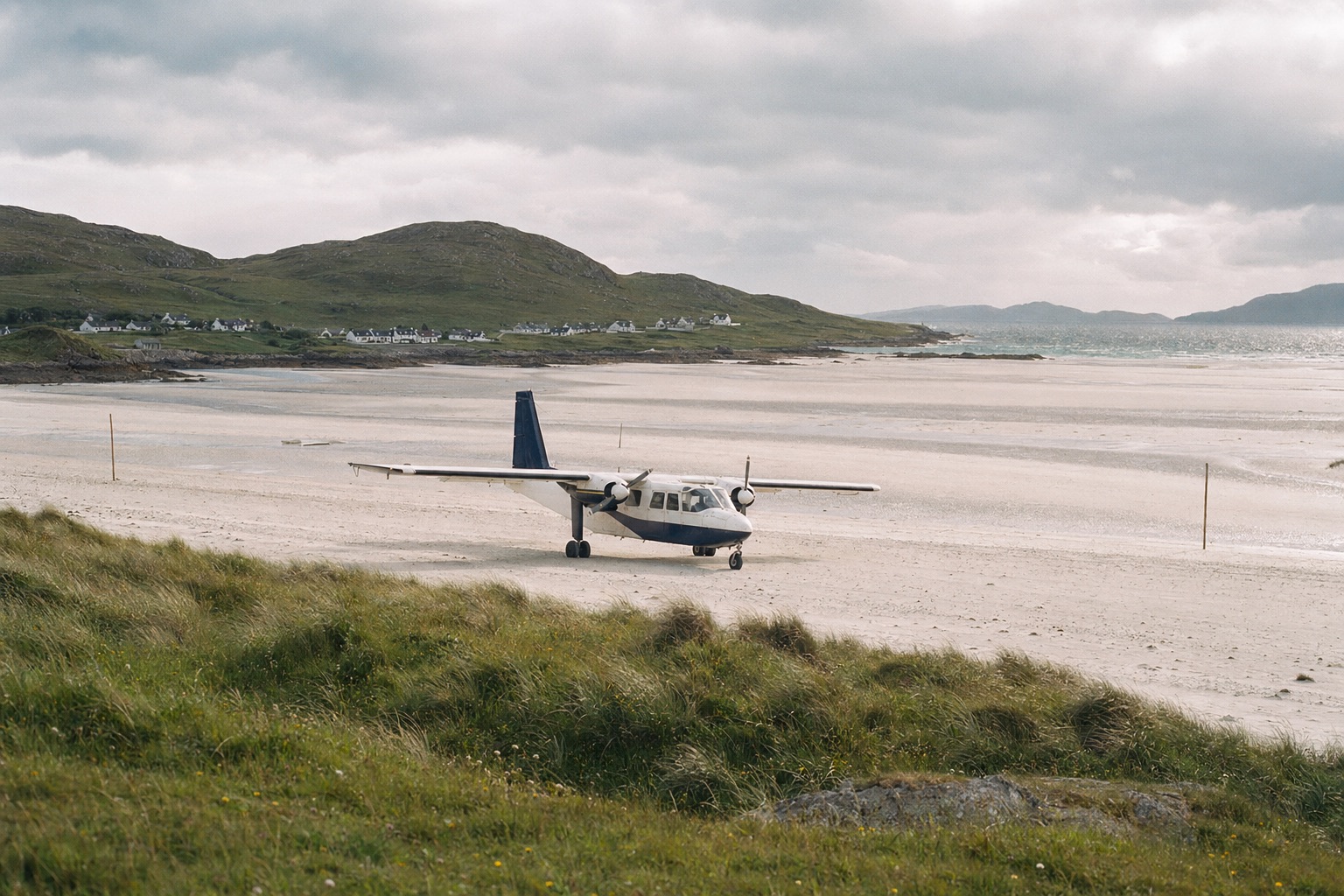
There are two flights in the British Isles that the international aviation press writes about every couple of years and you, probably, have not been on. One is the scheduled flight from Westray to Papa Westray in Orkney, which takes ninety seconds and is the shortest scheduled flight in the world. The other is the scheduled flight from Glasgow to Barra in the Outer Hebrides, which lands on a tidal beach. The runway is the actual beach. The schedule depends on the tide. When the tide is in, the runway is two metres of seawater.
Both are operated by Loganair on Britten-Norman Islanders, the small twin-piston workhorse that the British Isles use for unimproved-strip flying. Both are bookable as scheduled tickets. Both are, in our considered view, the best long weekend in the British Isles that almost nobody is taking.
This piece is about a three-day Hebridean trip combining a private leg and the scheduled-flight novelties. You leave London on a Friday morning, you land on a beach by lunchtime, you eat scallops, you sleep in a Georgian-era hotel, you fly the ninety-second flight on Saturday, and you fly home on Sunday evening with a story that is genuinely unusual.
What This Trip Actually Is
The Hebrides are 119 islands stretched along the Atlantic coast of Scotland. Roughly fifteen are inhabited. The Outer Hebrides — the long curving chain at the western edge — include Lewis, Harris, the Uists, Barra, and a scatter of smaller islands. Orkney is north of mainland Scotland, separately. They are a different country. They speak Gaelic.
What you go for: white-sand beaches the colour of the Caribbean (genuinely — the Atlantic at Luskentyre on Harris is turquoise on a sunny day, and there is one sunny day in five), Neolithic standing stones that predate Stonehenge, the seal colonies that come ashore at Berneray, an Atlantic light that has the same effect on photographers that Pantelleria has on novelists, the food (langoustines pulled out of the bay that morning, oysters from the Sound of Harris, peat-smoked salmon, mutton from the machair), and a quietness that is a thing that has been removed from most of the rest of Europe.
What you do not go for: weather. The Hebrides have weather like nowhere else. We come back to this.
The Flights
This is a trip with multiple aircraft segments. Ours is the rare itinerary that mixes private with scheduled, because the scheduled flights are themselves the destinations.
Leg 1 — London to Stornoway by light aircraft, Friday morning. From Biggin Hill, Farnborough, or Oxford-Kidlington, on a Pilatus PC-12 or a King Air, around three hours including a fuel stop in northern England (Carlisle or Newcastle). Direct on a faster aircraft is possible.
Leg 2 — Stornoway to Barra by Britten-Norman Islander, Friday lunchtime. This is the scheduled Loganair flight (LM631 or similar). Forty minutes. Lands on the Tràigh Mhòr (the great beach) at low tide. You will be one of nine passengers. The pilot will tell you the safety briefing in Gaelic and then in English. You will fly low along the western coast of Harris and South Uist. This is the flight you came for.
Leg 3 — Barra back to Glasgow on Sunday evening, again the scheduled Loganair Islander or Twin Otter. About 75 minutes.
Leg 4 — Glasgow to London by light aircraft (PC-12, again, around 90 minutes), or by scheduled flight on Sunday evening if you want to save the cost.
If a side trip to Orkney for the ninety-second flight matters to you — and it should — we add a Saturday morning private leg from Stornoway or Inverness to Westray, fly the Westray-Papa Westray-Westray loop, and back. The whole detour adds about £4,000 to the trip cost and a story that, in our experience, becomes the dinner-party story for years.
The Beach Landing, Specifically
Barra airport (HIAL identifier BRR, ICAO EGPR) is the only airport in the world where scheduled flights land on a tidal beach. The "runway" is three sticks marking the safe landing area on the Tràigh Mhòr. The beach is firm, fine-grained shell sand, perfect for an Islander but soft enough that you cannot park aircraft on it overnight (they are towed off and parked next to the small terminal building between flights).
The schedule is set six months ahead but adjusted daily to the tide times. Flights land at low tide, full stop. Sometimes that is 7 a.m.; sometimes that is 4 p.m. You book the flight, Loganair tells you the time. The crew will phone you on the morning of the flight if there is any change.
The terminal building has a tea room, a small museum about the airport, and one of the better airfield gift shops in Europe. You can buy a black-and-white photograph of an Islander parked on the beach for £18 and feel that you have brought home something genuinely meaningful for £18.
The Ninety-Second Flight
Westray and Papa Westray are two of the smaller Orkney islands, separated by 2.7 kilometres of water. The flight on the Britten-Norman Islander is, depending on wind, between 47 seconds and 90 seconds long. The record is 53 seconds. The cabin announcement is, we are told, something like "we are now at cruise altitude. We are now beginning our descent."
The flight is operated by Loganair and is bookable as a scheduled ticket, around £30 each way. The catch is that you have to get to Westray to take it. Westray is reached by Loganair flights from Kirkwall (the main Orkney airport, 12 minutes), or — for the comprehensive aviation enthusiast — by your own private aircraft.
We arrange the Saturday morning detour as follows: private flight from Stornoway to Kirkwall (90 minutes on a PC-12), then the scheduled Loganair routing Kirkwall–Westray–Papa Westray–Westray–Kirkwall (around 30 minutes total flying), then private flight back to Stornoway. You are back on Lewis for late Saturday lunch.
Where You Stay
Castlebay Hotel, Barra. A nineteenth-century white-painted hotel directly opposite Kisimul Castle (a thirteenth-century castle on a small island in the bay; you can ferry over for £6). Twelve rooms, restaurant downstairs, the bar is the unofficial centre of Barra's social life. Around £180 a night. This is where you stay on Friday.
The Scarista House, Harris. A converted Georgian manse on the west coast of Harris, looking over Scarista Beach. Six rooms. The dining room is one of the best in Scotland: scallops from the Sound, langoustines from Tarbert, mutton from the machair. Around £280 a night. Booking essential — Scarista has six rooms and seven months of demand.
Loch Bay Restaurant, Skye (if you extend the trip a day). A Michelin-starred seafood restaurant in Stein on Skye, with a single guest cottage. Combine with a Sunday morning visit to the Talisker distillery in Carbost. Adds a day, adds about £1,800 to the total.
We have rented private houses on Harris twice. The pattern is: a stone bothy on the west coast, four bedrooms, a peat fire, and a path down to the beach. Around £2,200 for a long weekend. The owners are friends of friends. We can ask.
What You Eat
This is a trip about shellfish. The water is cold and clean and the langoustines are extraordinary. The list, in priority order:
Cafe Kisimul, Barra — open during the season, run by an unlikely combination of a Glaswegian chef and his Bangladeshi wife, the menu is half Hebridean seafood and half curry, and the result is one of the more remarkable restaurants in the British Isles. Lunch around £35 a head.
The Scarista House, Harris — see above. The £75 set menu is the move. Booking ahead is non-negotiable.
The Anchorage, Tarbert (Harris) — small harbourside fish-and-chip shop with a proper restaurant attached. Langoustines straight off the boat. Around £40 a head.
Loch Bay, Skye — Michelin-starred, seafood-focused, the chef is Michael Smith. £100 tasting menu. Worth the day.
If you are at the Castlebay Hotel for breakfast, order the Hebridean smoked salmon. It is cured at a smokehouse on Lewis called Stornoway Black Pudding (the company makes more than just black pudding) and it is meaningfully better than what you will get in London at three times the price.
The Numbers
Indicative pricing as of April 2026. Operator rates move with fuel, weather, and date — we always send three real quotes before you commit.
A Friday morning to Sunday evening trip — four passengers, return London-Hebrides on a PC-12, the scheduled Barra and Westray flights, two doubles at Castlebay and Scarista — looks roughly like this:
- Aircraft (PC-12 segments London-Stornoway-Glasgow with positioning): £14,000-18,500
- Saturday Westray detour (private legs to Kirkwall + scheduled Westray ticket): £3,500-4,500
- Loganair scheduled flight Stornoway-Barra return: £640 (four passengers, both legs)
- Castlebay Hotel, two doubles, Friday night: £360-450
- Scarista House, two doubles, Saturday night: £560-700
- Meals across three days: £1,000-1,400
- Local transport (a hired Defender for the duration): £450-650
- Sulu concierge fee: £900
- Typical total: £21,500 to £27,500
That works out around £5,500 to £6,900 per person for a three-day weekend. By the standards of this list, it is mid-priced — more than Calvi, less than Megève. The proportion that is the aircraft is unusually high, because the distance is unusually long and the route is unusual.
A two-person version of the same trip is around £17,000 to £21,000 (£8,500 to £10,500 each), which is — we are not denying this — a meaningful expense for a long weekend. The full economic case for this trip relies on going as four. Below four, the maths starts to feel less defensible.
Honest Caveats About Weather
The Hebrides have weather. The Atlantic delivers low cloud, rain, and wind in larger volumes than the rest of the British Isles, and the visual approaches into Stornoway and Barra are weather-dependent. Loganair cancels the Barra flight roughly fifteen percent of the time, replacing it with a ferry from Oban (which takes five hours). For private legs, our PC-12 operators will divert to Inverness or Glasgow if the weather closes in.
If the trip cannot operate as planned, we re-route. We have done a "stranded in Glasgow" version of this trip three times that we know of. In two of them, the clients said the unplanned overnight in Glasgow was the best part. We are not promising you weather, we are promising you that we re-route.
Best months: late May, June, and September. July and August are warmer but busier. October to April is for romantics and Defoe fans only.
Why This Trip, Specifically
The Hebridean Run is the trip on this list with the lowest swagger and the highest interest. The Pantelleria trip and the Megève trip have more luxury in them; the Formentera trip and the Calvi trip have more sun. The Hebrides have something that none of the others have, which is a sense of being far away from anywhere, in a part of the British Isles that is not really like the rest of the British Isles, on a flight that has been part of the romance of British aviation since 1935.
We have done it eight times for clients in the last two years. Every single set of clients has come back asking for a longer version next year.
Message us on WhatsApp or Telegram. For the Hebrides we recommend booking 6 to 10 weeks ahead in season — Castlebay and Scarista House each have under fifteen rooms between them, and the right Saturday in June is the right Saturday for a thousand other people who heard the same story.