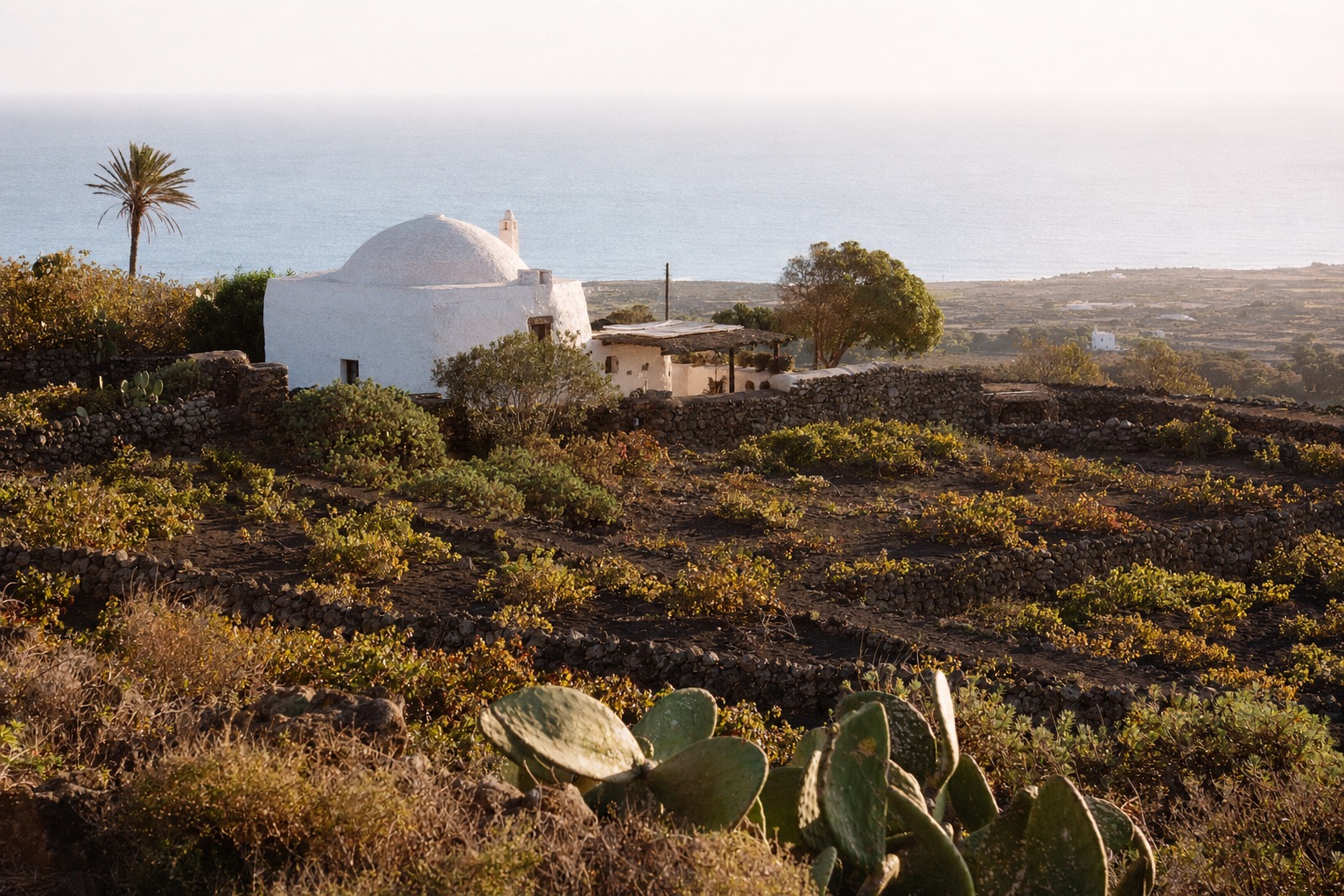
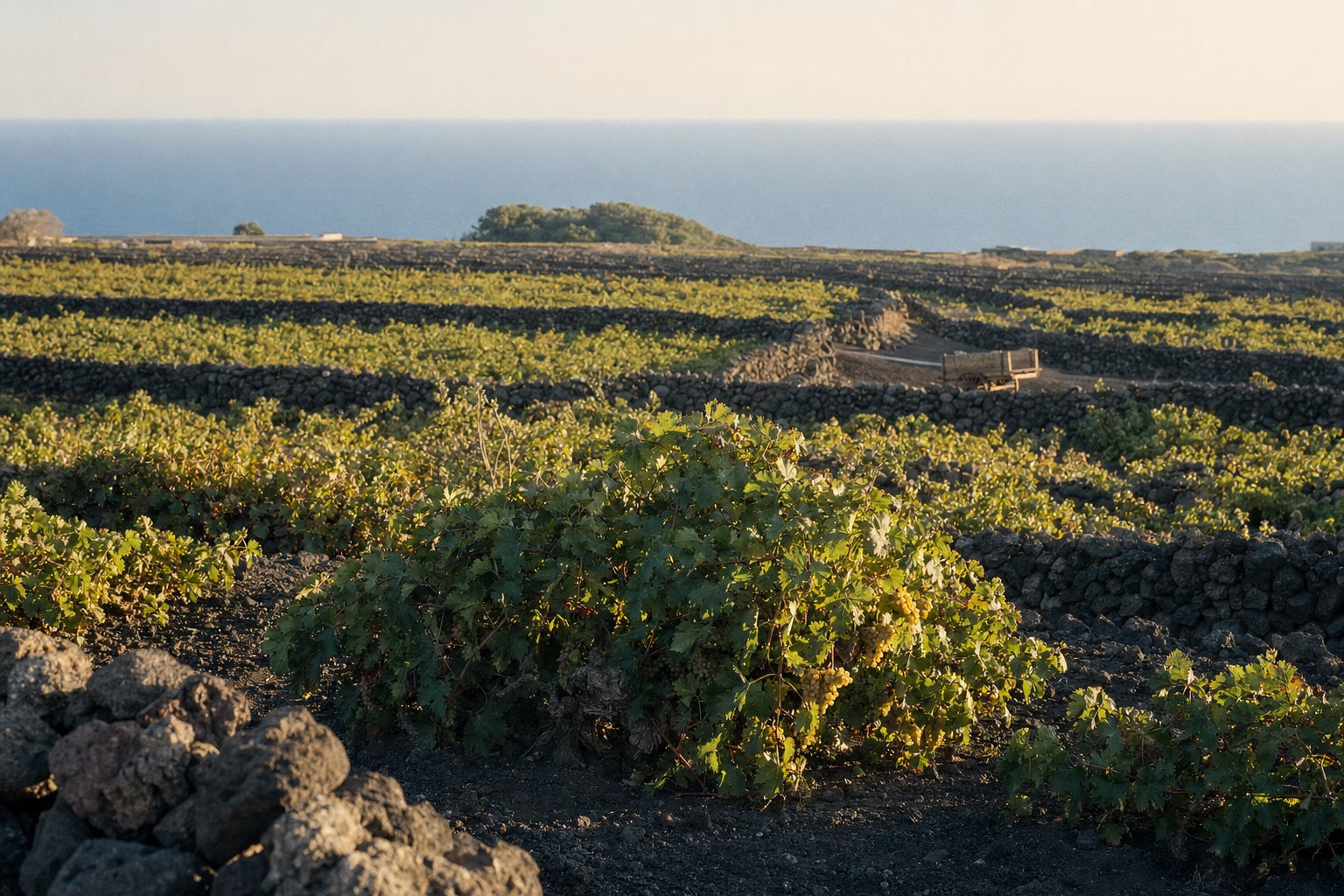
Pantelleria is sixty miles closer to Tunisia than it is to Sicily. It is a volcanic island shaped like a misshapen pumpkin, eighty-three square kilometres of black lava, dry-stone walls, capers, and grapevines pruned in low cushions called alberello. There is no real beach, no airport hotel, no McDonald's, no Hertz. There is a small airfield called Pantelleria-Marsala (LICG), a single road around the perimeter, four villages with no traffic lights between them, and approximately ten thousand stone houses called dammusi that have been there, in roughly the form you find them in, since the Arabs ran the place a thousand years ago.
It is the Italian island that fashion knows about and almost nobody else does. Giorgio Armani has been there since the 1980s. Carla Bruni and Nicolas Sarkozy own a dammuso on the southern coast. Truman Capote wrote in one. The island is a Slow Food fortress, the Zibibbo grapevine cultivation here is on the UNESCO Cultural Heritage list, and the food is the best Italian food you have not eaten yet.
October is when you should go.
Why October
In August, every flight to Pantelleria is full and every dammuso costs €1,200 a night. In November the sea is cold and half the restaurants close. In May the scirocco — the hot southerly wind from the Sahara — can pin you indoors for three days at a time. October is the magic window: the sea is still 22°C, the wine harvest has just finished, the restaurants are still open, the tourists have gone home, the rosso pelusi tomatoes are at their best, and the volcanic fumaroles steam in the cold morning air. The light is the kind of light photographers move to islands to chase.
You will pay around 35 percent less than the August rate for the same dammuso. The strip is quiet. The restaurants are pleased to see you.
Getting There
There is a scheduled flight from Palermo and Trapani on a small ATR turboprop, three days a week. There is also a ferry from Trapani that takes nine hours and runs only in summer. Neither of these is what we recommend.
The right way is by light aircraft from Naples (LIRN), Catania (LICC), or Palermo (LICJ). Naples-Pantelleria is about 90 minutes on a Piper Meridian or a TBM, and 60 minutes on a Citation Mustang. Catania-Pantelleria is around 65 minutes, the most direct option for anyone coming via Sicily. Palermo is 35 minutes — you can have lunch in Palermo and dinner in Pantelleria.
Pantelleria airfield itself has a 1,800-metre asphalt runway, a tower, customs (you are entering Italy from a sometimes-extra-EU direction, depending on routing, so they like to wave at you), and one ground handler called Aero Pantelleria. There are two petrol pumps and one taxi rank. The taxi rank functions intermittently. We arrange a car for you in advance.
Three Italian operators we use for this run:
- A Naples-based operator with a fleet that includes a Pilatus PC-12 and a TBM 940. They know Pantelleria better than the islanders. Our default for this route.
- A Sicilian operator out of Catania running two Piper Meridians, owner-flown, the cheapest option for a small group, slower than the PC-12 but a more old-school feel
- A Roman jet operator with a Citation Mustang available for last-minute trips. Faster, slightly less special.
The standard return flight from Naples on the PC-12, three or four passengers, with the aircraft positioned for the weekend, runs around €5,400 to €6,200. From Catania on the Meridian, around €3,200. We will tell you which one matches your weekend.
Where You Stay
The dammuso is the entire point of Pantelleria. There are no real hotels in the modern sense. There is one small luxury operation called Sikelia that runs a clutch of restored dammusi as a discreet hotel — about €600 a night in October, breakfast included, very Aman-adjacent in feel. There is also a place called Monastero on the western coast that we like for its restaurant.
For the rest, you rent a dammuso directly. A dammuso is a single-storey, thick-walled, white-painted stone house with a domed roof, designed to stay cold in August and warm in February. The good ones have private terraces, walled gardens with capers and prickly pears growing wild, plunge pools, and an outdoor kitchen for grilling fish.
Three areas to know:
Khamma and Tracino, on the northeast coast. Highest density of restaurants, closest to the Specchio di Venere (the volcanic mirror lake — see below). This is where most first-timers stay.
Scauri, on the southwest. Quieter, more rustic, the dammusi are larger and cheaper, the restaurants are fewer, the sunsets are extraordinary. This is where the people who have been five times stay.
Rekale and Tracino, the inland southeast. Slightly higher up, slightly cooler, looking over Mursia and the volcano. Good if you have a car and like quiet.
We have direct relationships with three dammuso owners. October pricing for a four-person house with a private pool runs €380 to €620 a night, two-night minimum.
Where You Eat
This is the section that will sell you.
Il Principe e Il Pirata, on the northeastern coast, is the trattoria that everybody from Stefano Pilati to Diane Kruger eats at when they are on the island. The view is the long curve of the bay towards the volcano. The food is the food: spaghetti with bottarga and pistachio, rabbit with capers, ricotta-and-anchovy crostini that you should order extra of. The owner is called Giovanni. The menu is whatever was caught and picked that morning. Around €60-€85 a head with wine.
La Vela, on the Cala of Tracino. Smaller, more refined, the kind of place where the chef sends out an extra course of lobster ravioli because you ordered a good wine. The owners are a husband-and-wife team. Reservations are essential and friendly. Around €100 a head.
Donnafugata Khamma is the wine estate's restaurant. Donnafugata is one of the great Sicilian wine houses, and their Pantelleria estate produces Ben Ryé, the passito di Pantelleria sweet wine that wine writers run out of adjectives over. The estate restaurant is a long pergola, the food is the simple-but-impeccable thing the Italians are very good at, and you taste through their wines on a bench at sunset. The Ben Ryé alone is reason enough to fly.
Il Cappero in Tracino, owned by the chef Gabriele Lasagni, has a Michelin star and is the destination dinner for serious eaters. Tasting menu around €130, paired wines extra.
For lunch the move is one of the dammuso terraces, with a table set up by your host or by the local cook we book for you. The local cook is a woman called Anna. Anna will pick herbs from your garden and produce a meal that you will think about in February.
Things You Will Want To Do
The thing about Pantelleria is that it is genuinely beautiful and you will want to be outdoors. The list:
Specchio di Venere (Mirror of Venus), the volcanic crater lake on the north of the island, milk-blue, ringed by white mineral mud that you smear on yourself and let dry in the sun. This is the one island activity you must do. It is most beautiful at 8 am or in the hour before sunset. There is no entrance fee.
The Sauna of Benikulà, a natural steam cave on the western flank of the volcano. You hike for fifteen minutes through olive groves, you crawl into a small lava cave, and you sit in 40°C steam for as long as you can stand it. The view as you walk back down the hill is the entire western coast.
The hot springs at Gadir — natural sea-water pools by the harbour, heated by volcanic vents, swimmable in October when the air is cool. There is a small bar.
The high road, which goes around the rim of the volcano (Montagna Grande, 836m) and gives you the view of the southern coast that everyone photographs. Forty-minute drive each way. Bring a sweater.
A boat day with a local skipper called Alessandro, who runs a fast wooden gozzo from Scauri. Around the island in five hours, with lunch on board, swim stops at the Elephant Arch and the Balata dei Turchi cliffs. Around €750 for the boat for the day, four people.
We arrange all of these. We have the contacts.
The Numbers
Indicative pricing as of April 2026. Operator rates move with fuel, weather, and date — we always send three real quotes before you commit.
A four-person, three-night, late-October trip — return from Naples on a Pilatus PC-12, dammuso with private pool, driver, dinners and a boat day — looks roughly like this:
- Aircraft (return Naples–Pantelleria, including positioning): €5,500-7,500
- Handling and customs: €300-450
- Dammuso, four-person, three nights: €1,400-2,000
- Driver in Pantelleria for three days: €400-500
- Boat day (Alessandro and lunch): €750-900
- Three dinners + two lunches at home with Anna: €1,800-2,400
- Sulu concierge fee: €450
- Typical total: €10,500 to €13,500
That works out around €2,600 to €3,400 per person for a long weekend on the most photographed island in Italy that nobody you know has been to. The dammuso alone, in August, will be the entire budget. The aircraft is roughly half the cost — but on a route where the alternative is two days of ferries and ATRs from Sicily, the time saved is most of why you are flying.
Honest Caveats
The wind on Pantelleria is real. Scirocco from the south is the hot, sand-carrying wind that can pin you in the dammuso for forty-eight hours. Maestrale from the northwest is cooler and shorter. October is mostly maestrale; scirocco events are typically two-day windows. Check the forecast. We do.
The water is volcanic. The "beaches" of Pantelleria are mostly black lava platforms with iron ladders down into deep blue water. There is no white sand. If you wanted white sand you should have gone to Formentera, which we also organise.
The roads are narrow, the rental cars are small, and the locals drive small Fiats at speeds that you should not try to match. We provide a driver. The driver is called Marco. Marco knows everyone.
There is no nightlife. There are about three bars on the entire island. The whole island is in bed by midnight. This is the correct answer.
We Send People Here Most Weeks In October
The dammuso owners we work with hold five-day blocks for us through October. The two operators we trust on this route position aircraft to Naples and Catania every weekend in season. If you tell us four dates, we can usually find one that lands close to the lower end of the bracket above.
Message us on WhatsApp or Telegram. Pantelleria is one of the easier sells on this site — and one of the trips that, more than any other, the people who do it tend to do every year afterwards.