Scotland is about to ask a very thin region to house and move a very large workforce. If you are a project manager or travel coordinator on a subcontract anywhere between Fort Augustus and Lerwick, the hard part of 2027 may not be the work. It may be finding construction crew accommodation in the Highlands and getting people to it every week without the rota falling apart.
This guide pulls together what is public as of October 2026: the projects, the accommodation plans, and the practical routes in. Dates and consents move, so treat every status below as "check before you commit".
How many workers will Scotland's grid build-out need?
SSEN Transmission's own 2024 housing strategy estimated that its site workforce would peak in 2027 at around 5,000 workers, across its major north of Scotland projects. It also said local labour is likely to be a relatively small share of that total, because of the scale and remoteness of the work. Those were October 2024 estimates, and SSEN flagged a significant margin of error on projects still early in development.
Read that as an order of magnitude, not a forecast to the head. The point for you is the mix. SSEN's strategy says it expects accommodation villages, new-build housing, redeveloped buildings and local hotels and rentals to be used together. Hotels and rentals are expected to absorb peak demand above the purpose-built provision, and to house infrequent visitors to site.
That last group includes you. Subcontractors who arrive for a two-week package are exactly the people who end up in the hotels and holiday lets that the strategy itself says councils may resist. The strategy document is public on SSEN Transmission's website and worth reading before you price a rota.
The projects and where they stand
Skye Reinforcement. A new 132kV double-circuit line from Fort Augustus to Broadford and on to Edinbane, with the Broadford and Edinbane substations extended. Section 37 consent was announced in June 2025 and SSEN lists the project as in construction. Balfour Beatty won the first phase in 2024, and the announcement at the time quoted up to 650 people at peak. Recent site news includes junction works on the A87 at Old Corry Road, Broadford, from 1 September 2026, and 44 welfare cabins delivered to Edinbane substation in September. Details are on the project page.
Western Isles HVDC link. A converter station and substation on Lewis, subsea cable from Arnish Point to Dundonnell, then underground cable to a converter near Beauly. SSEN lists it at stage 3 of 5, project refinement, with planning applications being finalised. Mainland compound works are already running along the A832 and near Beauly. A local newspaper report of a community council meeting quoted SSEN putting peak construction at about 350 workers for the link and on-island works. That figure is secondhand, so ask the principal contractor for the current number.
Shetland. Shetland Islands Council said in June 2026 that SSEN may need a workforce of about 1,500 on the islands, for three to five years from 2028. The work includes a northern substation hub near Toft, a second subsea HVDC cable to the mainland, and a substation on Yell for wind farm connections.
Others. Outside SSEN's network, SSE's Coire Glas pumped storage scheme near Loch Lochy has no final investment decision at the time of writing. If it proceeds it will compete for the same beds in the Great Glen. Treat it as a possible future draw on capacity, not a plan.
Where do crews sleep when the villages are not built yet?
For now, mostly in whatever exists. That means hotels, B&Bs, holiday lets and the odd refurbished building, in places where tourism already fills them from April to October.
The purpose-built answer is the workers' village. Their status varies by site, and none of it is settled enough to plan a rota around.
- Ashaig, Skye. Balfour Beatty proposed a workers' village at Ashaig, near Broadford (Highland Council reference 25/02051/FUL). A revision in June 2026 reduced the footprint and moved to double-storey blocks. Comments closed on 29 June 2026, and SSEN's project page shows the application as undecided.
- Torrin Road, Broadford. The application for a second temporary village was withdrawn in October 2025 after community feedback. SSEN said it would look for another site and consult first.
- Portree. SSEN is exploring a site at Kiltaraglen with Lochalsh & Skye Housing Association for temporary workforce housing. No planning application has been submitted.
- Stornoway, Lewis. A temporary village for up to 200 workers was applied for in early 2026, with use planned from mid-2027 to 2030. Check consent status.
- Sella Ness, Shetland. An existing 426-room accommodation block near Sullom Voe, operated by Sodexo. Councillors approved a ten-year extension to the end of 2035. In late 2024 about 300 oil and gas workers were already staying there, so do not assume it has spare rooms.
Shetland is also looking at accommodation barges, work camps and up to 150 legacy housing units. Council officials said SSEN gave a figure of about 40 minutes as the maximum distance from the work.
The planning lesson from Skye is simple. A village that is not consented is not a bed. If your programme depends on one, you need a fallback in writing.
The 2027 squeeze, in practice
You are not only competing with other contractors. You are competing with tourists, anglers, walkers and cruise coach itineraries on Skye, and with oil and gas contractors in Shetland. SSEN's strategy itself notes that tourism capacity across its area is limited.
Three things follow.
- Block-book early and for longer than you think. A venue will usually prefer one booking for a season to a string of five-night stays.
- Expect distance. A crew sleeping in Portree for a job near Broadford, or in Fort William for a job near Invergarry, adds a long daily drive on single-carriageway roads.
- Budget for the swing. When your team's hotel is full in July, the alternative may be a different town, and the extra mileage is a cost.
How do you get a crew to Skye?
By road from Inverness, which takes around two and a half hours to Broadford in good conditions, or by air to a small strip beside Broadford. Rail runs to Kyle of Lochalsh on the Kyle line and to Mallaig on the West Highland line, with a van or minibus for the last stretch.
The road is the pinch point. The A87 through Glen Shiel is the main route onto the island, and a closure there is felt immediately. When it shut in both directions after a collision in 2023, the published diversion ran by the A890 and A832, which is a long way round. Check Traffic Scotland before any crew change, and keep a second pickup plan for the rota day. The Mallaig to Armadale ferry is the other way onto the island, with seasonal timetables and limited vehicle space, so book it if you intend to rely on it.
Skye in focus: Broadford and the airstrip
Broadford airstrip (Ashaig) is a single paved runway, 07/25. Sources put its length at about 770 to 800 metres, so confirm the figure with the operator rather than trusting a listing. A 2007 CAA report noted no precision approach, which is why weather matters. It sits next to Ashaig, the same hamlet that Balfour Beatty's proposed workers' village is named after. If a village is built there, a short taxi from a flight to a bed is a real possibility, though nothing is confirmed.
A short runway limits what you can charter. The operator has to check performance for the actual payload and wind before it agrees an aircraft. Our guide to flying to Skye by private aircraft covers the aircraft and what they carry. For a crew with tool bags and PPE, weight is the first constraint, so say how much baggage there is when you ask for a quote.
How do you get crews to Shetland and the Western Isles?
By ferry or by scheduled flight, and in both cases capacity is the issue, not speed. Loganair and the ferries carry most of the traffic, and neither has much slack.
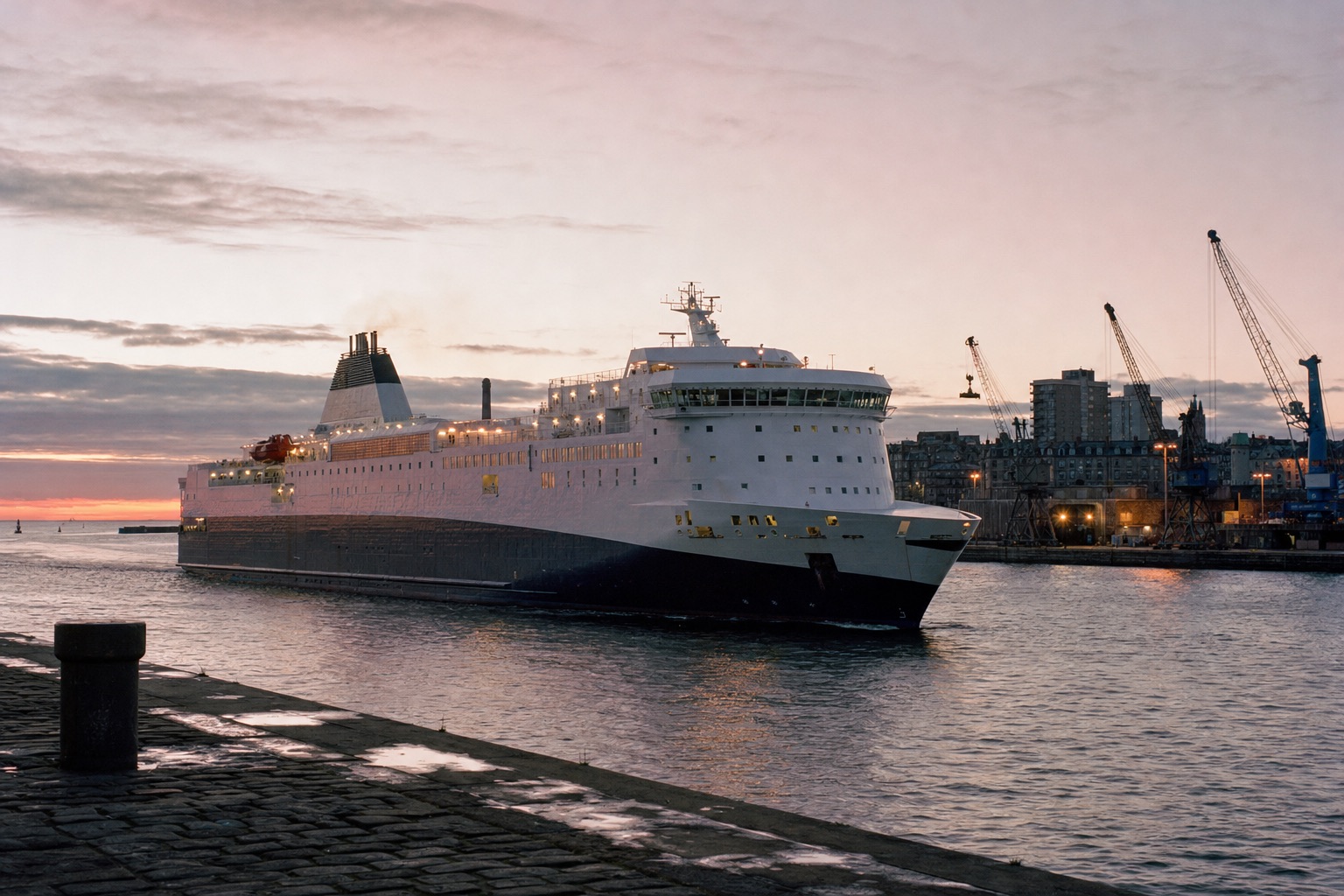
Shetland. NorthLink runs an overnight Aberdeen to Lerwick service, with some sailings calling at Kirkwall. The published 2026 timetable shows departures around 17:00 or 19:00 from Aberdeen and arrival in Lerwick at about 07:30. Cabins and freight space sell out, and winter weather cancels or retimes sailings. Loganair flies to Sumburgh from several mainland airports, including Inverness, but its Inverness services were cut to weekends only from 20 July 2026. The airline said full frequency would return from 26 October 2026, but this depends on funding, so check the live timetable before committing a rotation. Sella Ness is in the north mainland, well over an hour by road from Sumburgh.
The Western Isles. The CalMac Ullapool to Stornoway crossing takes about 2 hours 40 minutes. Vehicle spaces often sell out in summer. The Loganair Inverness to Stornoway flight takes roughly 45 minutes in the air and was cut to one flight each weekday from July. The same restoration date, 26 October 2026, applies, and it depends on funding.
Quick comparison by region
| Region | Main project | Usual routes in | What to watch |
|---|---|---|---|
| Skye | Skye Reinforcement | A87 from Inverness or Fort William, Mallaig ferry, Broadford airstrip | Single main road, Ashaig village not yet decided |
| Lewis | Western Isles HVDC link | CalMac Ullapool to Stornoway, Loganair from Inverness | Vehicle space in summer, reduced flights until 26 October |
| Shetland | Second HVDC link and northern hub | NorthLink from Aberdeen, Loganair to Sumburgh | Cabin availability, weather retimings, long drive north |
| Great Glen | Coire Glas (if approved) | A82, A87, rail to Fort William | Possible competition for beds, no decision yet |
Planning checklist for a rotating crew
Rotations fail at the edges: the day a flight is cut, the night a ferry is retimed, the week the hotel changes its mind. A few habits help.
- Fix the beds first, then the travel. Where people sleep decides which airport or port makes sense.
- Hold a second route for every crew change. Road and ferry, or flight and ferry. Do not rely on one daily service.
- Build in a buffer day at each end. Weather moves ferries and light aircraft. Plan the rota so a missed day does not strand a crew mid-package.
- Book accommodation for the whole programme. Rolling five-night bookings lose to season-long contracts.
- Get weights early. Baggage and tooling decide which aircraft and vehicle types are possible.
- Check consents, not press releases. A village with a planning application is not a village with planning permission.
- Write down who calls it. One named person decides when a crew change moves, and everyone knows who it is.
For the wider picture on moving crews around Scotland when things go wrong, see our disruption playbook for crews and our comparison of crew charter flights in Scotland.
Who makes the calls
Crew travel is a logistics problem with a lot of small decisions in it. Which flight is still running. Which hotel can take twelve people on a Thursday. Whether the aircraft can actually get that baggage into Broadford.
That is the work we do at Sulu. We use the best information available, check it against a person who knows the route, and decide quickly, because the answer is usually needed the same day. Our business crew travel service is built for exactly this kind of rota, and Sulu for business explains how it works.