Croatian charter fleets are large, standardised and mostly quite young, which is good news — there are far more decent boats than there are terrible ones. The question is not really which brand, because the differences between a Bavaria and a Dufour of the same year and size are smaller than the brochures suggest.
The question is size, layout, and three specification details that most people do not think to ask about until they are aboard.
Start With How Many Cabins, Not How Many Feet
The single most useful thing to understand: a boat's advertised capacity and its comfortable capacity are different numbers, and the gap is where charter weeks go wrong.
A 45-foot monohull with four cabins sleeps eight in cabins and will be listed as sleeping ten with the saloon converted. Eight people on that boat is a full boat. Ten is a boat where two adults sleep in the walkway, everyone queues for two heads, and the fridge runs out on Wednesday.
Our rule, and it is a rule rather than a preference: one cabin per couple, and never count the saloon. Then choose the length that gives you those cabins.
| Group | Monohull | Catamaran |
|---|---|---|
| 2–4 | 38–42 ft, 2–3 cabins | 40 ft, 3 cabins |
| 5–6 | 45–47 ft, 3–4 cabins | 44–46 ft, 4 cabins |
| 7–8 | 50–54 ft, 4–5 cabins | 47–50 ft, 4–6 cabins |
| 9–12 | Two boats, or a crewed yacht | 50–54 ft, 6 cabins |
Nine or more on one bareboat is where we generally suggest either two boats sailing together, which is more fun than it sounds, or stepping up to crewed.
The Boats Croatian Fleets Actually Run
Bavaria Cruiser 46 — The Workhorse
The most common charter boat on the Adriatic and, for a group of six, usually the right answer. Four cabins, two heads, a wide beam that gives it a genuinely spacious saloon, and a cockpit big enough that eight people can eat in it without choreography.
It is not an exciting boat to sail. It is beamy, it is not close-winded, and it will not thrill anyone who races. What it does is carry six people and their luggage comfortably, forgive an out-of-practice crew, and get fixed quickly when something breaks, because every base has the parts.
Roughly €5,500–7,500 a week in June, €7,500–10,000 in August.
Elan Impression 45 — The Better Sailing Boat
Slovenian-built, so local to the region, and a noticeably better sailing boat than the equivalent Bavaria. Stiffer, points higher, more responsive on the helm. If anyone in the group actually sails and will be disappointed by a floating apartment, this is the one to look for.
The trade-off is slightly less interior volume for the same length. Around a €300 to €600 premium over a comparable Bavaria.
Dufour 460 Grand Large — The Comfortable Compromise
French, well finished, better joinery than the German and Slovenian equivalents, and a cockpit layout that works well at anchor. Sails better than a Bavaria, has more space than an Elan. It is the boat we suggest most often when a group cannot decide.
Bavaria Cruiser 41 — The Budget Option That Actually Works
Three cabins, one or two heads, right for four people or five at a push. Meaningfully cheaper — often €3,500 to €5,000 in June — and for two couples it is entirely adequate.
Where it stops working is six people. It is done at four, comfortable at five, and cramped at six.
Lagoon 46 and Fountaine Pajot Saba 50 — The Catamarans
Four to six cabins, enormous deck space, a saloon on the same level as the cockpit, and no heeling. For families with children, groups containing people who do not sail, or anyone prone to seasickness, the case for a catamaran is strong and we make it fairly often.
The costs are the case against. €13,000–18,000 a week in June for a 45-footer, rising sharply in August. Berthing runs 1.5 to 2 times monohull rates because marinas charge on width and a cat takes two berths. And in a Croatian marina in August, a catamaran berth is the one most likely to be unavailable at all.
We go through the full comparison in Catamaran vs Monohull.
The Three Details Nobody Asks About
This is the part worth the reading time. Two boats of the same model and year, at the same base, at the same price, can produce very different weeks depending on these.
Bimini and sprayhood. In July and August the Adriatic sun in an unshaded cockpit is genuinely punishing, and the difference between a boat with a full bimini and one without is the difference between eating lunch in the cockpit and eating it below. Not all charter boats have one. Ask specifically, and ask whether it can stay up while sailing.
Air conditioning and the generator. Croatian August nights below deck are hot. Air conditioning that only runs on shore power means it works on the nights you are in a marina and not on the nights you are at anchor, which are the nights you wanted it. If a boat is advertised with air conditioning, the question is whether it has a generator to run it off the dock. This one detail moves the price and it is worth paying for in August, less so in May or October.
Year of the sails, not the year of the boat. A 2022 hull can have a 2018 mainsail that has been flogged by four seasons of charter crews. A tired, baggy main turns a good sailing boat into a motorboat with a mast. Ask for the year of the sail wardrobe separately from the year of the boat.
Add to those the general questions we recommend for any charter contract — boat name and hull identification number, last antifoul, dinghy outboard type — covered in Hidden Costs of Yacht Charter.
Where to Base Yourself
Split has the largest fleet choice in Croatia and puts Hvar, Brač, Vis and Šolta within a comfortable first day. Handover day is busy and the marina is chaotic on a Saturday in August, but the cruising is the best on the coast.
Trogir is fifteen minutes from Split airport, calmer at handover, and opens onto the same waters. For a first Croatian charter this is usually where we send people.
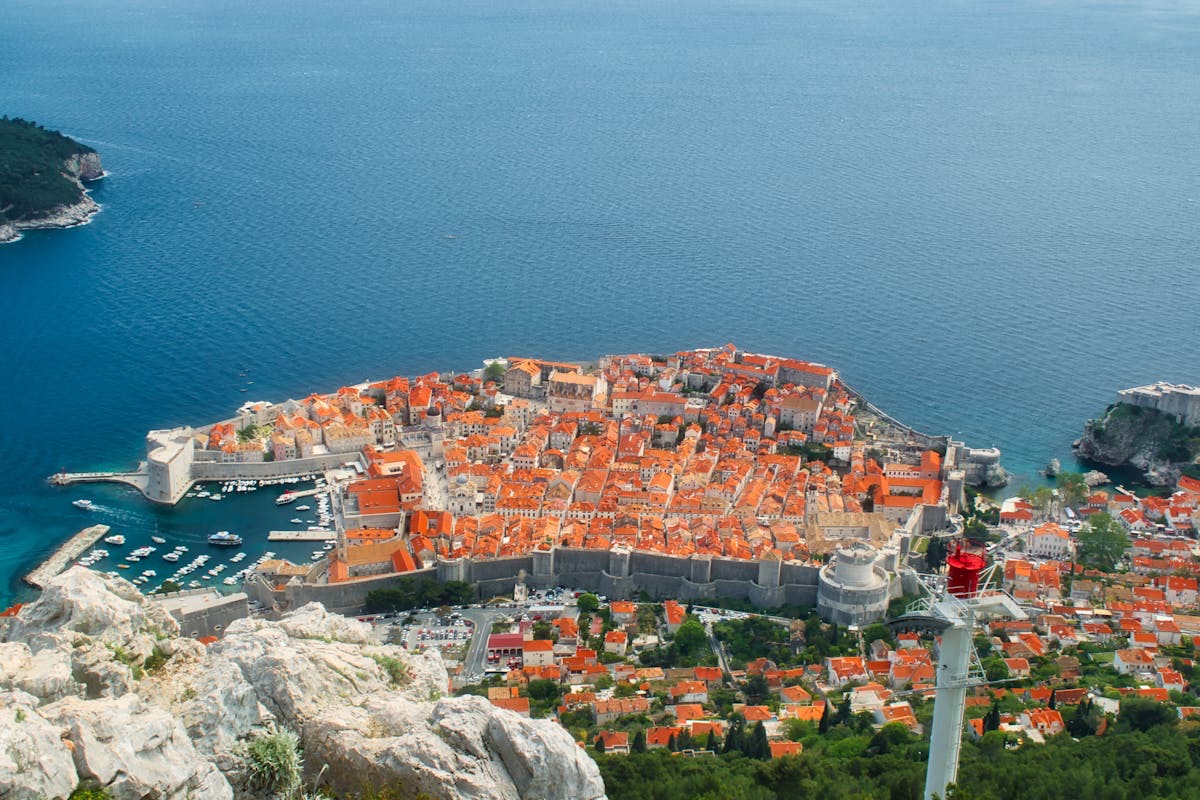
Dubrovnik is a beautiful city and a mediocre one-week base. The good sailing — the Elafiti, Mljet, Korčula — runs north, and a week from Dubrovnik spends its first and last days repositioning. For ten days or two weeks it makes sense. For seven it does not.
Zadar and Biograd open onto the Kornati archipelago, which is emptier and more dramatic than the southern islands and has fewer restaurants and less nightlife. For a quieter week with strong sailing, it is underrated.
The Croatia Route Planner has four worked itineraries with maps, and the Croatia Sailing Guide covers the islands themselves.
What It Adds Up To
Six people, mid-June, Bavaria Cruiser 46 out of Trogir, is roughly €6,500 for the boat. Then transit log, tourist tax, end cleaning, fuel and five or six marina nights, which realistically adds €1,800 to €2,600. Call it €8,300 to €9,100 all in, or around €1,450 a head for the week.
The same week in August on the same boat is closer to €11,000.
If you want the boat checked rather than described — the actual hull, the actual sails, the actual bimini — that is what we do. Tell us the group size and the week and we will come back with three specific boats, named, with the total cost of each. From £200 per request.