The Isles of Scilly sit 28 miles off Land's End, and getting there is a puzzle with three moving parts: a short runway, a ferry that sails once a day, and fog that does not care about your plans. Most visitors take the train to Penzance and then either the Scillonian ship or a Skybus flight from Land's End. That works. It also turns a 30-minute hop into most of a day.
A private flight to the Isles of Scilly can cut that to about three hours from London. It only works if the aircraft, the airport and the last mile all line up, and a few common assumptions are wrong. Light jets, for one.
Can you fly privately to the Isles of Scilly?
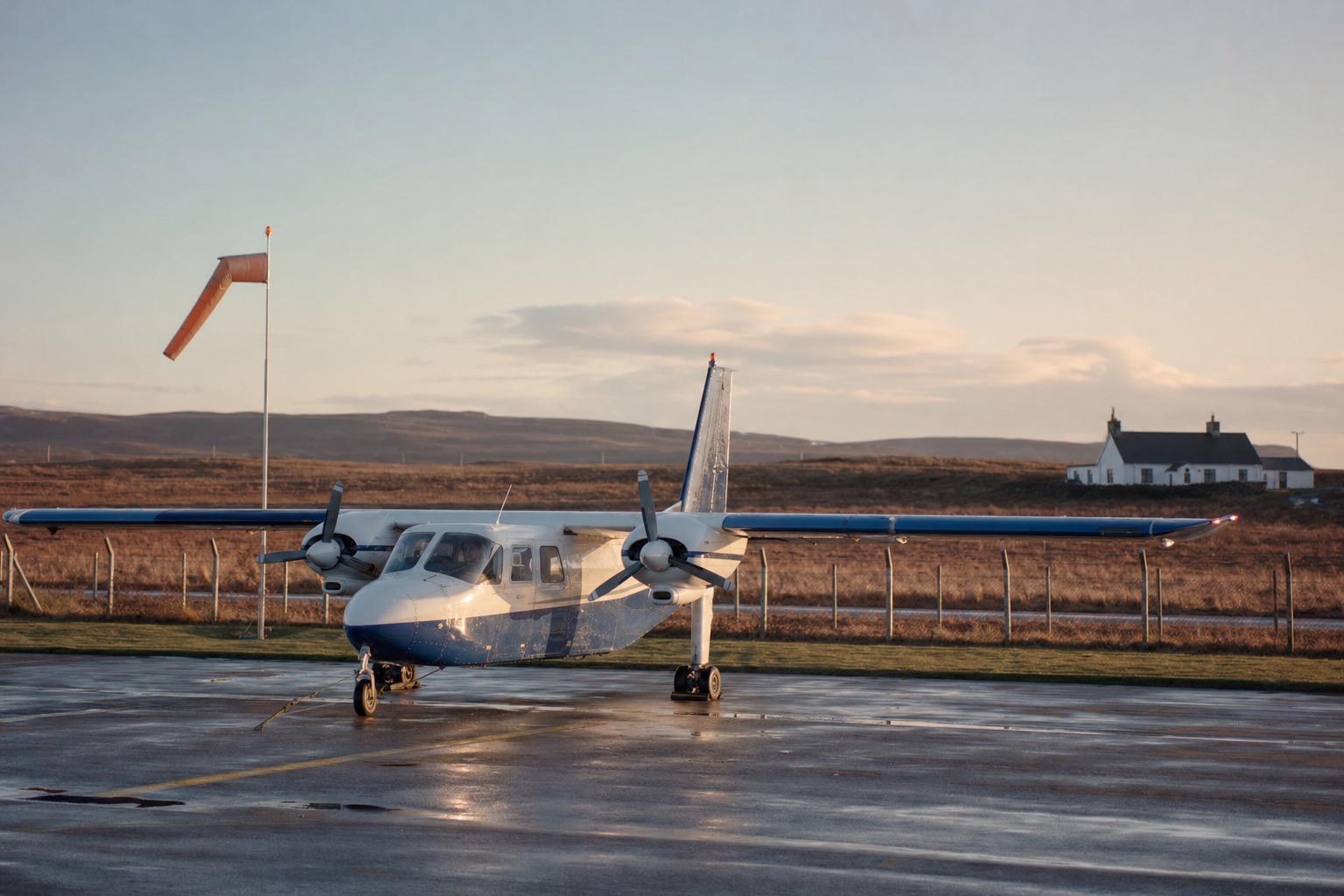
Yes, but the island airport limits what can land there. St Mary's (EGHE) is the only airport in the islands, run by the Council of the Isles of Scilly, and it accepts visiting aircraft with prior permission. The runways are short, the nearest fuel is on the mainland, and the aircraft that do the job every day are Islanders and Twin Otters.
The airport's two asphalt runways are 14/32 (23 m wide) and 09/27 (18 m wide). Published lengths disagree: SKYbrary lists 600 m and 523 m, while Wikipedia gives 694 m and 525 m. The council says the authoritative declared distances sit in the UK AIP (AD 2 EGHE-4), and that gradients reach 1:33 at the runway ends. Whichever figure is right, it is a short strip with a slope.
That decides the aircraft:
- Islander and Twin Otter. Skybus flies both to St Mary's every day, so these are proven. Skybus describes its Twin Otters as 19-seaters; the Islander is smaller, at roughly eight or nine seats.
- Single-engine turboprops and King Airs. Possible in principle, but the operator has to show the performance numbers against the AIP distances for the weight and weather on the day. Some will say yes, some will say no.
- Light jets. We would treat these as a no. Citation-class aircraft need more runway than St Mary's offers, and there is no margin for a go-around on a wet day. Fly the jet to a long runway and finish the trip another way.
- Helicopters. Not constrained by the runway. Wikipedia lists a grass helipad on the airfield, and Penzance Helicopters flies scheduled services to both St Mary's and Tresco.
For the logic of when a smaller aircraft beats a faster one, see turboprop vs light jet.
St Mary's Airport: hours, PPR and what it lacks
St Mary's does not behave like a business airport. The council's general aviation page sets the terms, and they matter for planning.
Prior permission is required. The PPR form goes by email to air traffic control, at least two hours ahead. ATC replies with approval, the landing fee and a payment reminder. Payment is by bank transfer. Your operator handles this, but it is worth knowing the notice is short and the fee is quoted case by case.
Hours are tight and there is no Sunday. As published, summer hours are Monday to Saturday, 08:00 to 18:30. Winter hours are Monday to Friday, 08:15 to 12:15 and 13:15 to 17:30, plus Saturday 08:15 to 12:15. The airport is closed on Sundays and hours can change by NOTAM. The page does not say which dates count as summer, so confirm with ATC.
No fuel. The council says plainly that there is no Avgas and no fuel of any kind, no hangarage and no engineering. A visiting aircraft carries fuel for the return, which eats into payload.
Approach aids. The page lists an NDB on 321 kHz (ident STM) and PAPI lights on both runways. A non-precision aid means higher weather minima than a big airport, which is the root of the fog problem later in this guide.
Customs. Flights from outside Great Britain need a General Aviation Report. Domestic flights do not.
Visitors are not allowed in the ATC building, and there is no lounge. Ground handling is basic, so a pre-arranged transfer does the job of a terminal.
How long does it take to fly to Scilly from London?
About three hours door to door by private aircraft, against seven to ten by public transport. The two sensible private routes are a direct flight in an Islander-class aircraft, or a faster turboprop to Land's End or Newquay with a short hop on top.
London to St Mary's is roughly 250 nautical miles from a south-east London airfield. In a PC-12 or King Air that is about an hour and a quarter. In an Islander at a typical cruise it is nearer two hours. These are our own estimates from distance and typical speeds, not operator timetables.
Land's End (EGHC) is the natural stepping stone. It belongs to the Isles of Scilly Steamship Company, has a 784 m asphalt runway (Wikipedia) and a CAA private use aerodrome licence that, per that listing, covers daytime use only. Skybus flies to St Mary's from there in about 20 minutes. Check PPR with the airfield before you rely on it, because published sources disagree.
Newquay (EGHQ) is the long-runway option. Cornwall Airport Newquay has a 2,744 m runway, and its aerodrome page shows 06:45 to 21:30 hours from Monday to Saturday (07:00 on Sundays) for the 2026 summer period. It takes jets without strain. The catch is the onward leg. Skybus suspended Newquay to St Mary's flights until 31 August 2026, citing crew and aircraft shortages, and moved passengers to Land's End. We could not confirm the current status, so check before building a trip on it.
| Route | Flight time (est.) | Door to door, central London (est.) | Fits |
|---|---|---|---|
| Islander or Twin Otter, London area to St Mary's | About 2 hours | About 3 to 3.5 hours | Up to 9 (Islander) or more (Twin Otter), no transfers |
| Turboprop to Land's End, then Skybus | 1h15 plus 20 min | About 3 hours | 4 to 8 people, one change |
| Jet or turboprop to Newquay, then Skybus | 1 hour plus 30 min | About 3.5 hours | Only if the Newquay service runs |
| Train to Penzance, then Penzance Helicopters | 20 min (heli) | About 7 hours | 1 to 3 people, value |
| Train to Penzance, then Scillonian ship | About 2h45 at sea | 9 to 10 hours | Cheapest, weather-tolerant |
The train time is the biggest variable in the lower rows, so treat them as a rough comparison rather than a promise. The Scillonian crossing figure comes from ferry listings, which vary. The helicopter flight is 15 to 20 minutes depending on the source.
For picking the London end, which London airport suits a private flight walks through Farnborough, Biggin Hill, Luton and the small fields. For south-east London, Biggin Hill is the usual start. The same island logic applies to the Channel Islands, which we cover in our small-aircraft guide.
What happens when fog closes St Mary's?
Flights get cancelled, and usually late. Scilly is the classic fog-grounding destination in UK aviation. Isles of Scilly Travel, which runs Skybus, defines weather to include fog and reduced visibility, and says affected flights are generally cancelled within two hours of departure. It also warns that good visibility at one end tells you nothing about the other end or the alternate.
That is the real planning problem. You can wake up to a clear Surrey sky and a closed St Mary's, and the decision lands when you are already airborne or at the airfield.
Four habits make a difference.
Build a second route. The Scillonian ship sails from March to November and is the usual fallback when flights stop, though it has its own weather limits. 2026 is the current ship's last season: Scillonian IV is due in March 2027 with room for 600 passengers.
Know which operator is covering you. Penzance Helicopters states that it may cancel or delay, and that it does not cover accommodation or meals after a cancellation. It also says the EU's passenger-rights rules do not apply to helicopters. Read the terms before you rely on an easy rebooking.
Keep the stay flexible. A day trip with a fixed return is the riskiest version. If the return must happen today, plan the same-day fallback, whether that is a hotel on St Mary's or an alternative mainland landing.
Choose the season. Winter hours are shorter (see above) and there is less daylight to recover a delayed flight, so summer gives you more room. Fog itself can turn up in any month.
Tresco, the off-islands and the last mile
Tresco is car-free, and the transfer is the part that catches people out. Vehicles stay on the mainland. On arrival, Tresco's staff meet you and run a free electric shuttle to your accommodation, according to the island's travel guide. There is no public transport.
The three ways in:
- Direct by helicopter. Penzance Helicopters flies from Penzance Heliport to Tresco in about 15 minutes. Touchdown to doorstep is a few minutes. It is the fastest and most direct route, and the Tresco Estate describes it that way.
- Via St Mary's. Land by air at St Mary's, take the airport-to-quay transfer, then a scheduled boat to Tresco. Tresco's travel page lists £12 return for the transfer and £7 single for the boat, and offers private boat transfers for a supplement. Prices change, so confirm.
- Scillonian, then a boat. Sail to St Mary's, wait for the onward boat, and tag your luggage at Penzance Quay so it goes straight to Tresco.
Tresco asks guests to send a pre-arrival form, because the island does not receive arrival details from transport providers.
The other islands, Bryher, St Martin's and St Agnes, are reached by inter-island boat from Hugh Town quay, on timetables set by the boat operators from day to day. Flying into St Mary's then hopping by boat is the standard way, and the boats do not run in rough sea.
A day trip is possible. Penzance Helicopters' day trip product allows up to nine hours on the islands, and its 2026 day trip fares run from roughly £149 to £199 per person return, depending on how early you book. The Tresco Abbey Garden and the beaches are the usual draws. The catch is the one above: a fixed same-day return is the riskiest fog bet.
The Penzance Helicopters service has been run by Starspeed, part of the Luxaviation Group, since November 2022. We found no published charter pricing for the Scilly route, so a dedicated helicopter charter is a quote request, not a fixed product.
How much does a private flight to the Isles of Scilly cost?
Expect roughly £4,000 to £10,000 return for a whole aircraft carrying a small group, before landing fees, VAT and positioning. That is a market planning range, not a quote.
The maths comes from hourly rates. Our UK small-aircraft charter cost guide puts a PC-12 at about £1,600 to £3,400 an hour and a King Air 200 from about £1,400. A turboprop to Land's End and back is around two and a half to three hours of flying plus the Skybus leg, which lands in the middle of that range. An Islander-class twin direct to St Mary's flies for longer. We found no published Islander charter rate, so that line is the least certain.
| Option | Indicative figure | What it covers |
|---|---|---|
| Whole turboprop, London area to Land's End and back | £4,000 to £10,000 (market range) | Aircraft only, 4 to 8 people |
| Islander-class twin direct to St Mary's | Quote only | Up to 9 people, no change |
| Train plus Penzance Helicopters day trip | About £149 to £199 per person plus rail | Operator's 2026 day trip fares |
| Skybus or Scillonian | Published fares | Scheduled seats, not a private aircraft |
Add the St Mary's landing fee, which ATC quotes with the PPR approval, plus Skybus seats or a private boat transfer where relevant. If the party is one or two people, the helicopter or Skybus is almost always the better value. A whole aircraft pays off for four or more, or when the trip is time-critical.
We can sort the route
Scilly is a trip where the logistics are the hard part, and the hard part changes by the hour. The airport, the weather window, the aircraft that fits, the way onto Tresco: each depends on the others.
Sulu uses the best intelligence available to research what can land, what is flying and which route holds up if the fog rolls in. Then people make the calls: to the operator, ATC, the boat and the hotel. Fast, and checked by a person before it reaches you. If the morning changes, we rework the plan, not you.