The French Riviera is the most expensive stretch of coastline in the Mediterranean. It is also the most glamorous, the most photographed, and for the right kind of week, the most rewarding. This guide explains what a French Riviera yacht charter actually costs in 2026, where to berth, when to go, and what to expect when you cross between France, Monaco and Italy in a single afternoon.
If you are still at the "is this worth it" stage, start with our Mediterranean charter guide and the yacht charter cost breakdown first. This article assumes you have decided the Riviera is where you want to be, and now you want to know how it actually works.
Why the Riviera Is Priced Differently
Everywhere else in the Mediterranean, the cost of a charter is driven by the boat. On the Riviera, the cost is driven by where you stop.
A 45-foot sailing yacht that charters for 4,000 euros a week in Croatia will charter for 5,500 to 7,000 euros on the Riviera. That is a 30 to 70 per cent premium for the same boat. Once you start looking at crewed motor yachts, the gap gets wider. A 30-metre crewed motor yacht that runs 75,000 euros a week in Greece will run 110,000 to 140,000 euros on the Riviera in July and August.
Then there is the berthing. A night in Porto Cervo in Sardinia will cost you 400 euros. The same night in Port Hercule Monaco in season will cost 1,500 to 2,500 euros for a 30-metre yacht. In Saint-Tropez peak week, a 35-metre motor yacht pays 2,000 to 3,000 euros a night to berth in the old port. Multiply that across a week and the berthing alone can match the cost of a decent bareboat charter anywhere else in the Med.
None of this is a scam. The Riviera has limited berth supply, very high demand, and a short season. The premium is real and it prices itself.
Real 2026 Charter Costs
Here is what you can expect to pay for a week on the Riviera in 2026, excluding APA.
| Yacht type | Size | Peak week (Jul-Aug) | Shoulder (May, Sep) |
|---|---|---|---|
| Bareboat monohull | 40-45 ft | 5,500-7,500 EUR | 3,500-5,000 EUR |
| Bareboat catamaran | 42-48 ft | 9,000-14,000 EUR | 6,000-9,500 EUR |
| Crewed sailing yacht | 50-60 ft | 25,000-40,000 EUR | 18,000-28,000 EUR |
| Crewed motor yacht | 25-30 m | 90,000-140,000 EUR | 60,000-95,000 EUR |
| Crewed motor yacht | 35-45 m | 180,000-350,000 EUR | 120,000-230,000 EUR |
| Superyacht | 50 m+ | 450,000 EUR+ | 300,000 EUR+ |
Add APA on top. APA (Advance Provisioning Allowance) covers fuel, food, drinks, berthing, ice, flowers and crew groceries. On Riviera crewed charters it runs 30 to 35 per cent of the base fee, higher than the 25 to 30 per cent typical of Greece or Croatia because fuel and berthing are both more expensive here. For a 25-metre motor yacht at 100,000 euros a week, budget 30,000 to 35,000 euros APA.
French VAT (20 per cent) applies to charters that start in France and cruise in EU waters. There is a structured exemption for charters that spend part of the week in international waters, which most brokers will explain. If you start in Monaco, Monaco has no VAT, which is one of the reasons so many charters begin at Port Hercule.
The Seven Ports You Need to Know
Monaco (Port Hercule and Port de Fontvieille). The Riviera's party piece. Port Hercule sits directly under the palace and hosts everything from 15-metre boats to 150-metre superyachts. Fontvieille is the smaller second port on the west side. Both are glamorous and both are expensive. A 30-metre motor yacht pays roughly 1,200 to 2,500 euros a night in Port Hercule in season. During the Monaco Grand Prix that number is not a real number. It is whatever the auction lets it be.
Cannes (Vieux Port and Port Canto). Cannes Old Port is the working heart of the city, right on the Croisette. Port Canto is five minutes east and quieter. In season, expect 400 to 900 euros a night for a 25-metre yacht in Vieux Port, more during the Film Festival in mid-May.
Antibes (Port Vauban). The largest marina in Europe and the home of the "Quai des Milliardaires", the row of berths that hosts the world's largest private yachts. A 30-metre boat in Port Vauban runs 500 to 1,000 euros a night. If you are not on a superyacht, Antibes is the most practical base on the Riviera: good restaurants, a walkable old town, decent provisioning.
Saint-Tropez (Vieux Port). Still the most photographed berth in Europe. It is small, loud, and completely booked between mid-July and late August. Vieux Port is stern-to the quay, right on the Place du Port. In peak week, a 30-metre boat will pay 1,800 to 2,800 euros a night and will be lucky to get the slot at all. Book months out or stay in the bay.
Villefranche-sur-Mer and Cap Ferrat. Villefranche is the deepest bay on the Riviera and arguably the most beautiful. There are no marina berths for medium or large yachts, just mooring balls and anchoring. You take the tender ashore. Most of the Riviera's best anchorages are on this stretch: Villefranche bay, Beaulieu, the tip of Cap Ferrat, and Passable on the west side.
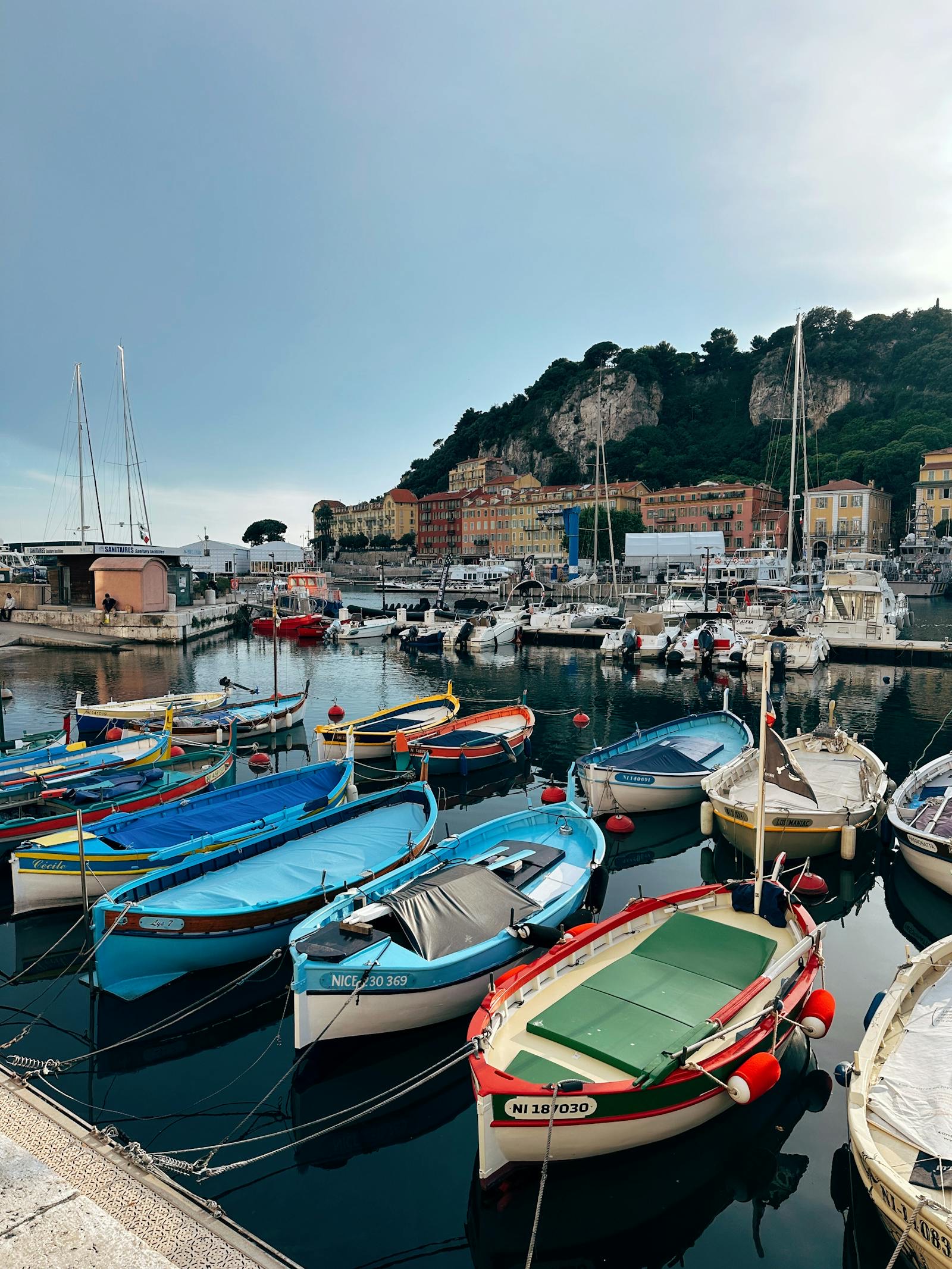
Nice (Port Lympia). Smaller than Cannes and Antibes, usually the cheapest berth on the coast. Good for a night if you need proximity to the airport. Expect 300 to 600 euros a night for a 25-metre yacht.
Menton. The last port before the Italian border. Underrated and usually available. Lovely old town, quieter than anywhere west of Monaco, good base for a morning run into Italy.
When to Go
The Riviera season runs from late April to early October. Here is the honest calendar.
Late April to mid-May. Warm enough, quiet, the best value of the year. Water is still cold (18-19 degrees) and not everyone will want to swim. Restaurants are opening up. Good for couples and mature groups.
Mid-May (Cannes Film Festival). The Festival runs roughly 13 to 24 May 2026. Cannes is impossible. Berths are booked a year out. Prices are 50 to 100 per cent above normal. Every surrounding port fills up with overflow. If you are not specifically going for the festival, avoid this week.
Late May. Water warming up, weather settled, crowds thin. One of the best windows of the year.
4 to 7 June 2026: Monaco Grand Prix. The 2026 Monaco Grand Prix has been moved to early June, the first time the race has run in June in decades. Berth requests at Port Hercule had to be submitted by 27 February 2026 with a 300-euro non-refundable booking fee. Berths for sub-25-metre yachts start around 20,000 euros for the race weekend and reach 50,000 euros for premium locations. A berth with direct sightline of the track costs 100,000 to 150,000 euros. Superyachts pay more. Charter yachts chartered specifically for the race weekend run 30,000 to over a million euros for the week depending on size.
Mid-June to mid-July. Peak conditions start. Water at 22-24 degrees. Everything is open. Prices are full but availability still reasonable.
Mid-July to late August. Absolute peak. Hot (28-32 degrees air, 25-26 water). Every berth full. Prices at their highest. The Mediterranean has not been this crowded since last year. Book 6 to 12 months in advance.
September. The best month of the year on the Riviera if you can wait. Warm water, warm air, thinning crowds, restaurants still open, prices dropping 15 to 25 per cent from peak. If you are booking late, read our last-minute yacht charter guide and aim for the first two weeks of September.
Early October. Season winding down. Restaurants in smaller ports start to close. Weather can turn. Not a bad week but the risk of a rain day is real.
A Practical Seven-Day Itinerary
This is a classic week that balances the iconic stops with the quieter anchorages, assuming you are on a 25 to 35-metre crewed motor yacht starting from Monaco.
Day 1 (Saturday): Monaco to Villefranche. Boarding at Port Hercule around 4 pm. Champagne, briefing, light cruise to Villefranche bay. Dinner on board, swim off the back of the boat. 8 nautical miles.
Day 2 (Sunday): Villefranche and Cap Ferrat. Morning anchorage at Passable on the west side of Cap Ferrat for swimming. Lunch on board. Afternoon at Paloma Beach or Plage de Passable. Evening back to Villefranche or on to Beaulieu. 12 nm.
Day 3 (Monday): Villefranche to Îles de Lérins. Long cruise west past Nice, Antibes and Cannes to the Îles de Lérins (Saint-Honorat and Sainte-Marguerite), the two small islands just off Cannes. Anchor between them. Tender ashore to Saint-Honorat for the monastery and the monastery wine. Dinner on board at anchor. 32 nm.
Day 4 (Tuesday): Lérins to Saint-Tropez. Cruise west along the Esterel massif, the red rock coast between Cannes and Saint-Tropez. Lunch at anchor in the Calanques d'Anthéor or at Agay. Into the Gulf of Saint-Tropez by mid-afternoon. Anchor in the bay or berth in Vieux Port if you booked it. Evening ashore. 38 nm.
Day 5 (Wednesday): Saint-Tropez Peninsula. Day cruise around the Saint-Tropez peninsula. Pampelonne Beach for lunch (book a restaurant ashore: Club 55, Loulou, La Réserve). Afternoon anchorage off Plage des Salins or Plage de l'Escalet. Evening back in Saint-Tropez or anchored off. 15 nm.
Day 6 (Thursday): Saint-Tropez to Cannes. Cruise back along the Esterel. Anchor at Île Sainte-Marguerite for lunch and a final swim. Afternoon into Cannes. Berth in Vieux Port, walk the Croisette, dinner ashore. 38 nm.
Day 7 (Friday): Cannes to Antibes to Monaco. Morning cruise to the Cap d'Antibes. Anchor off Plage de la Garoupe or Billionaires' Bay. Lunch on board. Afternoon back to Monaco for final night. 22 nm.
Day 8 (Saturday): Disembark Monaco. Breakfast on board. Off by 10 am.
Total distance: approximately 165 nautical miles over seven days, well within the capability of any motor yacht and comfortable for a crewed sailing yacht with good conditions.
Crossing Borders: France, Monaco, Italy
The Riviera sits at the point where three countries meet. You can technically cross all three borders in an afternoon. What you need to know:
France to Monaco. Technically a border crossing but practically invisible for charter purposes. Monaco is not in the EU but has an open customs arrangement with France. No formalities when you arrive.
France to Italy. Crossing into Italian waters is a real border. You pass Menton and enter Italy around Ventimiglia. For charters staying for a single day and returning, most crews handle it quietly. For longer stays in Italy you need to clear in and pay Italian port dues. If your charter starts in France, check whether your contract allows cruising into Italian waters. Many do, specifically so you can take advantage of the French VAT exemption rules.
The VAT point. Charters that start in France and spend a defined percentage of the week in international or non-EU waters qualify for a reduced VAT rate. This is why so many Riviera charters make a one-day run into Italian waters or a sunset cruise beyond 12 miles. Your broker will structure this into the itinerary automatically. You do not need to do anything except enjoy the cruise.
Documents. Passports for all guests and crew must be on board at all times. Monaco marinas occasionally run spot checks. EU citizens do not need to clear in when crossing between France and Italy, but non-EU citizens (including UK passport holders) technically should, and in practice rarely do on short charter visits.
Riviera vs Other Mediterranean Destinations
For comparison with the other Med destinations we cover, here is how the Riviera stacks up.
| Destination | Typical week cost (crewed 30m) | Marina fees | Food ashore | Crowds |
|---|---|---|---|---|
| French Riviera | 90,000-140,000 EUR | Very high | Very high | Very high |
| Italian Riviera | 85,000-130,000 EUR | Very high | High | High |
| Sardinia (Costa Smeralda) | 80,000-120,000 EUR | Very high | High | High |
| Amalfi Coast | 85,000-130,000 EUR | High | High | Very high |
| Croatia | 55,000-85,000 EUR | Moderate | Moderate | High |
| Greece | 45,000-75,000 EUR | Low | Low-moderate | Moderate |
| Turkey | 40,000-65,000 EUR | Low | Low | Moderate |
The Riviera is 50 to 100 per cent more expensive than Croatia for equivalent yacht and experience. The difference buys you three things: the shore scene, the specific places (Saint-Tropez, Monaco, Cap Ferrat) that cannot be replicated, and the quality of the food and hospitality infrastructure. Whether that is worth double the cost depends entirely on what you actually want out of the week.
Who the Riviera Is For
It is not for everyone. The Riviera rewards a specific kind of charter: short distances, frequent port visits, long lunches ashore, a high density of social moments. If your idea of a sailing holiday is anchoring alone in a quiet bay and reading a book, you will be happier in the Ionian or the Cyclades.
The Riviera is at its best when you want to eat at Club 55 on Pampelonne Beach, walk the Croisette in Cannes, berth next to the yachts you have seen in magazines, and finish the week with dinner at the Louis XV in Monaco. It is social, visible and photographed. That is the point.
How Sulu Helps
Booking a Riviera week without making a mistake requires three things most people do not have: knowledge of which brokers have the right boats, knowledge of which berths are actually bookable in season, and the time to compare five real quotes across the same dates.
We handle all of that. Tell us the week, the group, and roughly what you want the days to look like. We come back within 48 hours with three options across the right boat sizes, real berthing availability at the ports you care about, the VAT structure explained in plain English, and the APA estimated honestly rather than optimistically.
If you want to understand the booking cycle first, read our guide on the best time to book a yacht charter. If you are already sure about the dates, message us on WhatsApp or Telegram and we will start on the shortlist today.