A private flight from London to Courchevel can end beside the ski slopes, on a runway that climbs at 18.6% and gives you no second chance. It can also end at Chambéry, with a helicopter waiting. Most broker quotes default to the second. This is what the first one actually involves.
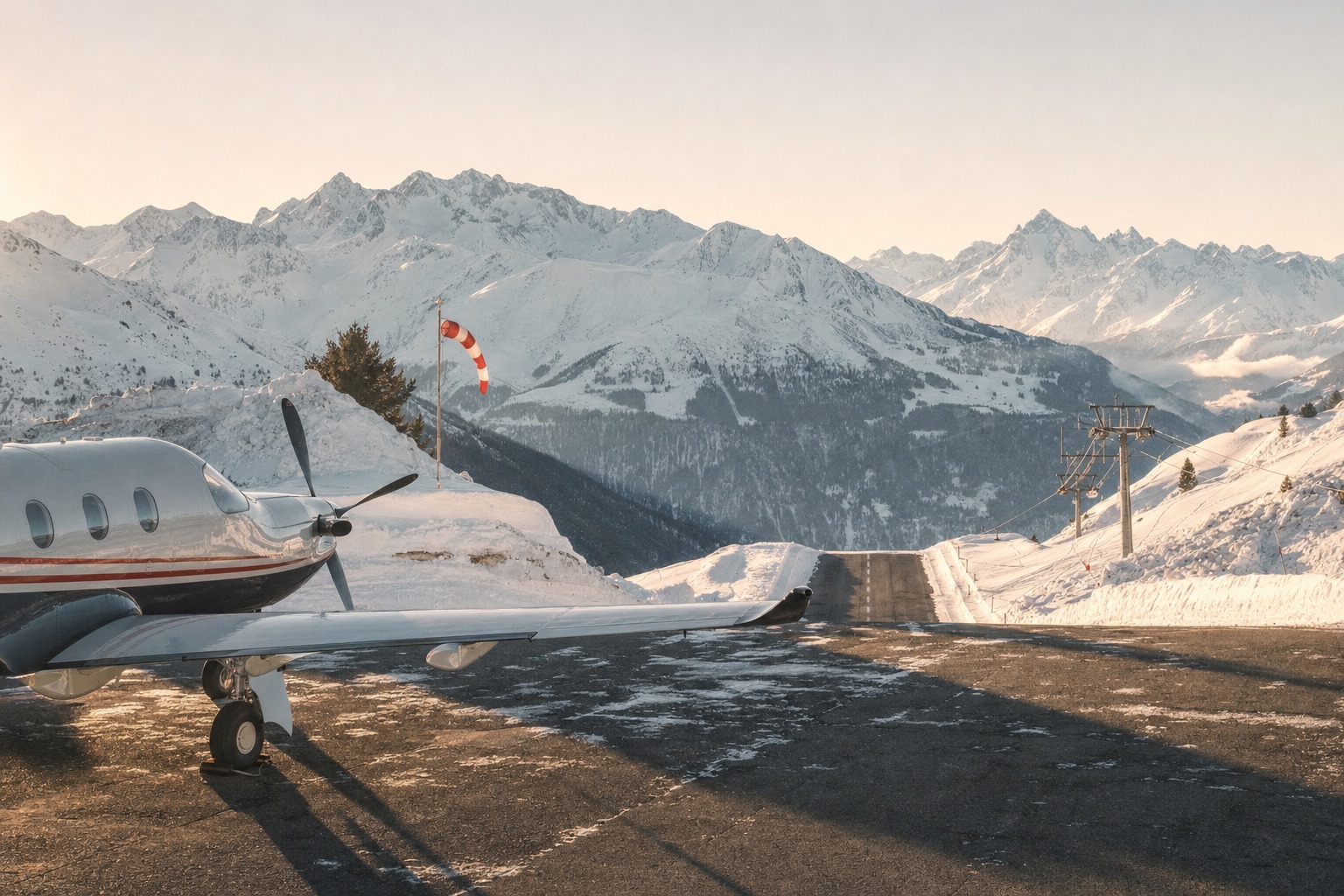
Can you fly a private plane straight into Courchevel?
Yes, but only in a turboprop (a Pilatus PC-12 or similar) flown by a pilot with a specific altiport access authorisation, and French rules make ordinary charter of such an aircraft difficult. For most London parties the practical route is a jet to Chambéry or Geneva, then a helicopter of 20 to 35 minutes.
The restriction is not about the size of your wallet. Courchevel (ICAO code LFLJ) is a restricted-use airfield. The French AIP text we have seen says public transport operations with aeroplanes need approvals from the operator's own regulator plus a separate authorisation from the French civil aviation authority for that altiport. It is also why PrivateFly notes that most commercially chartered fixed-wing flights are restricted, while owners can land in their own aircraft. That AIP extract dates from 2014, so treat the detail as background and ask for the current position.
So there are three ways to arrive by fixed-wing:
- Alpine Airlines. A French operator based at the altiport, with a French air operator certificate and a twin-engine fleet. On its own site it says it is the only airline authorised to use Courchevel and Megève, and lists flight times from Courchevel of 15 minutes to Chambéry, 18 to Geneva and 1 hour 25 to Paris. It runs more than 400 flights a year there. Whether it will take a London origin is a question for them.
- An aircraft you own or co-own. The 2024 accident report we cite below involved a Belgian members' club flying under non-commercial rules. Around 800 flights to Courchevel in five years came from that one club.
- A helicopter, which can use the altiport without the same restrictions.
Everything else is a jet landing somewhere else. If you want the gentler first mountain landing, our piece on Megève by plane covers the alternative.
The altiport: 537 m, 18.6% slope, no go-around
Courchevel's runway is about 537 metres long and sits at roughly 2,000 metres above sea level. The official chart shows a slope of 18.66% over most of its length, which is a little over 10 degrees. You land uphill on runway 22 and take off downhill on runway 04. The slope does the braking.
There is no instrument approach, no runway lighting and no go-around. The valley walls rule out a second attempt. If the approach is wrong at the threshold, you are landing anyway. That makes it daylight, visual flying only.
The French investigation bureau (BEA) describes the technique in its report on a 2024 PC-12 accident. Pilots overfly the strip first to check the surface, parking and the two windsocks. They then fly a wide turn to a long final, hold 85 knots in a PC-12 in calm wind, and aim at the middle of the bank below the threshold, so the wheels touch at the runway markings. The one rule the report repeats: never go below the threshold height before the threshold.
The airfield has an AFIS information service rather than a control tower, and keeps its runway clear of snow through the winter. Opening hours are limited and can be extended by agreement with the operator, and no one lands after dark. Check the altiport's own site for webcams, NOTAMs and the winter 2026-27 tariff.
Méribel (LFKX) is the next altiport along. Its runway is 406 metres at a slope of about 11%, and it also requires special training. It is a leisure strip, not a charter option, and we mention it only so the name does not confuse you.
Which aircraft and pilots are allowed to land at Courchevel altiport?
Propeller aircraft and helicopters only, flown by pilots who hold either a French mountain flying qualification or an altiport access authorisation from a mountain flight instructor. Jets are not permitted, and the authorisation is tied to the type or class of aircraft the pilot trained on.
The relevant French order dates from June 2019 and was updated in 2023. The training must now be done at an approved or declared training organisation. Because the order sets themes rather than a minimum number of landings, the instructor decides how long the course lasts.
For the PC-12, Alpine Airlines runs a two-day course: 2 hours 30 of theory and about 3 hours of flying, starting from Chambéry. It is available all year, and the company suggests avoiding December to April for scheduling and cost. Price is on request.
Why this matters to you as a passenger. In February 2024 a Belgian-registered PC-12 hit the bank below the runway threshold on landing, lost its left wing and came to rest in the snow. The two pilots had minor injuries. The BEA concluded the approach was unstable and cited the captain's limited mountain experience, a practical access course it judged short, and a co-pilot with no mountain experience to monitor the approach. The captain had held his authorisation for about a month and was on his third Courchevel flight. The BEA also noted earlier events (2017, 2019, 2021, one of them fatal) where short training was a factor. The operator then restricted altiport flights to captains with the full mountain flying qualification.
That is useful, practical guidance. Before you accept a direct Courchevel flight, ask:
- Does the captain hold the full mountain flying qualification, or only the access authorisation?
- How many Courchevel landings in the last season, and when was the last?
- Is the second pilot also mountain-experienced?
- What is the weather cut-off, and who makes the call?
A good operator answers all four in one message. If the answers are vague, take the Chambéry route.
Altiport, Chambéry or Geneva: which is faster door to door?
The altiport is fastest by a distance when everything lines up: you step off the aircraft within minutes of the hotel. Chambéry with a helicopter is the dependable runner-up. Geneva adds a border and a longer transfer. The times below are from landing to the resort (our estimates, built from the sources), and the costs are published market starting prices, not quotes.
| Route | Last leg | Landing to resort | Market cost of last leg | Catch |
|---|---|---|---|---|
| Courchevel altiport (turboprop) | None | About 10 to 20 minutes | Landing fees (see tariff) | Small pool of aircraft and pilots; daylight only |
| Chambéry + helicopter | 20 to 25 min | About 45 to 60 minutes | From about €1,700 to €2,300 each way | Helicopter also depends on weather |
| Chambéry + car | About 100 km | About 1 hour 15 normally | A few hundred euros | Traffic can double on changeover Saturdays |
| Geneva + helicopter | 30 to 35 min | About 55 to 70 minutes | From about €2,750 each way | Cross-border formalities to plan |
| Geneva + car | About 179 km | About 2 hours | A few hundred euros | Saturday queues at the Swiss border |
Sources for the table: Alps2Alps for road and helicopter times and prices, PrivateFly for the €1,700 helicopter figure. Helicopters typically carry five passengers, so a party of six needs two or a split.
The weak point of the car routes is the N90 between Albertville and Moûtiers. On Saturday changeover days the same source says transfer times can double. A flight that saves you three hours in the air and returns them in a queue is not a good flight.
The air leg from London is roughly 430 nautical miles, about an hour and a half in a light jet and nearer two hours in a PC-12. Your handler confirms exact timings.
Where do you clear customs on a private flight from London to Courchevel?
Almost certainly at an airport with a border police presence before the final hop, and the Courchevel altiport itself needs to be confirmed in writing. Since Brexit a UK flight enters Schengen from outside, so your passports are checked at the first point of entry.
This is the one fact we would not state flatly, because the published sources disagree. One airport guide lists seasonal customs at the altiport on request. A pilots' forum thread from 2013 says Courchevel lost its customs service. The pages of the altiport's own site that we could read do not say. French customs designate the airports that can take flights from outside the EU, and a restricted-use altiport is not a standard entry point.
Our working assumption, until your operator confirms otherwise in writing: clear at Chambéry, whose business aviation terminal is set up for it according to broker listings, then fly the 15 minutes to the altiport as a domestic French hop. That also gives you a fuel stop, a weather check and a decision point (more below). Your handler files the border and customs notices, usually with a day or more of notice. Check the hours before you book, not after, because winter weekend cover can be shorter.
The return works the same way in reverse: the border check happens before you leave France, so allow for it in the departure time.
What happens when the weather closes the altiport?
You land at Chambéry or Geneva and continue by helicopter or car, which is why the sensible plan treats Chambéry as the base case and the altiport as the upgrade. Low cloud, strong wind or fresh snow on the runway can close Courchevel for hours or days, and there is no instrument approach to get you down through cloud.
The plan we would build for a London departure:
- Fly the jet or turboprop to Chambéry, clearing customs there.
- Check the altiport webcams, the AFIS report and the captain's judgement while on the ground.
- If the altiport is open and the pilot qualified, continue for 15 minutes. If not, helicopter, or car if the helicopter is also grounded.
Alpine Airlines keeps aircraft at Chambéry in winter for this kind of hop, and the helicopter operators cover the same airports. A helicopter is weather-dependent too, so keep a car booked as the third layer for a trip that matters.
Daylight is the other constraint. With no runway lighting, a late departure from London in midwinter ends at Chambéry, whatever the weather.
What it costs in the market
There is no fixed price for Courchevel. These are the market figures we found, shown with their sources, and the arithmetic is ours.
- PC-12 charter. Broker listings cluster between about €1,800 and €2,800 per flight hour (our small aircraft cost guide covers UK rates in more detail). London to Courchevel is about two hours each way, so a return is roughly four billable hours, or €7,000 to €11,000 before positioning, landing fees and handling. That is only relevant if you have found an operator with the right approvals.
- Jet to Chambéry plus helicopter. PrivateFly quotes a four-seat Citation Mustang from around €12,500 return to Chambéry, plus about €1,700 each way for a five-seat helicopter. At the higher helicopter prices quoted by other operators (€2,300 from Chambéry, €2,750 from Geneva), the return lands around €16,000 to €18,000 for up to four people.
- Landing fees are published on the altiport's winter tariff page and are the item that varies most by season.
Empty-leg flights toward Chambéry or Geneva are worth asking about for the jet leg, though you cannot plan a peak-week trip around one. Our empty leg guide explains why. If you are weighing a PC-12 against a jet more generally, turboprop vs light jet sets out the trade-offs.
When to book for Christmas and February half-term
Book as early as you can for any ski week, and be flexible about the day. Pilot numbers are small, the altiport is daylight-only, and the same weeks drive up helicopter and road demand.
The dates that matter this winter, from the French education ministry calendar: Christmas holidays run from 19 December 2026 to 4 January 2027. February holidays run by zone: 6 to 22 February (zone C), 13 February to 1 March (zone A) and 20 February to 8 March (zone B). Most English schools break for half-term in the week of 15 February 2027, which lands in the middle of all three. Check your own school's dates.
HelloJet notes that outside school holidays, in January or March, availability is wider and bookings can come together within days. Fly on a Sunday or midweek in a peak week if you can, and avoid Saturday road transfers unless you are in the air above them.
We make the calls so you do not have to
Courchevel is a good example of why we exist. The decisions that matter here are not in the brochure: which pilot holds which qualification, where the border check happens, what the weather will do at 10 am on Saturday, and who is on the phone when it changes. We use the best live information available, then people who pick up the phone and make the call.
You tell us the date and the party. We come back with a plan that has a plan B built in, and we tell you if Chambéry is the better answer. See what we arrange on our private aviation page.