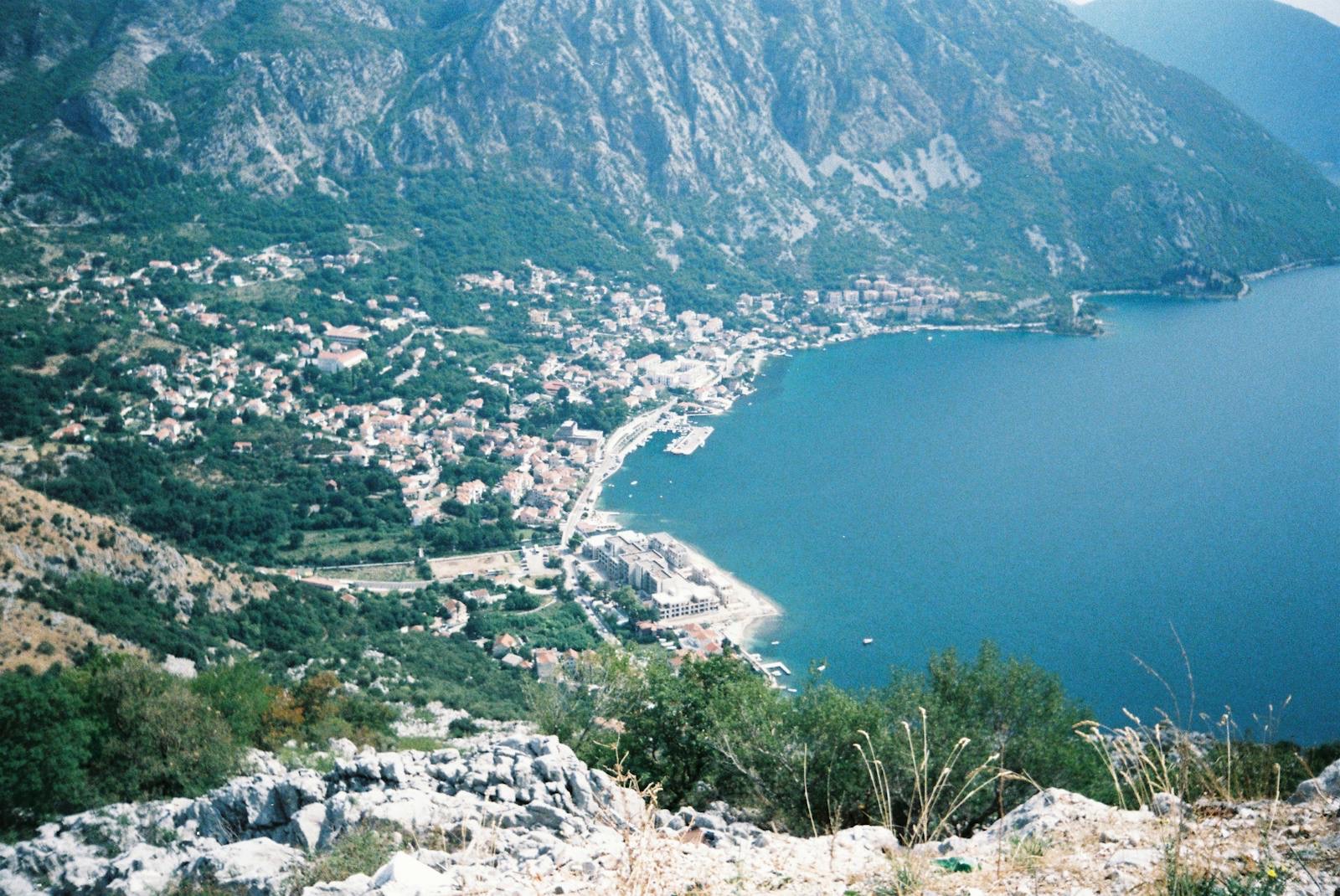
Montenegro is the best-kept secret in Adriatic sailing. Thirty kilometres south of the Croatian border, you find the same clear water, the same pine-covered coast, a deeper and more dramatic bay than anywhere in Croatia, and prices that are 30 to 40 per cent lower. The reason Montenegro is quieter than Croatia is not that it is worse. It is that most charter fleets are based in Croatia and the border is a minor inconvenience. This guide explains how to get past the inconvenience and enjoy what is arguably the best single week of cruising in the Adriatic.
If you are already considering Croatia, read our Croatia sailing guide first, then decide whether to cross the border for a few days or make Montenegro the whole trip.
Why Montenegro Is Worth the Effort
Start with the Bay of Kotor. It is the only fjord-like formation in the Mediterranean, a 28-kilometre deep bite out of the coast lined with mountains that rise 1,700 metres straight out of the water. UNESCO protected, Venetian-flavoured, and genuinely different from anywhere else in the Adriatic. You cannot sail into it without realising you are looking at something unusual.
Then there is Porto Montenegro in Tivat, one of the best-equipped marinas in the Mediterranean. Built from a former naval base, it has 450 berths, can host yachts up to 250 metres (some of the longest private yachts in the world have spent time here), and has the infrastructure and service levels of Monaco at a fraction of the cost. It is also the easiest place in Europe to combine a marina stay with a proper resort week.
The coast south of the bay runs past Sveti Stefan (the famous island-hotel that every postcard of Montenegro has on its cover), Budva (the old town, walled, Venetian, touristy but good), and down to Bar and Ulcinj near the Albanian border. None of this is as well known as the Dalmatian coast, which is exactly why it is less crowded and cheaper.
Finally, the prices. A bareboat sailing yacht that rents for 4,500 euros a week in Split rents for 3,000 to 3,500 euros in Bar. A restaurant meal that costs 45 euros a head in Hvar costs 25 to 30 euros in Budva. Fuel, marinas, taxis, everything is cheaper. You save meaningful money by moving a border south.
What It Actually Costs
Here is what to budget for a Montenegro week in 2026, excluding APA for crewed boats.
| Yacht type | Size | Peak week (Jul-Aug) | Shoulder (Jun, Sep) |
|---|---|---|---|
| Bareboat monohull | 40-45 ft | 3,000-4,500 EUR | 2,200-3,500 EUR |
| Bareboat catamaran | 42-48 ft | 5,500-8,500 EUR | 4,000-6,500 EUR |
| Crewed sailing yacht | 50-60 ft | 15,000-25,000 EUR | 11,000-18,000 EUR |
| Crewed motor yacht | 25-30 m | 55,000-85,000 EUR | 38,000-60,000 EUR |
| Crewed motor yacht | 35-45 m | 110,000-200,000 EUR | 75,000-140,000 EUR |
For comparison, the equivalent 30-metre crewed motor yacht runs 90,000 to 140,000 euros a week on the French Riviera in peak season. Montenegro is roughly 30 to 40 per cent cheaper for the same boat, the same week, the same experience quality.
Marina fees are the other major saving. Porto Montenegro is the most expensive berth in Montenegro and it is still cheaper than Hvar or Split in peak season. Most ports outside Porto Montenegro are half the price of their Croatian equivalents. See the marina table later in this guide for specifics.
Clearing In: Customs, Vignettes and How It Actually Works
This is the bit that puts most bareboat charterers off, and it should not. Clearing into Montenegro is more straightforward than clearing into most Caribbean countries and takes roughly 30 to 90 minutes if you do it at the right marina.
Ports of Entry. Montenegro has four official Ports of Entry for yachts: Bar (the southernmost), Zelenika (Herceg Novi area, just past the Croatian border), Tivat (where Porto Montenegro is), and Kotor (at the head of the bay). Yachts arriving from Croatia almost always clear in at Zelenika or Tivat. Zelenika is fastest if you are passing through. Tivat, specifically Porto Montenegro, is the most comfortable because customs and immigration are on-site at the marina.
What you need. Passport for each person on board, boat papers (registration, insurance), the crew list from wherever you started. If you are on a bareboat charter from Croatia, your charter company will give you the crew list and the cross-border paperwork before you leave their base.
The vignette. Every foreign yacht in Montenegro must buy a vignette (cruising permit), even if you are just stopping for fuel. The fee is based on length, rig type, and how long you want the permit to run. As a rough guide for 2026:
| Boat type | 3 days | 7 days | 30 days |
|---|---|---|---|
| Sailing yacht 10-15 m | 50-90 EUR | 90-160 EUR | 180-300 EUR |
| Motor yacht 10-15 m | 75-130 EUR | 140-250 EUR | 280-450 EUR |
| Sailing yacht 15-24 m | 140-220 EUR | 260-400 EUR | 500-800 EUR |
| Yacht 24 m+ | Per-metre rate | 400 EUR+ | 1,000 EUR+ |
Pay directly to the Harbour Master's office by card. Stick the sticker on the boat somewhere visible (the crew will know where). The vignette is checked occasionally by coastguard.
Tourist tax. On top of the vignette, you pay a small tourist tax per person per night, around 1 euro per adult per night. This is collected at check-in.
Total extra cost for a typical bareboat week: vignette plus tourist tax plus roughly 50 to 100 euros for agent services if you use one, totalling 300 to 500 euros for a 45-foot boat with six people on a seven-day cruise. Against the saving on the charter itself, this is well worth it.
If you are on a crewed charter, the captain handles all of this and you never touch it. The cost goes through APA.
The Seven Ports That Matter
Porto Montenegro (Tivat). The headline marina. 450 berths, 24-hour customs, supermarket, shipyard, 64-metre pool, yacht club, high-end restaurants, and direct flights from London via Tivat airport (15 minutes). Night fees for a 15-metre yacht run 80 to 130 euros depending on season; 25-metre motor yachts pay 200 to 400 euros a night. For context, the equivalent berth in Porto Cervo Sardinia is double.
Kotor (Marina Kotor and old town quay). The headline view. Tucked at the head of the bay under a Venetian wall that climbs the mountain behind the town. Marina Kotor is small (around 100 berths, mainly for sub-20-metre yachts), so larger boats anchor out or berth stern-to the town quay. Night fees: 70 to 120 euros for a 15-metre yacht, anchoring is free. Old town is touristy in the day but quiet after 10 pm.
Portonovi Marina (Herceg Novi). The newest marina in Montenegro, opened 2020, at the mouth of the bay. High-end (One&Only resort attached), quieter than Porto Montenegro, good first stop after clearing in at Zelenika.
Herceg Novi. A Venetian town at the very entrance of the bay. Less polished than Kotor, less touristy, good base if you want to eat in a proper Montenegrin restaurant rather than an expat one. Anchor off and tender in.
Budva. The biggest resort town on the coast, 20 km south of Tivat. The old town is genuinely beautiful. The nightlife is loud. Anchoring off is free and common; the marina is small and usually full. Good for a single night, maybe two.
Sveti Stefan. The famous island-hotel. You cannot land on Sveti Stefan itself (it is a private hotel), but you can anchor off in the bay and swim ashore to the adjacent beach. The photograph you have seen of Montenegro is almost certainly of Sveti Stefan at sunset. Worth the detour.
Bar and Ulcinj. The southern end of the coast, close to Albania. Less visited, quieter, worth a day each if you want to see a side of Montenegro that is not on the tourist map.
A Practical Seven-Day Itinerary
This itinerary assumes a bareboat charter starting from Dubrovnik (the nearest major charter base) and making Montenegro the focus of the week. You can also charter from Bar or Tivat directly, but the Croatian fleet is larger so Dubrovnik is the more common start.
Day 1 (Saturday): Dubrovnik base to Zelenika. Board in the afternoon, provisioning, short hop across the border to clear in at Zelenika. 15 nautical miles. Anchor overnight in the bay nearby or berth at Portonovi.
Day 2 (Sunday): Zelenika to Kotor. The day you bought the trip for. Cruise the length of the Bay of Kotor, 28 km of deep blue water lined with mountains. Stop at Our Lady of the Rocks (the small man-made island with a church in the middle of the bay), continue to Perast and finally Kotor. Berth at the town quay or anchor off. Walk the walls above Kotor old town for sunset. 25 nm.
Day 3 (Monday): Kotor to Porto Montenegro. Short morning cruise back to Tivat. Check into Porto Montenegro, spend the day using the facilities (pool, spa, lunch at one of the waterfront restaurants). Dinner at Al Posto Giusto or Bokun. This is your rest day. 10 nm.
Day 4 (Tuesday): Porto Montenegro to Budva. Leave the bay via the narrow Verige channel, round Cape Oštro, and head south to Budva. 18 nm. Anchor in the bay, tender into the old town for dinner.
Day 5 (Wednesday): Budva to Sveti Stefan. Short morning hop to Sveti Stefan. 4 nm. Anchor off for the day, swim, lunch on board, sunset view of the island. Overnight at anchor or return to Budva.
Day 6 (Thursday): Sveti Stefan to Herceg Novi. Longer cruise back up the coast and into the bay, ending at Herceg Novi for the night. 32 nm. Dinner in the old town.
Day 7 (Friday): Herceg Novi to Dubrovnik (clear out). Cross back into Croatia. Clear out of Montenegro at Zelenika before you leave. Short cruise to Dubrovnik for the final night. 20 nm.
Day 8 (Saturday): Disembark Dubrovnik.
Total: approximately 125 nautical miles. Comfortable for a monohull at cruising speed.
Croatia vs Montenegro: Which Is Better?
For a bareboat charter week, the honest answer is: Croatia has more fleet and more islands, Montenegro has one better bay and lower prices. If this is your first Adriatic charter, do Croatia (Split area, Hvar, Vis, Korčula, Mljet). If this is your second or third Adriatic charter and you want something different, Montenegro is the obvious next step.
A comparison:
| Factor | Croatia | Montenegro |
|---|---|---|
| Fleet size | Very large | Small |
| Marina density | High (hundreds) | Low (dozen or so) |
| Anchorages | Many | Fewer but deeper |
| Scenery variety | Islands and straits | One spectacular bay |
| Crowds in August | Very high | Moderate |
| Charter costs | Full price | 30-40% cheaper |
| Food costs | Tourist pricing | Normal pricing |
| Customs hassle | None | Minor |
| English spoken | Widely | Widely |
| Nightlife | Hvar, Split | Budva, Porto Montenegro |
The practical compromise, and what most people end up doing, is a week from Dubrovnik that spends two or three days in Croatia (Mljet, Lastovo, the Pelješac peninsula) and three or four days in Montenegro (Bay of Kotor, Budva, Sveti Stefan). That captures the best of both with only one border crossing.
Practical Notes
Getting there. Tivat airport handles direct flights from London (Wizz Air, British Airways seasonal), Manchester and most major European cities in summer. Dubrovnik airport is an hour's drive from the Montenegrin border and has more flights year-round. If you are starting your charter in Montenegro, fly into Tivat; if you are starting in Croatia and crossing, fly into Dubrovnik.
Currency. Montenegro uses the euro despite not being in the EU. Cards are accepted in most marinas and restaurants. Keep some cash for small places and for paying the tourist tax if needed.
Language. Montenegrin (basically the same as Serbian, Croatian and Bosnian). Everyone under 40 in tourist areas speaks good English. Marina staff speak English universally.
Weather. Similar to Croatia. Reliable summer weather from June to early September. The Bora (a strong northeast wind) can hit the Adriatic in shoulder season but is rare in July and August. Sea temperature peaks at 24-26 degrees in August.
Provisioning. Supermarkets in Tivat, Kotor, Budva and Herceg Novi are well-stocked. Porto Montenegro has a Voli supermarket on-site. Read our provisioning guide for a practical approach to stocking the boat.
Health and safety. Standard Mediterranean cruising. No specific hazards. Hospitals are modern in Tivat, Kotor and Bar.
Who Montenegro Is For
Second-time Adriatic charterers who liked Croatia but want to avoid the peak-season Hvar crowd. Sailors on a budget who do not want to compromise on the quality of the coast. Anyone who is drawn to the Bay of Kotor specifically (if you have seen the photos, you already know). Couples and small groups who want a quieter week with one or two big nights out in Porto Montenegro or Budva. Not ideal for first-time Med charterers who want maximum variety or a large fleet to choose from.
If you are still weighing the Med destinations, our Mediterranean charter guide and our Italy sailing guide cover the main alternatives.
How Sulu Helps
The Montenegrin charter fleet is small, which means the good boats book out early and the rest are not worth having. Finding a strong bareboat for a specific week in June or July requires calling half a dozen operators and checking availability across Dubrovnik and Tivat in parallel. For a crewed charter, the number of genuinely good boats based in Montenegro is in the low double digits, so you need to know which ones are actually worth booking.
Tell us the week, the group, and roughly what you want the week to look like. We come back with three strong options across the right boat sizes, honest pricing, and a clear view on whether Montenegro or a Croatia-Montenegro combo is the right shape for your group. Message us on WhatsApp or Telegram.