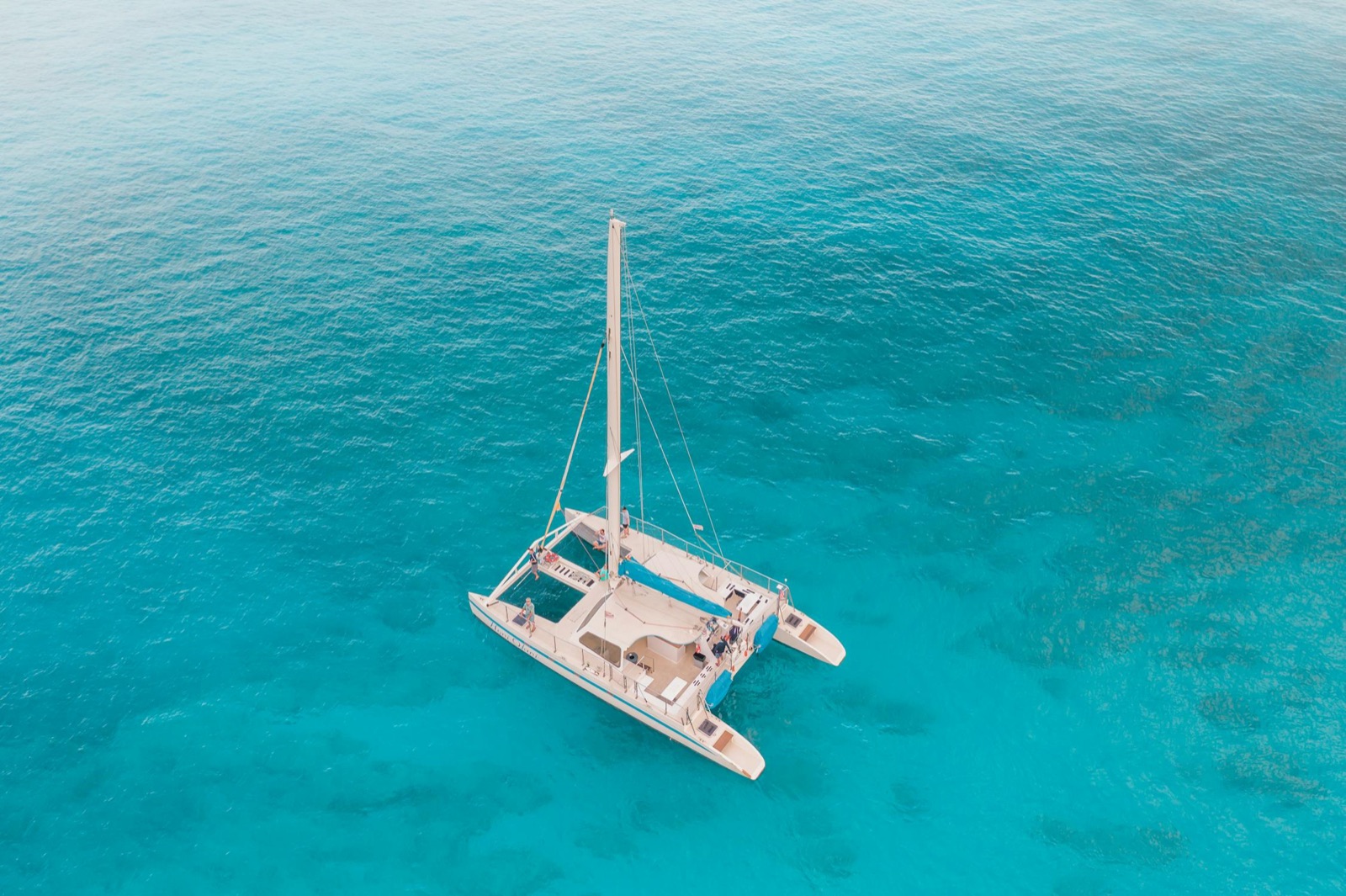
Ibiza is the most famous Balearic island and Formentera is the smaller one just south, with the clearest water in the Mediterranean and some of the best anchorages in the western Med. Together they make a perfect one-week charter: short distances, spectacular water, good food, proper nightlife when you want it and quiet bays when you do not. This guide explains how to actually do it in 2026, with real costs, the anchorages that matter, the rules about Posidonia seagrass, and a seven-day itinerary.
If you want to compare the Balearics to other Mediterranean destinations, read our Mediterranean charter guide and the Mallorca itinerary for the neighbouring island. Mallorca and Ibiza are often compared but they are very different charter experiences.
What Makes These Islands Different
Three things set Ibiza and Formentera apart from everywhere else in the Med.
The water. The colour of the water off Formentera is not Instagram filtering. It is genuinely turquoise, caused by the combination of a white sandy bottom, the absence of river silt, and the protected Posidonia meadows that keep the water clear. Drop an anchor in Playa de Ses Illetes on a calm day and you can see the bottom under ten metres of water. Nothing in Croatia, Greece, or Italy looks like this.
The distances. Ibiza and Formentera are tiny compared to the cruising distances in Greece or Turkey. The entire coastline of both islands plus the crossing between them totals about 80 nautical miles. You can do an entire week without ever sailing more than 15 nm in a single day. This makes the Balearics ideal for groups that want long lunches at anchor, swimming breaks, and minimal time underway.
The shore scene. No other Mediterranean destination has this density of options. You can berth at Marina Ibiza Magna in Ibiza Town and walk to some of the most famous clubs in the world. You can anchor off Cala Jondal and tender into Blue Marlin, one of the most photographed beach clubs anywhere. You can drop hook off Formentera and eat langoustine at Juan y Andrea (legendary, book a month out). Or you can anchor in a quiet cove on the north coast and see nobody all day. The choice is yours hour by hour.
What It Actually Costs in 2026
Here is what you can expect to pay for a week in Ibiza and Formentera in 2026, excluding APA on crewed boats.
| Yacht type | Size | Peak week (Jul-Aug) | Shoulder (Jun, Sep) |
|---|---|---|---|
| Bareboat monohull | 40-45 ft | 4,500-6,500 EUR | 3,200-4,800 EUR |
| Bareboat catamaran | 42-48 ft | 7,500-12,000 EUR | 5,500-9,000 EUR |
| Crewed sailing yacht | 50-60 ft | 22,000-35,000 EUR | 15,000-25,000 EUR |
| Crewed motor yacht | 25-30 m | 75,000-120,000 EUR | 55,000-85,000 EUR |
| Crewed motor yacht | 35-45 m | 150,000-280,000 EUR | 100,000-200,000 EUR |
The Balearics are slightly cheaper than the French Riviera (10 to 20 per cent less for equivalent boats) and roughly comparable to Sardinia. They are noticeably more expensive than Croatia (30 to 40 per cent premium) because fleet supply is tighter and demand is heavier in July and August.
Day charters are very common in Ibiza. A full day on a 15 to 20-metre motor yacht runs 2,000 to 3,200 euros including skipper in peak season. If you cannot commit to a week, a two-day split charter (one day coast-to-coast, one day around Formentera) is a real option.
Marinas in Ibiza are some of the most expensive in the Mediterranean. A 25-metre yacht at Marina Ibiza Magna or Marina Botafoch in peak week pays 800 to 1,400 euros a night. A 40-metre superyacht pays 2,500 to 4,500 euros a night. Port de Ibiza (the old commercial port, now used for larger yachts) is marginally cheaper. For comparison, Porto Cervo in Sardinia charges similar money. If you do not need a berth, almost every night of a good Ibiza-Formentera week should be spent at anchor.
The Posidonia Rules You Must Know
This is the single most important practical point in this guide. Get this wrong and you will be fined several thousand euros and ejected from the anchorage by the coastguard. Both Ibiza and Formentera have strict anchoring regulations designed to protect the Posidonia seagrass meadows that keep the water so clear.
The basic rule: you cannot anchor on Posidonia. You can anchor on sand. Anywhere.
How to tell the difference: from above water, Posidonia is dark (green-brown-black) and sand is light (white-yellow). When you arrive at an anchorage, motor in slowly, look over the bow, and find a sandy patch. You will see them clearly in the clear water. Drop anchor only in the sand.
Where enforcement is strictest: Formentera, particularly Ses Illetes, Llevant, and all the beaches along the north coast. There are paid mooring buoys in the most popular spots, managed by Balearia or the local authority, which you can pre-book during peak season. Book these if you are on a large boat or you want the peace of mind.
Fines: 600 to 3,000 euros for small boats, up to 10,000 euros for larger yachts. Enforcement is active in July and August. The coastguard patrols the main anchorages daily.
The practical solution: use a mooring buoy where one exists, anchor only on visible sand elsewhere, and always pay attention on the way in. Your skipper or captain will know the rules. If you are on a bareboat, read the charter company's briefing carefully and do not skip the anchorage walkthrough.
There is a Posidonia app that marks seagrass and sand zones around Formentera. Worth downloading.
The Ports and Anchorages That Matter
Ibiza Town (Marina Ibiza, Marina Botafoch, Club Náutico). The main harbour. Marina Ibiza is the premium option, Marina Botafoch the second premium option, Club Náutico the cheaper option. Berths are tight in peak season and expensive. Good base for one night at the start or end of the week; not for five nights. From any of them, the old town (Dalt Vila) is a 15-minute walk uphill, and Pacha and Lío are next door.
Cala Salada (north coast, 15 minutes from San Antonio). A beautiful sheltered bay surrounded by pines. Anchorage on sand, popular but never as crowded as the south. Good lunch stop, not usually an overnight unless the wind is kind.
Cala d'Hort (southwest coast). The famous view of Es Vedrà, the rock island that rises 400 metres out of the sea. Sunset here is one of the great photographs of the Balearics. Anchorage off, tender to the restaurant on the beach.
Cala Jondal (south coast). Home to Blue Marlin Ibiza, one of the most famous beach clubs in the world. Anchor off in 5 to 8 metres of sand, tender ashore, book a day bed in advance if you want one. Busy and expensive but worth one day of the week.
Cala Bassa (west coast). Another famous beach club (Cala Bassa Beach Club). Similar to Cala Jondal but slightly quieter. Sand anchorage.
Cala Comte (west coast). Swimming anchorage rather than a club stop. Clearest water on Ibiza, protected from the meltemi, good lunch break with the best on-board swimming of the week.
Portinatx (north coast). Quietest anchorage on Ibiza. Sheltered from south and west winds, good overnight in the right conditions. If you want a calm night away from the noise, this is the place.
Es Vedrà anchorage. Not a beach, just an anchorage off the west side of the rock. You do not land. You swim, dive, photograph, eat lunch. On a calm day in June, one of the most dramatic spots in the Mediterranean.
Formentera: Ses Illetes (north tip). The postcard beach of the Balearics. Turquoise water, white sand, paid mooring buoys or careful anchoring in sand pockets. In peak season, busy but manageable. In June or late September, beautiful and quiet.
Formentera: Espalmador. The small uninhabited island just north of Formentera. The famous mud bath is closed to protect the ecology, but the anchorage on the Formentera-facing side of Espalmador is still one of the best in the Med on a calm day.
Formentera: Cala Saona (west coast). Tucked into a bay between cliffs, protected from tramontana, good lunch stop with two restaurants on the beach.
Formentera: Migjorn beach (south coast). A long open beach that runs the length of the island. Not protected in a blow but beautiful in settled weather. Juan y Andrea is the famous restaurant (on Ses Illetes actually, not Migjorn). Book well in advance.
La Savina (Formentera port). The only port on Formentera. Small, busy, used by ferries. Berth if you must, but anchoring off is nearly always better.
A Practical Seven-Day Itinerary
This itinerary assumes you are chartering from Ibiza Town (most common starting point) on a sailing yacht or catamaran. Distances are short and the whole loop is well under 100 nautical miles for the week.
Day 1 (Saturday): Ibiza Town, boarding and shakedown. Board in the afternoon, provisioning, short cruise out of the harbour to Cala Jondal or Cala Bassa for the first swim and dinner at anchor. 8 nm.
Day 2 (Sunday): Round the south coast to Formentera. Cruise west along the south coast of Ibiza past Cala d'Hort and Es Vedrà (stop for lunch in the anchorage off Es Vedrà, photograph the rock). Afternoon crossing south to Formentera, anchoring at Cala Saona or Migjorn for the night. 20 nm.
Day 3 (Monday): Formentera's west coast. Morning at Cala Saona. Mid-morning round the south-west corner. Lunch stop at Migjorn beach. Afternoon cruise up the east side of Formentera to the anchorage off Ses Illetes or Espalmador. Overnight on a mooring buoy or carefully anchored on sand. 15 nm.
Day 4 (Tuesday): Ses Illetes and Espalmador day. Rest day, no real cruising. Swimming at Ses Illetes, tender over to Espalmador for a walk (respecting the protected areas), lunch at Juan y Andrea (book in advance), sunset back on the boat. 0-3 nm.
Day 5 (Wednesday): Cross back to Ibiza and round the east side. Morning cross from Formentera back to Ibiza, anchoring at Cala Jondal for a long lunch at Blue Marlin. Afternoon continue up the east side to Cala Llonga or Santa Eulària anchorage for the night. 18 nm.
Day 6 (Thursday): North coast of Ibiza. Cruise up the east coast to the north and round to Portinatx. Quiet anchorage, early dinner on board, the quietest night of the week. 22 nm.
Day 7 (Friday): Back to Ibiza Town via the west coast. Down the west coast past Cala Comte and Cala Bassa (lunch stop), round the south-west tip, back to Ibiza Town for the final night. Dinner ashore in Dalt Vila or at La Gaia, the boat fresh and moored before the weekend turnover. 25 nm.
Day 8 (Saturday): Disembark Ibiza.
Total: approximately 110 nautical miles. Comfortable for a monohull or catamaran at relaxed pace.
When to Go
Late April to mid-May. Warm enough during the day (22-25 degrees), cool at night. Water is 18-20 degrees: swimmable for the brave. Restaurants opening up. Prices at 40 to 50 per cent below peak. Good for couples who want the place quiet.
Late May and early June. The best value window of the year. Warm, settled weather. Water at 21-23 degrees. Restaurants fully open. Crowds still thin. Prices 20 to 30 per cent below peak.
Mid-June to mid-July. Into peak season. Hot (28-30 degrees). Everything open. Crowds growing daily. Prices at the high end.
Mid-July to late August. Absolute peak. Hot (30-32 degrees). Every anchorage busy, every club booked, every restaurant fully booked two weeks out. Prices at their highest. If you are doing Ibiza peak week, book everything (charter, anchorage moorings, restaurants, clubs) in advance. See our last-minute yacht charter guide if you are trying to book late.
September. The best month of the year if you can wait. Warm water, warm air, thinning crowds from mid-September onwards, prices dropping 15 to 30 per cent. Ideal for everyone except those specifically going for the clubs (which slow down from mid-September).
October. Last chance before the season ends. Water still warm (22-23 degrees) but weather less reliable. Crowds gone. Prices at their lowest.
Practical Notes
Getting there. Ibiza airport has direct flights from London, Manchester, Dublin and most European cities year-round in summer. Jet2, easyJet and Ryanair dominate. In peak August, flights are expensive; book early. The airport is 7 km from Ibiza Town, taxi to marina around 20 euros.
Charter bases. Ibiza Town (Marina Ibiza, Marina Botafoch) is the main bareboat base. Some operators start in San Antonio on the west coast. Charter companies include Moorings, Sunsail, Dream Yacht Charter, Sailogy's local partners and several local Ibiza-based operators.
Provisioning. Supermarkets in Ibiza Town (Eroski, Mercadona), Santa Eulària, and San Antonio. For the first day, most charterers use a local delivery service that brings provisions directly to the boat. Read our provisioning guide for the approach.
Language. Spanish (Catalan and Castilian). Everyone in tourist areas speaks English.
Nightlife. Pacha, Lío, Ushuaïa, DC-10, Amnesia, Hï Ibiza. If clubs are the point of the week, stay close to Ibiza Town or Playa d'en Bossa and plan your anchorages around being able to reach them. If clubs are not the point, Formentera and the north coast will give you the quiet you came for.
Kids. Ibiza is surprisingly family-friendly away from the party coast. Formentera is excellent for kids: shallow water, sand, easy beaches. See our family sailing guide for age-specific advice.
Ibiza vs Other Balearics
A quick comparison with Mallorca and the other Balearic options:
| Factor | Ibiza and Formentera | Mallorca | Menorca |
|---|---|---|---|
| Sailing distances | Very short | Medium | Short |
| Water clarity | Best in the Med | Very good | Excellent |
| Anchorage density | Very high | High | Moderate |
| Shore scene | Intense | Varied | Quiet |
| Posidonia rules | Strict | Strict | Strict |
| Charter cost | High | Medium-high | Medium |
| Nightlife | World-class | Moderate | Quiet |
| Best for | Groups, social weeks | Everything | Quiet, family |
Mallorca is larger, more varied, and better for a traditional sailing holiday with different conditions each day. Ibiza is more glamorous, more social, and better for a week where the water and the scene are the point. Menorca is the quiet option, underrated, and the best of the Balearics for families who want to avoid the crowds.
How Sulu Helps
Booking Ibiza well in peak season requires knowing which bareboats are actually available (fleet is tight in July and August), which crewed yachts are worth the money (there is a lot of average product in this market), and which moorings and restaurants need to be pre-booked before you arrive. We handle all of this.
Tell us the week, the group, what the mood of the holiday is (quiet week, party week, or a mix), and we come back within 48 hours with three options that fit. If you are unsure about dates, we can also tell you the cheapest and quietest week of the year that still gives you proper weather. Message us on WhatsApp or Telegram.