Two Sardinias, One Decision
Sardinia sells two different holidays and you should choose yours before asking about prices.
The first is the Costa Smeralda: the northeast corner built up from 1962 under the Aga Khan's consortium, now the densest concentration of superyachts in the Mediterranean each August. Porto Cervo is its capital, and everything people say about Sardinia costing a fortune refers to roughly fifteen kilometres of this coast.
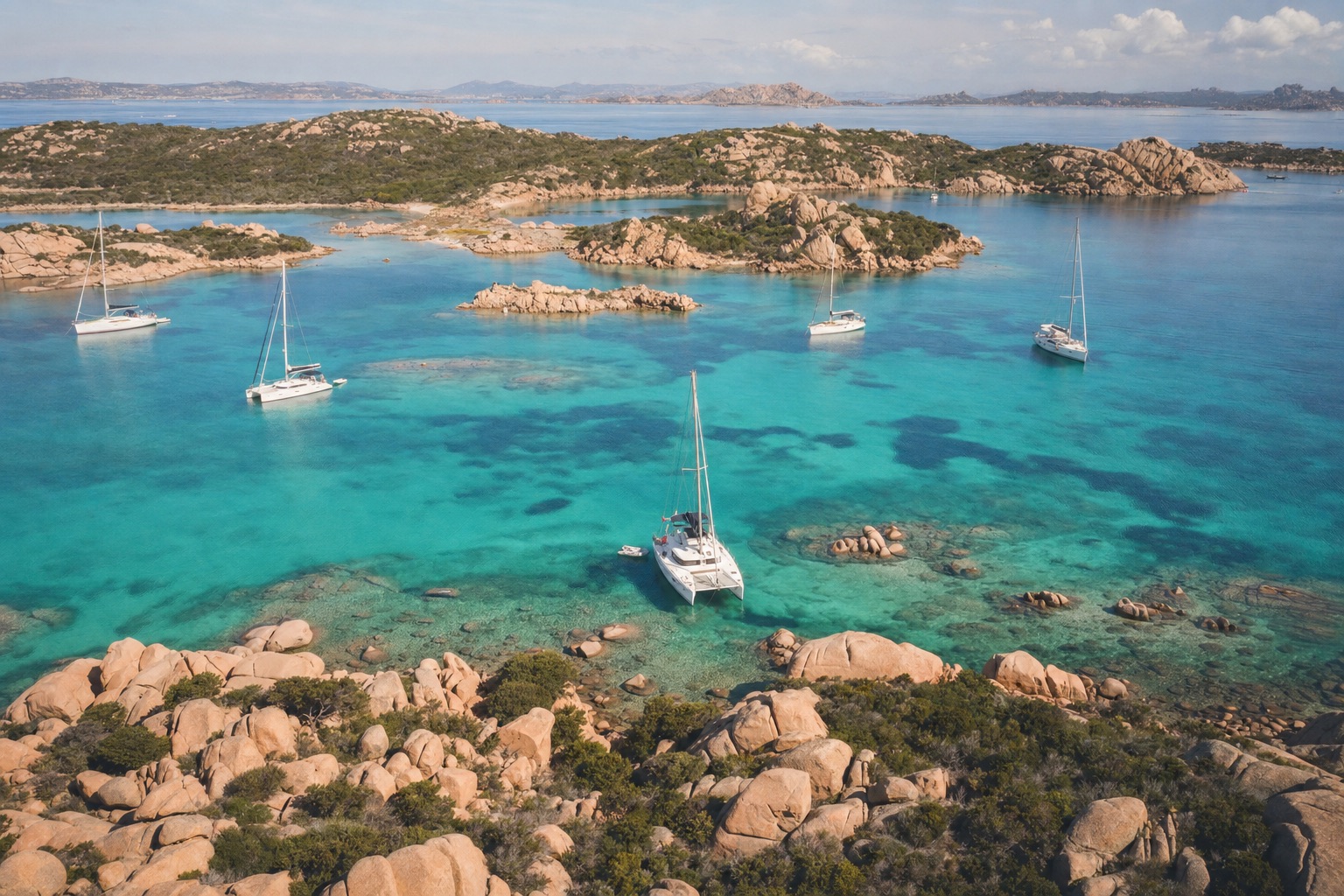
The second is everywhere else, which mostly means the La Maddalena archipelago just north: granite islands, water clear enough to count starfish from the deck, mooring buoys instead of marinas. Same boat, same week, radically different bill.
This guide covers both, because most good charters here blend them: evenings in Porto Cervo when you want the scene, nights at anchor in the park when you want sleep.
What It Costs in 2026
Real boats, real asking rates, all excluding VAT (22% in Italy), APA and gratuity:
| Boat | Weekly rate | Notes |
|---|---|---|
| Crewed catamaran (~23m, new build) | €54,000-60,000 | Four cabins, families love these |
| Crewed sailing yacht, 21m | €18,000-23,000 | 2025 refit, six guests |
| Motor yacht, 25m (Benetti, new 2025) | €60,000 | Nine guests |
| Custom Line 33m | €125,000 | Eleven guests |
| Sunseeker 35m | €140,000 | Twelve guests |
| 50m class (Rossinavi, Columbus) | €270,000-310,000 | The August A-list tier |
So the honest framing: entry level around €25,000, the serious middle between €60,000 and €140,000, superyachts from €150,000 past €500,000 in peak weeks. Then add roughly 30 percent across the total for APA, tax and tips, exactly as you would anywhere else in Italy.
Marina fees deserve their own line because Porto Cervo breaks every benchmark: €200 to €400 per night for a 40-foot yacht in summer, and larger yachts pay four figures nightly without blinking. Rates roughly double in August versus other Italian marinas.
The August Question
Should you come? Depends what you want from the trip.
In the second week of August, Porto Cervo holds over one hundred yachts above 30 metres alongside, with another eighty-plus anchored out at Pevero, Romazzino and Cala di Volpe. That is the event. If your ideal week includes seeing and being seen, dinner reservations that require a broker's phone call, and the spectacle of the world's largest private fleet gathered in one harbour, August delivers something no other coastline can.
If you came for quiet swimming off granite rocks, book late June or the first half of September instead. The water stays warm through September, the Mistral that makes July and August sailing lively (and the Strait of Bonifacio uncomfortable) eases off, and restaurant tables stop requiring month-old favours.
Where You Sleep Each Night
The standard pattern among people who do this coast repeatedly: two or three nights in a marina, the rest at anchor.
Porto Cervo Marina exists for the evening: the Piazzetta people-watching, Promenade du Port galleries, the restaurants where lunch becomes dinner. Pay for those nights deliberately. Then leave.
The anchorages hold their own against anything in the western Med. Cala di Volpe and Romazzino for the hotel-beach afternoons. Across in the archipelago: Spargi's Cala Corsara, Santa Maria's Cala Santa Maria, Razzoli's wind-carved channels. Mooring buoys in the national park run roughly €20-50 a night depending on zone and boat size, a rounding error beside a Porto Cervo slip.
One rule worth repeating: the park zones change and enforcement is real, including fines for anchoring on posidonia. Take a skipper who works these waters weekly, or ask us to verify current zoning before your route locks in.
The Pink Beach and Other Archipelago Rules
Budelli's Spiaggia Rosa gets its colour from crushed shells and foraminifera in the sand. Landing has been banned since the nineties; today you view it from the water behind a buoy line, which is genuinely enough, since the best angle is offshore anyway. Swimming happens at neighbouring coves. Guides that imply otherwise are out of date or selling something.
La Maddalena town itself makes a good half-day: a working Sardinian town with a ferry link to Palau, gelato that hasn't heard of premium pricing, and none of Porto Cervo's theatre.
A Week That Works
Day 1: board at Olbia or Porto Cervo, short hop to Cala di Volpe for a first swim. Day 2: Porto Cervo night one, Piazzetta dinner. Day 3: north into the park, Spargi for the day, Budelli buoy overnight. Days 4-5: Santa Maria, Razzoli, La Maddalena town. Day 6: south again, Mortorio or Soffi for a last quiet night. Day 7: return to base.
Total distance barely reaches 90nm. This is another coast that rewards motoring slowly rather than sailing hard; if you want wind in the rigging as the point of the week, Greece or Croatia will serve you better, as our Mediterranean comparison explains.
Day Charters and the Riva Economy
Not everyone needs a week. Porto Cervo runs one of Europe's densest day-charter markets, and the boats tell you who visits: Riva Ego 68s, Riva 68' Diables, Azimut 68S opens, Maori 64s, plus maxi-RIBs for the sensible money. A serious day boat with skipper and fuel runs €3,000-7,000 in high season depending on the badge on the hull; the Rivas price like the jewellery they resemble.
The standard day shape works well: morning loop through the Maddalena sounds, lunch stop at a beach club on Romazzino or an anchorage at Spargi, then the slow parade back past Cala di Volpe around five, when the light does its best work on the granite.
One caution for day guests: Sardinia's sun plus sea glare is fiercer than the Balearics at the same latitude, and a Riva offers roughly the shade of a dinner plate. Book the boat with a bimini or plan your shirt collection accordingly.
Eating Ashore Without a Second Mortgage
Porto Cervo's Piazzetta restaurants charge Milan prices with a harbour view attached, which some people consider the point. The better value follows the anchorages: beach clubs at Romazzino and Capriccioli serve the same grilled fish as the marina addresses for less theatre, and in the archipelago proper, harbour-side trattorie on La Maddalena town's waterfront still cook for islanders first.
Wine deserves planning. Vermentino di Gallura (the only Sardinian DOCG) comes from hills behind the northeast coast and appears everywhere by the carafe; Cannonau, the island's Grenache cousin, pairs with anything grilled and travels poorly in heat, so drink it ashore rather than cellaring it aboard through August.
For provisioning, Olbia's supermarkets on the way to the marinas beat everything inside the Costa Smeralda bubble, where a punnet of strawberries can cost what it did in Mayfair. Shop before you board.
Weather Windows
June and September remain the professional recommendation, but the coast sails comfortably May through October if you respect one neighbour: the Mistral. When it pumps down from the Gulf of Lion, the exposed west-facing bays become untenable and the Strait of Bonifacio turns into a wind tunnel that even superyachts avoid. The fix is geographic, not heroic: the entire northeast corner has a bay for every wind direction within two hours' motoring, and any skipper who works these waters holds the fallback list in their head.
August heat brings its own arithmetic. Afternoon temperatures past 34°C turn marina berths into ovens without shore power, another argument for anchoring off where the breeze arrives unfiltered.
Getting There
Olbia's Costa Smeralda airport sits twenty minutes from the main marinas and handles plenty of business aviation, so a same-day fly-and-board works easily; our aviation service runs this routing constantly in summer. Alghero serves the northwest if you ever base there instead.
If Sardinia sounds like your kind of August, tell us your dates and group. We will send three boats with real totals, including what a mixed marina-and-anchor plan saves versus sleeping in Porto Cervo all week. Message us on WhatsApp or Telegram. For the other Italian classic, see our Amalfi Coast charter guide.