Most people who fly private for the first time arrive way too early. Not because they are nervous about the plane. Because they have spent two decades being told to be at Heathrow three hours before departure, and the muscle memory is hard to unlearn.
If you have a flight from Biggin Hill at 10am, you can pull up to the FBO at 9.40am, hand the keys to someone who parks the car, walk through the lounge in two minutes, and be airborne by 10.05am. The first time you do this you will feel like you are getting away with something. After three or four trips you will start to think of commercial aviation as a form of low-grade abuse.
This article is for people who have booked their first private flight, or are about to. Not the cost side. The pricing question is covered in our post on small aircraft charter costs. This is the experience side. What actually happens. What you should know before you walk in.
The Twenty-Minute Rule
The rule you keep hearing is "arrive 15 to 30 minutes before departure". This is true. It is also worth understanding what it means in practice.
The crew is at the aircraft about an hour before your slot, doing the walk-round, the fuel check, the flight plan filing. They do not need you for any of that. By the time you walk through the FBO door, the only thing left to do is verify your identity, glance at your bags, and walk to the plane.
If you turn up too early, you will sit in a lounge and drink coffee. That is fine. Nobody will rush you onto the aircraft. But there is no advantage to being there at 9am for a 10am flight. You will not beat any queues, because there are no queues.
A pragmatic target: arrive twenty minutes before your slot. Five minutes for the car drop, five for ID and any customs paperwork, ten in the lounge if you want a coffee.
What An FBO Actually Is
FBO stands for Fixed Base Operator. The name is unhelpful. The thing itself is a private terminal.
If you have only ever seen the inside of Heathrow Terminal 5, an FBO will feel small. The one at Biggin Hill is a single building roughly the size of a nice restaurant. The one at Farnborough is bigger but still feels like a wing of a country hotel. Cambridge, Oxford, Lydd, and Rochester each have their own version. None of them have a Boots.
What they do have:
- A reception desk where one person checks your ID and your booking
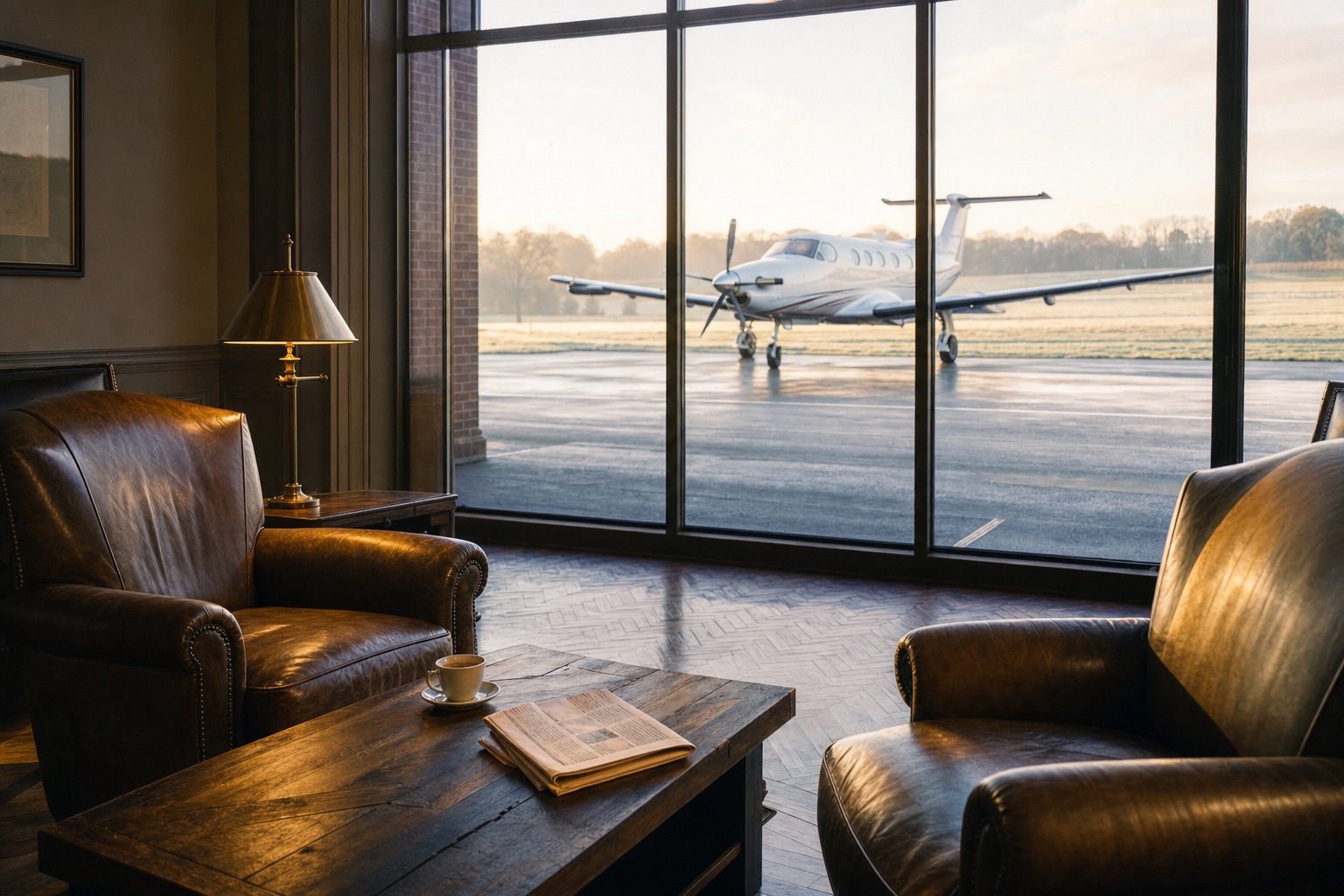
- A lounge with armchairs, decent coffee, a few magazines that nobody reads
- A children's corner with toys if you have booked a family trip
- A small kitchen with sandwiches, fruit, sometimes proper hot food on request
- A view onto the apron where you can see your aircraft
- A door that opens directly onto the airfield
That is the whole building. There is no duty-free, no Pret, no Border Force queue snaking around three switchbacks. The total walk from your car to the aircraft is usually under two minutes.
The car bit matters. At Biggin Hill and Farnborough you can drive to the door of the FBO and a member of staff will park the car for you. At smaller airfields like Cambridge or Rochester you park in a small free car park 30 seconds from the entrance. Nobody charges you £40 a day.
Security, But Not As You Know It
The most common question first-timers ask: is there security?
Yes. It just does not look like Heathrow.
On a domestic UK flight from one private airfield to another, security is essentially a friendly conversation. The handler glances at your bags. You show ID. That is it. There is no x-ray belt, no shoe-removing, no liquids in clear bags.
On an international flight, the process is slightly more visible. UK Border Force will check your passport, either inside the FBO at the bigger airfields (Biggin Hill, Farnborough) or aircraft-side at smaller ones. Customs may want to glance in your bags if you are flying somewhere they consider sensitive. In practice it takes five minutes at most. You can stay seated in the lounge while the paperwork is dealt with.
The reason private aviation is not subject to the full TSA-style theatre is twofold. First, the crew and operator already know who you are. They have your name, your passport details, your itinerary, often from the moment the booking was made. Second, the regulator distinguishes between "general aviation" (private flights) and "commercial passenger transport". The threat profile is different and the rules reflect that.
This is not the same as no security. Things still go through a paperwork check. Just not a humiliation ritual.
Boarding Is Walking
There is no jet bridge. There is no bus.
When the captain is ready, somebody from the FBO walks you out of the lounge door and across the apron to your aircraft. The walk is short, usually under a minute. The captain or first officer will be standing at the foot of the stairs.
Climb the stairs. The crew will introduce themselves, show you where the seatbelts are, talk you through anything specific to the aircraft. Bags small enough to keep with you go on the seat next to you or in a small overhead bin. Bigger bags go in the external hold while you board.
On a four to eight-seat turboprop or light jet, you will typically have a choice of seats. There is no seat assignment. Pick the one with the view, or the one closest to the table, or the one that faces backwards if you do not enjoy taxi-ing tail-first.
Then the door closes. The taxi to the runway is short, usually four or five minutes. You take off. By the time the wheels are up you are thirty minutes ahead of where you would be at Heathrow on a good day.
The Cabin Is Smaller Than You Think (And That's The Point)
If your mental image of private aviation comes from films, the cabin will be smaller than expected.
A Cessna 421 carries six passengers and you cannot stand up in it. A King Air 350 carries seven or eight and you can almost stand up in it. A Pilatus PC-12 carries up to eight and the cabin is genuinely walkable. A Citation CJ3 carries seven and is the first cabin where the interior feels properly jet-like.
None of these are Gulfstreams. None of them have a bedroom or a shower. They are all small workhorse aircraft built for one to three-hour hops at most.
The good news: small does not mean uncomfortable. You have a real leather seat with proper recline. You have a small table that folds out. You have power for a laptop. You can talk to the people you are flying with without raising your voice. You can hand a passport to the captain without getting up.
The other good news: small means cheap, by private aviation standards. A four-hour day-return to the Channel Islands on a Pilatus PC-12 for four people comes in well under what an off-the-rack Gulfstream charter would cost for the same trip. The detailed breakdown is in the small aircraft cost guide.
The Sulu position on this is the same as the brand position on aviation. Small is the honest version. We do not sell Gulfstreams that the maths does not support. We sell the aircraft that actually fits the route.
What You Can Bring
Luggage allowance on a private flight is by volume, not by weight or by ticket. The captain will tell you what fits.
On a small twin like a Cessna 421, expect to bring a standard cabin-sized rolling case per person plus one personal bag. On a turboprop like a PC-12 or King Air, the external hold takes proper suitcases. On a light jet you have more space and can bring soft golf bags, skis, or larger luggage without issue.
The rules are notably lighter than commercial:
- Liquids are not limited. A litre of duty-free, a bottle of champagne, full-size sunscreen, none of it is a problem.
- Sharp objects within reason (corkscrews, multi-tools, small knives) are fine. Sword, no.
- Food can come with you. Hot, cold, smelly, it does not matter. We have seen people board with a charcuterie box from a deli on the way.
- Pets are usually fine if you mention them at booking. Small dogs in cabin, larger dogs in cabin too, depending on the operator. The crew will tell you what they accept.
- Children are welcome on every operator we work with. No "infant in arms" admin. Bring a car seat if you want, it secures with a normal seatbelt.
- Bicycles, golf clubs, skis travel as hold luggage. Tell the booking team in advance so they size the aircraft accordingly.
What you cannot bring: anything you would not put on a commercial flight (firearms, explosives, the obvious). The captain has final say.
What To Wear (And What You Don't Need)
There is no dress code. There is also a soft norm that nobody mentions out loud.
What people actually wear:
- Smart casual: dark jeans or chinos, a good shirt or knitted polo, leather shoes or clean trainers
- Resortwear on summer day-trips: a linen shirt, lightweight trousers, decent sandals if you are flying to a beach
- Business attire if it is a work trip and you are going straight from the aircraft to a meeting
What people do not wear:
- Tracksuits, hoodies with big logos, the things you would wear to Tesco at 11pm
You will not be turned away in athleisure. You will look like someone who has not flown before. The other passengers at the FBO (and the crew) will notice. It does not matter. Wear what you want. But know that the unspoken norm is comfortable but slightly considered.
You do not need to dress for cold or jet lag. The cabin is warm, the flight is short. You will not be sat in a chilled metal tube for nine hours.
Landing And The Bit People Forget
Landing is the part first-timers forget to think about.
At a UK private airfield you taxi to the apron, the door opens, the stairs come down, you walk to the FBO. From the wheels touching down to standing at your car is typically under ten minutes. There is no jet bridge wait, no walk through three terminals, no bag carousel.
At a European destination airfield (Calvi, Le Touquet, Geneva, Ibiza) the process is essentially identical, with a small additional step for customs and passport stamping. The handler walks you to the customs office (or the office comes to you), the stamp goes in, the bags get glanced at, you are out. Total: ten to fifteen minutes on a normal day.
The really useful version of this is when you have pre-booked ground transport. A car is waiting at the FBO when you land. The bags go straight in the boot. You are at your destination, in our experience, an hour ahead of the friend who took easyJet that morning. On a Saturday day-trip from London to Calvi the time saving is the entire point.
Five Things First-Timers Wish Someone Had Told Them
In no particular order, based on debriefs we have had with new charter clients:
-
You can bring food and drink onto the aircraft. Nothing is forbidden. We have watched a client board with a full picnic basket from Fortnum & Mason and the crew just helped lift it on. The catering on the aircraft is often modest (sandwiches, fruit, drinks), so if you want something specific, bring it.
-
The crew will fly the route you want, within reason. If you would like to take a slight detour over Mont Saint-Michel on the way to Brittany, ask. Within fuel and air-traffic limits the captain will route around for the view.
-
You can check the weather honestly with the captain. They are not paid to fly in conditions that risk anyone's day. If the captain says "we will divert to Cherbourg if the cloud does not lift", that is not bad service, it is professionalism. The good captains tell you the truth.
-
Toilets exist on most aircraft from PC-12 size up. On a Cessna 421 the answer is "go before you board". This is rarely a problem on flights under two hours.
-
You can text the operator the day before to reconfirm. A short message ("everything still on for tomorrow?") gets a clear answer and saves the morning anxiety. Good operators welcome it.
When Flying Private Is Worth It (And When It Isn't)
The honest answer, from the desk that does this every week.
Worth it when:
- You are flying as a group of three or more. The cost-per-person drops sharply.
- The destination is a short-runway airfield commercial airlines do not serve (Le Touquet, Megève, Lugano, Pantelleria, Calvi)
- The schedule is tight and you would otherwise lose half a day to commercial connections
- You are carrying something awkward (bicycles, instruments, large dog)
- Privacy actually matters (medical, divorce, business sensitivity)
Probably not worth it when:
- You are solo on a route that has a direct commercial flight
- Your destination is a hub airport (Heathrow, Charles de Gaulle, Schiphol) where the time saved on the airport side is minimal
- You are flexible on dates and a major airline has a sale on
- The flight is long-haul. Small aviation is not built for transatlantic. That is a different conversation.
We say this as the operator. If a commercial flight is cheaper and saves you the same amount of time, take the commercial flight. The opportunity for private aviation is the place where commercial is not actually faster, or the route does not exist.
When You're Ready To Try It
The first flight is the one that teaches you what private aviation actually feels like. The hard part is overcoming the assumption that it must be enormously complicated or formal. It is neither. It is two minutes of paperwork, a short walk, and a quiet flight.
If you want to try a short hop, we can put numbers against your specific route within the hour. London to the Channel Islands, London to Calvi, Geneva to Madrid, London to Le Touquet for the day. We send back a few real options across operators we know, with the total cost broken out so there are no surprises.
Message us on WhatsApp or Telegram with the date, the route, and the number of passengers. You will have a clear answer in an hour, often faster.